A 32-year-old software engineer with ₹15 lakh in savings discovered that inaction can be as damaging as poor financial decisions. According to reports from Mint, Abhishek Kumar, SEBI RAI and advised at SahajMoney, left almost all his money in a savings account for four years without realizing the impact. While he hadn't lost anything through bad investments or market crashes, his money was losing roughly 3% in purchasing power annually due to inflation running at about 6% while his savings account earned around 3%. The financial planner explained that money without a goal goes nowhere, and Kumar's had been going nowhere for 4 years. This case highlights a common mindset trap where small, unnoticed expenses like daily tea or coffee deliveries or forgotten OTT subscriptions feel harmless individually but collectively drain wealth over time.
The financial planner implemented a simple but effective reallocation strategy that didn't involve exotic products or complicated investment strategies. As reported by Mint, ₹4 lakh was set aside as an emergency fund through a combination of sweep-in FD and liquid fund, with part staying in boring investments on purpose. ₹6 lakh was allocated for a house down payment in five years, with most amount invested in debt funds since the five-year horizon wasn't considered long enough for significant equity risk. For retirement, Kumar started a ₹45,000 monthly SIP in equity funds, marking his first investment in equities, with the SIP eventually increased after becoming comfortable with market fluctuations. The strategy emphasizes that redirecting small, unnoticed amounts into equity mutual funds and letting compounding do the heavy lifting is how ordinary salaries turn into real financial freedom over time.
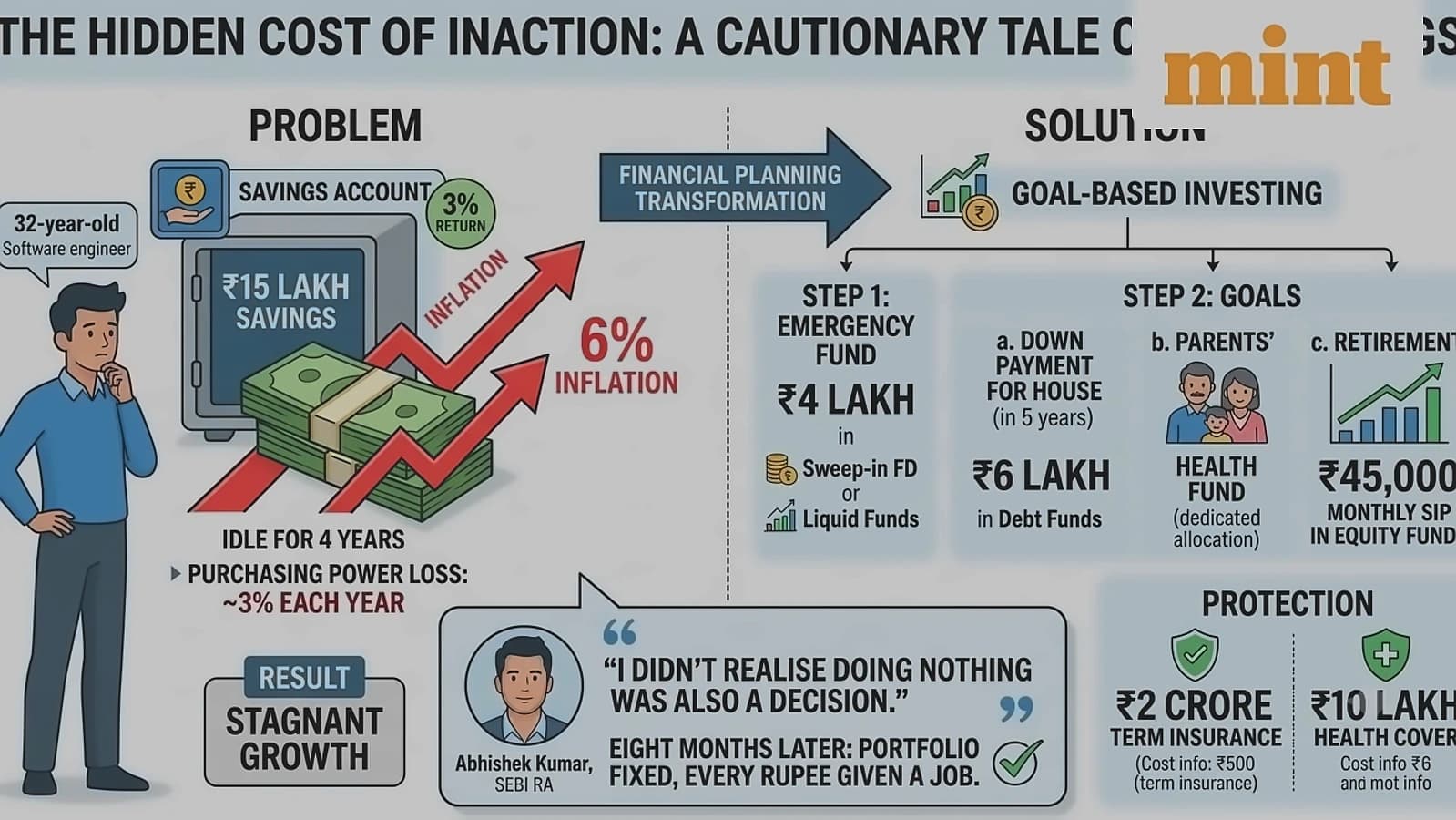
The portfolio restructuring included comprehensive insurance coverage before aggressive investing. According to Mint, Kumar secured a ₹2 crore term insurance policy and ₹10 lakh health cover, costing less than ₹30,000 annually. The financial planner emphasized that insurance was addressed before investing aggressively, ensuring proper risk management. The strategy focuses on giving every rupee a specific job rather than leaving money idle in low-yielding savings accounts. Without adequate safety nets, emergency situations can force redemptions that break compounding, as every rupee pulled out early doesn't just lose its own future growth but also the growth that would have built on top of it for every subsequent year.
The case demonstrates the power of early investing through a compelling mathematical example. As reported by the latest analysis, imagine two investors both investing until age 60 - one starting at 30 with ₹3,000 monthly for 30 years totaling ₹10.8 lakhs, and another starting at 35 with ₹5,000 monthly for 25 years totaling ₹15 lakhs. Despite investing more money, the early starter achieves an estimated final corpus of ₹1.04 crore while the later starter gets ₹93.9 lakhs. This illustrates how time compounds more effectively than additional capital, with the early starter's money growing for an extra 5 years. The analysis shows that someone who begins small and early will almost without exception end up ahead of someone who begins big and late, making the timing of investment decisions more critical than the absolute amount invested.
Eight months after the portfolio restructuring, Kumar summarized the key lesson in one sentence: "I didn't realise doing nothing was also a decision." As reported by Mint, the experience highlighted that being careful with money doesn't always mean making sensible financial decisions. The case demonstrates how simple inaction can result in significant financial losses over time, even when no bad investments are made. The latest analysis reinforces this by showing how small, everyday decisions - whether ₹100 daily expenses or investment timing - can have massive long-term outcomes, making automation and consistency more important than willpower alone.