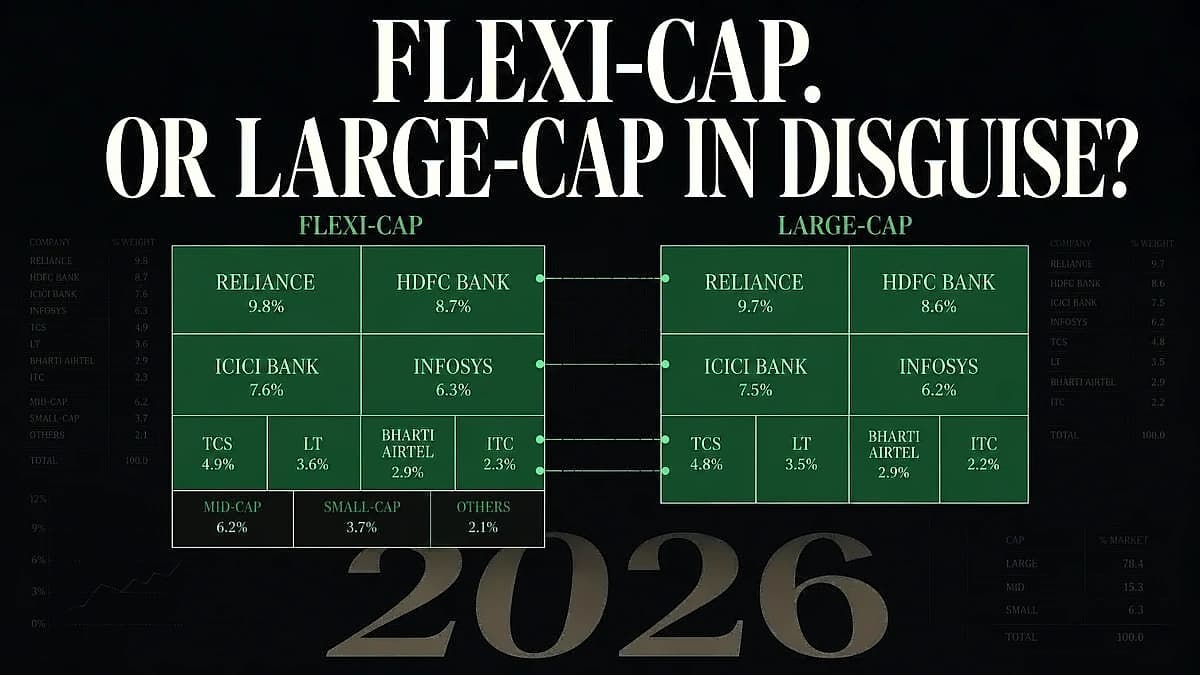
Investors often assume that spreading money across different mutual fund categories automatically creates a diversified portfolio. According to reports from Mint, a combination of one flexi-cap, one mid-cap and one small-cap fund may appear to offer exposure across companies of different sizes. However, experts say the number and labels of funds are less important than what the schemes actually hold. Unmesh Kulkarni, Managing Director and Group Product Head, emphasized that "Three funds can be enough, but simply combining three categories does not guarantee diversification."
A flexi-cap fund itself can invest across large-, mid- and small-cap stocks, making separate mid-cap and small-cap funds potentially redundant. As reported by Mint, Uttam Agarwal, Chief Business Officer at Bajaj Capital, noted that "Two or three funds can still have significant overlap in stocks, sectors or investment themes, which may create an illusion of diversification." The key concern is that investors may own three schemes but remain exposed to similar risks, as two funds belonging to different categories could still own several of the same companies or have similar sector and factor exposures.

Experts caution against using the number of AMCs or schemes as a proxy for diversification. According to Mint reports, Kulkarni recommended that investors should prioritize diversification of the underlying portfolio, followed by investment style and fund-management approach. Agarwal similarly emphasized looking first at the underlying portfolio, with investors then considering differences in investment styles and fund managers as additional layers of diversification. The practical test should be whether funds provide different sources of risk and behave differently across market cycles, rather than simply carrying different names.
There is no universal allocation that suits every investor, with appropriate mix depending on risk capacity, investment horizon and volatility tolerance. As reported by Mint, for long-term investors with higher risk appetite and 10-year or longer horizon, Kulkarni suggested a reasonable starting framework of 50-60% in flexi-cap funds, 20-30% in mid-cap funds and 15-20% in small-cap funds. More conservative investors could maintain larger flexi-cap allocations while limiting mid- and small-cap exposure. Recent investor flows show continued appetite for these categories, with mid-cap funds receiving ₹6,989 crore inflows in August 2026 and small-cap funds receiving ₹7,973 crore.
For investors entering equity mutual funds for the first time, experts recommend simplicity over immediately building a multi-fund portfolio. According to Mint reports, Agarwal suggested that "As the investor gains experience, understands their risk tolerance and has a longer investment horizon, mid- and small-cap exposure can be added where appropriate." A single well-selected flexi-cap fund can provide exposure across market-cap segments, or investors could consider a broad-market index fund for a low-cost, rules-based approach. The key is starting with one diversified core fund to understand equity market behavior and volatility tolerance before adding more complex exposures.