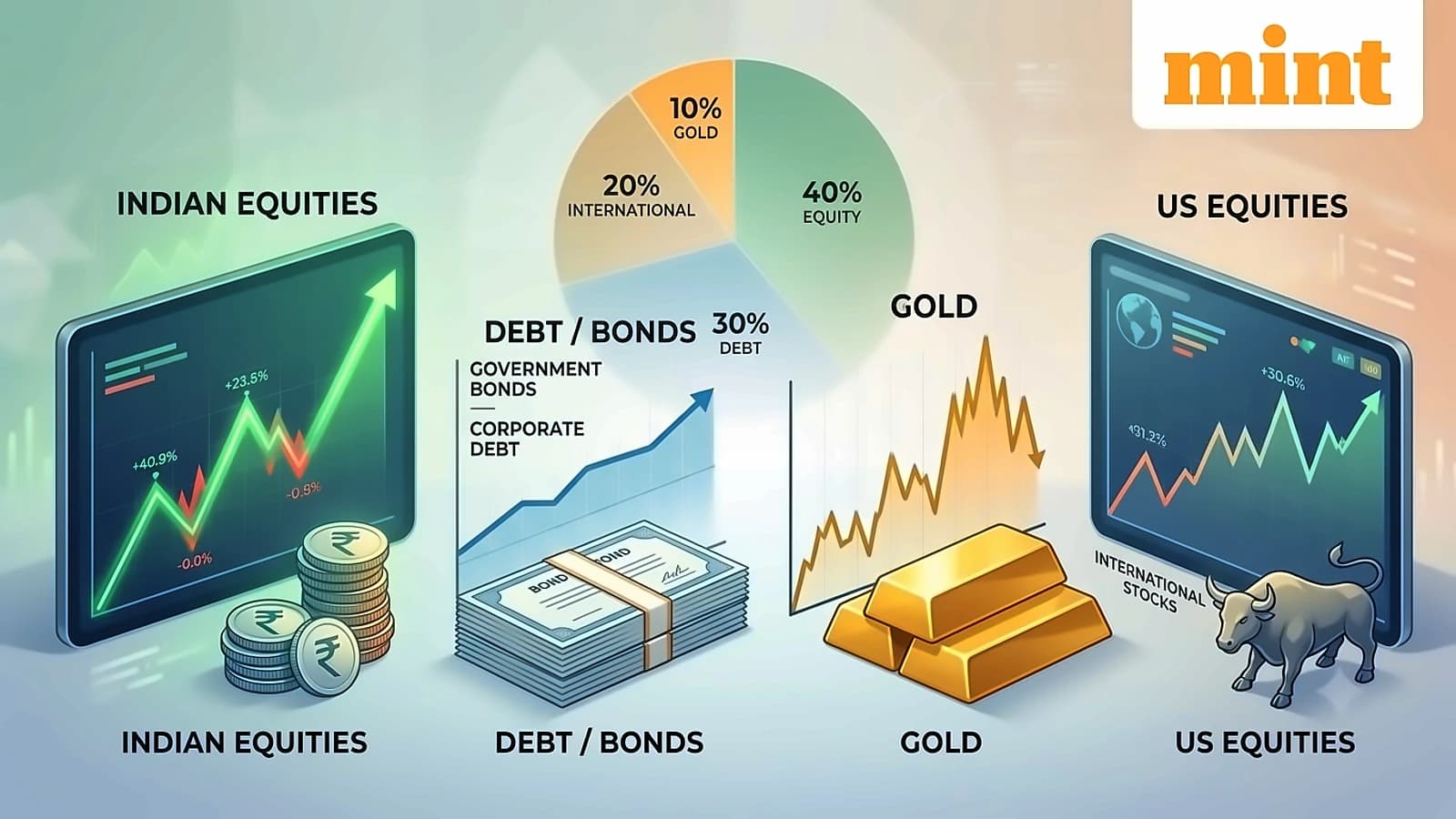
The Indian stock market has experienced significant volatility in recent weeks, driven by global cues, crude oil prices, and geopolitical tensions between the United States and Iran in West Asia. According to reports from Mint, during this uncertain period, investing ₹10 lakh requires a clear asset allocation strategy based on an investor's risk profile and financial goals. Financial advisors generally classify investors into three categories — conservative, moderate and aggressive — with each category having a different mix of equity, debt, gold and cash investments. The current market environment highlights the importance of strategic diversification across asset classes to navigate volatility effectively.

For conservative investors, the primary focus remains capital protection with 50-55% allocation in debt instruments such as debt funds and fixed deposits, while 25-30% can be allocated to equity, and 10-15% to gold and other safe investment options such as the Public Provident Fund (PPF), according to two investment experts who spoke to Mint. This conservative approach prioritizes preservation of principal over growth potential, making it suitable for investors with low risk tolerance. Conservative investors may also consider alternative investment options like REITs and InvITs which offer 8-12% returns with low-moderate risk levels and moderate liquidity requirements.
Moderate investors may maintain a balanced approach by allocating 40-45% to equities, 40-45% to debt, and 10-15% to gold. As reported by Mint, this middle-ground strategy provides exposure to both growth and stability while maintaining diversification across asset classes. The moderate approach is designed for investors seeking steady returns with some growth potential while managing risk exposure. Alternative investment options for moderate investors include AIFs (Category I & II) which deliver 12-25% IRR with moderate-high risk levels and require a minimum investment of ₹25 lakh, making them suitable for high net worth individuals seeking growth opportunities.
Aggressive investors typically prioritise long-term wealth creation with 50-55% allocation to equities, while keeping 25-30% in debt for liquidity and stability. According to Mint, around 5-10% may also be allocated to gold or silver as a hedge against market volatility. For those seeking high risk and high returns, they can allocate as much as 80% of their fund to equities. Experts suggest maintaining 2-5% in liquid cash to capitalise on sudden market corrections. Alternative investment options for aggressive investors include private credit opportunities offering 12-18% yields and P2P lending providing 10-15% returns with moderate risk levels.
For short-term goals like achieving ₹50 lakh in one year with ₹1 lakh monthly investments, equity mutual funds are the most suitable option according to financial experts. The approach focuses on large-cap funds for stability with moderate growth, mid-cap funds for higher growth opportunities with manageable risk, and small-cap funds for further boosting returns while being cautious about their volatility. Hybrid funds are recommended to reduce overall risk by investing in both equity and debt, providing stability suitable for short-term goals with balanced risk appetite. Alternative investment options like sovereign gold bonds and gold ETFs can provide 8-12% returns including appreciation with low risk levels and high liquidity, serving as effective inflation hedges.