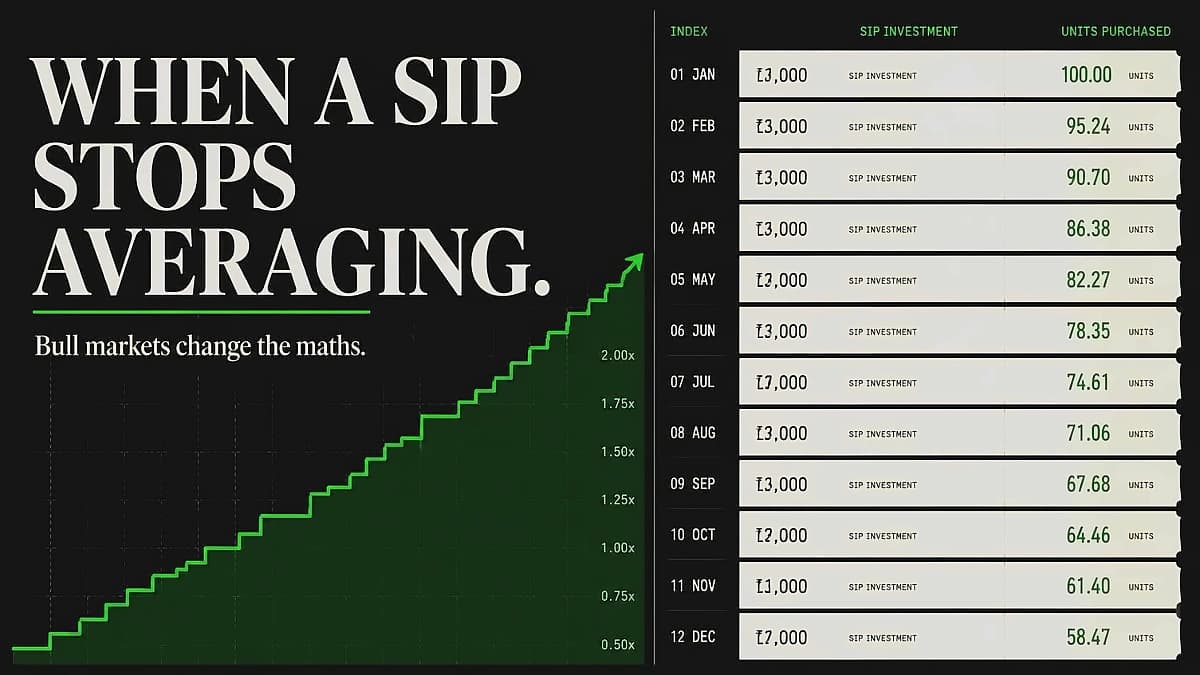
A comprehensive study by DSP Asset Managers comparing 30 years of market data across 16 countries has revealed that Systematic Investment Plans (SIPs) may not always generate higher headline returns than lumpsum investing, but they often deliver more consistent and resilient outcomes for investors. According to the DSP report, SIP investors have generally generated positive real returns over the long term, even in markets where lumpsum investments struggled after adjusting for inflation. The study emphasizes that SIPs act as a hedge against behavioural biases and allow investors to participate in long-term average market outcomes. As per the latest analysis, the reason SIP works is not financial - it is behavioural. It removes the investor from the decision of when to enter and accepts long-term average outcomes rather than chasing exceptional ones, letting the structure do the work that emotion would otherwise disrupt.
India emerged as one of the best-performing markets for SIP investors in the study. Over the past 30 years, Indian equities delivered 12% SIP returns compared with 11% lumpsum returns in local currency terms. The study found that SIP real returns stood at 5%, while lumpsum real returns were lower at 4%. India also demonstrated exceptional consistency, with about 74% of rolling five-year SIP periods delivering returns above 8%, the highest among all countries analyzed. Average five-year SIP returns in India were 13%, compared with 12% average five-year lumpsum returns. The data suggests that a SIP once started, the data suggests, should go on for decades - ideally, it never stops. This approach has historically delivered disciplined, uninterrupted investing across full market cycles.

Current market valuations reveal interesting opportunities across different segments. Large-cap valuations are broadly in line with long-term averages, with the one-year forward PE at 19 against a historical average of 17. Relative to US large caps, Indian large caps trade at a 14% discount, compared to near parity historically. However, SMIDs present a different story with their forward PE of 24 sitting well above a long-term average of 18. Their premium to large caps has expanded and their earnings yield relative to bond yields has turned deeply negative, with the compensation for risk, relative to history, being thinner. India's corporate return on equity currently sits at 15%, recovered from a low of 12% yet still below the last peak of 22%. The gap is explained by how the current cycle differs from the previous peak, which was a three-engine cycle versus the current one-and-a-half engine cycle.
The recovery in India's corporate fundamentals is real, though the next leg requires broader economic participation. For ROEs to close the gap, India needs private consumption to broaden, capacity utilisation to rise, and corporate balance sheets to expand again. Until then, valuations need earnings momentum to justify themselves. The valuation gaps between large caps and SMIDs suggest that positioning still matters, even when everything feels equally uncertain. The data highlights that volatile markets tend to reward the ones who stay with a structure rather than the ones who keep adjusting to the noise. The study concludes that the next leg simply needs more of the economy to participate, which is not a reason for caution but a reason to stay the course, as India's corporate fundamentals remain sound if not yet complete.