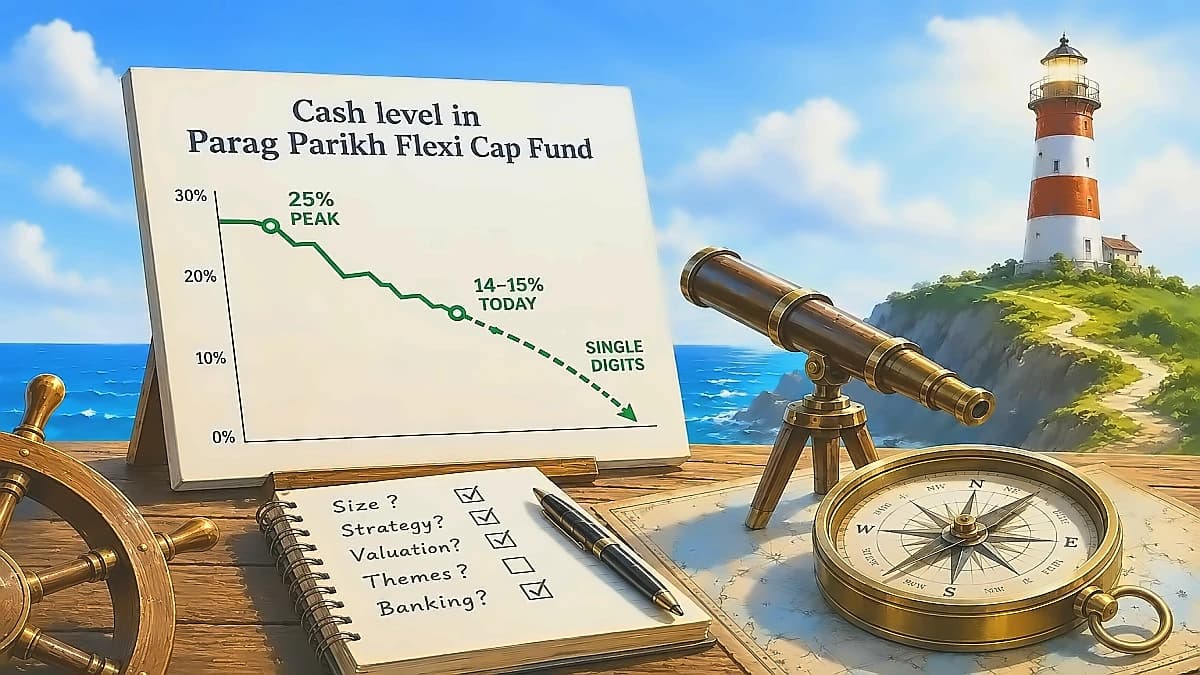
The Parag Parikh Flexi Cap Fund made selective changes to its equity portfolio in July, increasing holdings in 11 existing stocks while maintaining its strategic cash reduction approach. According to the latest portfolio disclosure, the fund's assets under management rose to ₹1.49 lakh crore as of July 31, 2026, up from ₹1.43 lakh crore at the end of June. The fund's cash allocation declined from 12.72% in June to 11.74% in July, continuing its systematic reduction from the peak of near 25% to the current 14-15% level. As reported by Mint, the fund made no fresh equity additions or complete exits during the month, focusing instead on selective increases in existing positions. The fund did not reduce its stake in any stock or make a complete exit from any holding during July, with holdings in 22 stocks remaining unchanged including major positions in Axis Bank, Bharti Airtel, CDSL, Cipla, HDFC Bank, ICICI Bank, Infosys, ITC, Kotak Mahindra Bank, Mahindra & Mahindra, Narayana Hrudayalaya, Nesco, Power Grid Corporation, Swaraj Engines, TCS, Zydus Lifesciences, Zydus Wellness, and The Great Eastern Shipping Company.
The fund's largest position increases included HCL Technologies, where holdings rose by 5.76 lakh shares to 4.66 crore shares, taking the allocation from 0.20% to 0.29% of net assets. Coal India recorded the second-largest increase with 10.27 lakh shares added, increasing holdings to 17.58 crore shares from 17.48 crore shares. Indraprastha Gas saw the biggest addition in terms of shares, with the fund buying 1.06 crore shares to reach 10.54 crore shares in July from 9.48 crore shares in June. Other notable additions included Petronet LNG (added 51.57 lakh shares), Dr Reddy's Laboratories (added 8.45 lakh shares), and CIE Automotive India. The fund also increased holdings in Bajaj Holdings & Investment, EID Parry, Maharashtra Scooters, and Maruti Suzuki India during the month. The fund's largest position increases included Petronet LNG, where holdings rose by 52% from 1 crore shares to 1.52 crore shares, with allocation increasing from 0.20% to 0.29% of net assets. CIE Automotive India recorded the largest percentage increase at 73%, with shares rising from 4.64 lakh to 8.03 lakh, though it remains a small position at 0.02% of net assets.
The fund's recent performance has been more muted, returning 0.90% over one year compared to 5.19% for the benchmark. However, its long-term performance remains strong with a 10-year return of 17.49%, significantly outperforming the BSE 500 TRI's 13.66% and the average flexi-cap fund's 13.87%. The fund has delivered 20.42% over seven years and 13.58% over five years, compared with 16.29% and 12.12% respectively for the BSE 500 TRI. As reported by Mint, the fund's five-year annualised return stands at 13.77%, with critics attributing recent underperformance to its size but Thakkar pointing to his previous experience managing similar stretches of underperformance. In a note to unitholders, Rajeev Thakkar, CIO and director of PPFAS Mutual Fund, said the recent underperformance was "not noteworthy" in terms of its duration or magnitude, pushing back against concerns that the fund had failed to deliver returns comparable with bank fixed deposits. He attributed the recent underperformance partly to PPFAS Mutual Fund's strategy of investing in stocks and sectors that may be out of favour with the broader market.
Current market valuations show significant disparities across market segments, with Nifty 100 trading at 20.8 times earnings, Nifty Midcap 150 at 30.7 times earnings, and Nifty Smallcap 250 at 34.6 times earnings. The fund's sector allocation shows banks at around 19.97%, followed by IT-Software at 10.30% and computer software at 8.64%. Thakkar continues to avoid fashionable themes like Defence, Energy Transition, Fintech, and direct holdings in AI model-building companies, while maintaining investments in hyperscalers selling AI computing infrastructure. The fund's strategy involves buying stocks and sectors that the market has turned against, which typically results in trailing performance for periods of one year or more. As reported by Mint, the fund continues to hold the same number of shares in several of its largest positions including HDFC Bank (7.55% allocation), Power Grid Corporation (5.98%), and ITC (5.74%), with changes largely driven by market price movements rather than buying or selling activities. The fund house said it continues to evaluate investments on their individual merits and would invest when it finds an attractive opportunity, adding that its investment approach is not driven by the macroeconomic environment but remains focused on individual companies.
The fund's latest portfolio disclosure serves as a document that investors can hold the fund manager accountable to, providing transparency beyond typical fund manager communications. According to the report, monthly portfolio disclosures will offer investors a way to test whether Thakkar's promises and positioning hold up. The fund's current cash position of 11.74% will be monitored through upcoming disclosures, with the March portfolio disclosure expected to reveal whether the fund maintains its commitment to further reducing cash levels. The fund, which manages ₹1.49 lakh crore as of July 31, 2026, remains India's largest actively managed equity scheme and maintains a five-star rating from Value Research. The fund aims to generate long-term capital growth through an actively managed portfolio primarily comprising equity and equity-related securities, with the ability to invest in Indian and foreign equities and related instruments, as well as debt securities. The fund is benchmarked against the Nifty 500 TRI and is managed by Rajeev Thakkar, Raunak Onkar, Raj Mehta, Rukun Tarachandani, Tejas Soman, Mansi Kariya, and Aishwarya Dhar.