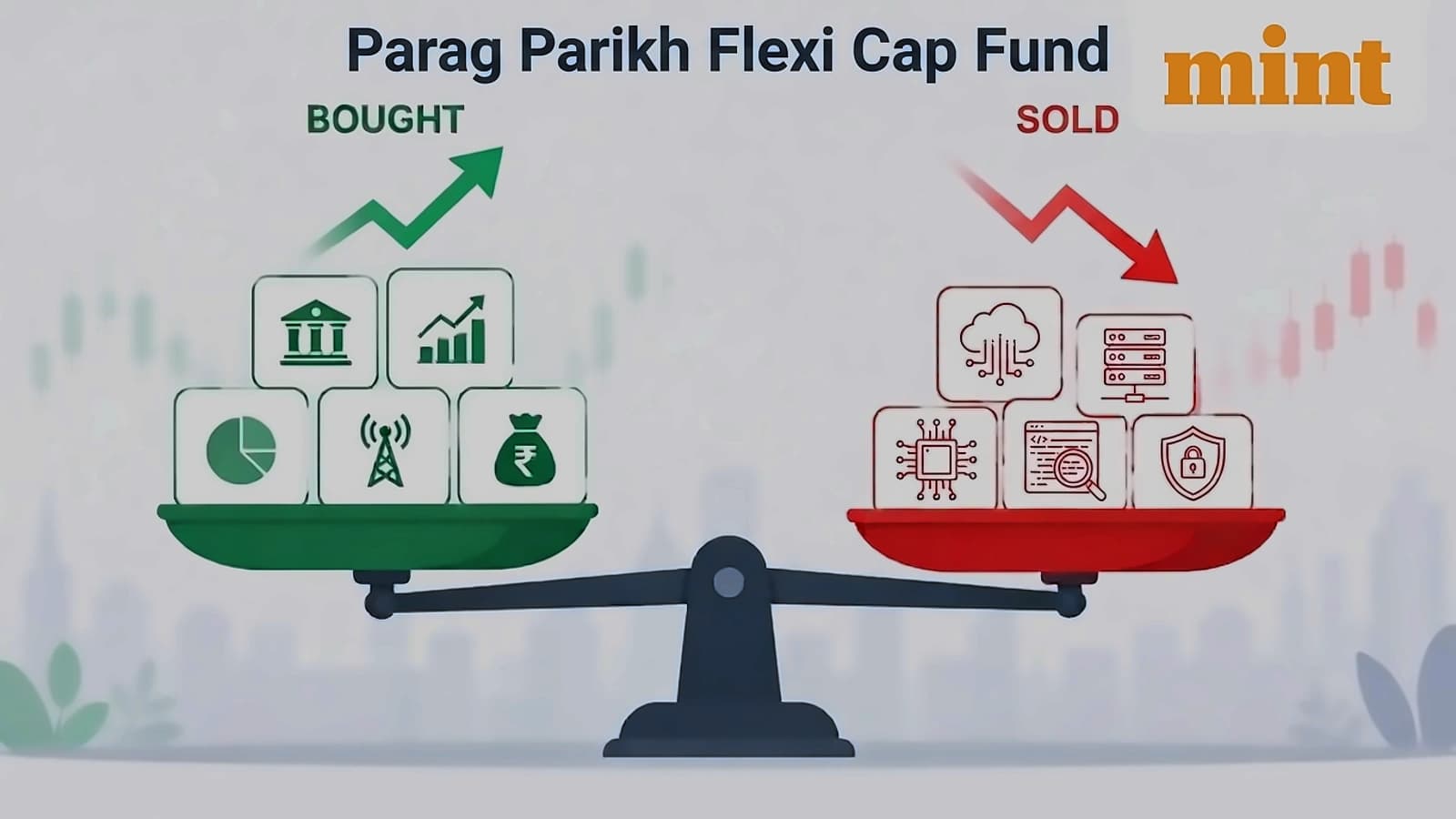
Parag Parikh Flexi Cap Fund, India's largest open-ended equity scheme with an AUM of ₹1.43 lakh crore as of June 30, 2026, implemented a strategic shift in June 2026 by increasing exposure to domestic banking and financial services while reducing holdings in US technology stocks. According to reports from Mint, the fund raised stakes in HDFC Bank (0.45 percentage points increase to 8.33%) and ICICI Bank (0.41 percentage points increase to 5.52%) while simultaneously trimming positions in Microsoft, Alphabet, Amazon, and Meta Platforms. However, the fund has now doubled down on IT stocks, even as these companies experience significant market value losses.
Despite IT stocks ranking among the market's biggest wealth destroyers this year, Parag Parikh Flexi Cap Fund has significantly increased its holdings in all three major IT companies. As reported by The Economic Times, the fund added 54 lakh shares of Infosys, taking its holding to 4.27 crore shares from 3.73 crore shares in May, raised its HCL Technologies stake by 31.15 lakh shares to 4.61 crore shares, and added 18.26 lakh shares of TCS, lifting its holding to 1.77 crore shares. The fund manager's conviction rests on current cash flows rather than future AI narratives, with management preferring companies that earn in dollars and pay in rupees while wage inflation remains subdued. According to latest data, TCS has crashed 55% from its all-time peak of ₹4,592.25 hit on August 30, 2024, and is down 36% year-to-date. Infosys has fallen 47% from its all-time high of ₹2,006.45 on December 13, 2024, down 34% so far this year. HCL Technologies is down 43% from its peak of ₹2,012.20 on January 13, 2025, a 30% YTD decline.
In June 2026, Parag Parikh Flexi Cap Fund added 12 new stocks to its portfolio while making significant additions to existing holdings. According to data compiled by ACE MF, the fund's biggest addition was ITC, buying 1.55 crore shares during the month, taking its total holding to 30.33 crore shares valued at ₹8,704.36 crore at the end of June. Among the fresh bets, Petronet LNG was the largest with an investment valued at ₹281.03 crore, followed by Canara Bank (₹139.71 crore), UltraTech Cement (₹126.31 crore), Hindustan Unilever (₹93.54 crore), Divi's Laboratories (₹92.44 crore) and BSE (₹54.12 crore). The fund also invested ₹33.55 crore in TVS Motor Company, ₹22.27 crore in IDFC First Bank, ₹21.84 crore in Ashok Leyland, ₹4.50 crore in Tata Consumer Products, ₹1.34 crore in Lupin and ₹0.38 crore in JSW Energy.
As of June 2026, the fund's top 10 holdings include HDFC Bank (8.33%), Power Grid Corporation of India (6.23%), ITC (6.07%), ICICI Bank (5.52%), Coal India (5.35%), Bajaj Holdings & Investment (4.63%), Kotak Mahindra Bank (4.23%), Mahindra & Mahindra (3.56%), HCL Technologies (3.44%), and Axis Bank (3.16%). According to Mint data, the fund increased allocations to HDFC Bank, ICICI Bank, ITC, Bajaj Holdings & Investment, Kotak Mahindra Bank, Mahindra & Mahindra, and Axis Bank while trimming exposure to Power Grid Corporation of India, Coal India, and HCL Technologies. The fund's recent IT stock acquisitions have significantly boosted its technology exposure.
Despite IT stocks experiencing severe corrections, the sector is now considered attractively valued. As reported by The Economic Times, the top four largecap IT names trade at a 36% discount to their 10-year average P/E, yet still throw off a roughly 6.7% free cash flow yield and 5.7% shareholder yield, backed by net-cash balance sheets. The top five IT companies now offer an average dividend yield of 4.9%, with Wipro at 5.7%, HCL Tech at 5.6%, TCS at 4.9%, Infosys at 4.7% and Tech Mahindra at 3.6%. However, brokerage DSP Mutual Fund notes that while earnings growth is absent and firms lack visibility on how earnings will shape up, the sector is no longer expensive. DSP's market strategist Sahil Kapoor emphasizes that "The sector is no longer expensive. But a valuation bottom needs earnings visibility, not just lower multiples. Currently, earnings growth is absent." The ongoing AI-driven disruption is likely to pressure existing revenue streams, but management commentary suggests AI is significantly expanding the addressable market by creating new technology spending opportunities. Brokerage Motilal Oswal strikes a more cautious note, estimating that while ~15–20% of IT services revenue may face AI-led productivity and automation pressures, the key differentiator will be the ability of incumbent IT firms to replicate, scale, and commercialize AI-native delivery models faster than peers.