According to reports from Mint, a comprehensive comparison of category-average returns shows that large-cap funds and aggressive hybrid funds have delivered broadly similar returns over the long term. The performance data reveals that aggressive hybrid funds recorded higher category-average returns across the 1-, 3-, 5-, and 7-year periods, while the 10-year returns were almost identical. The gap was relatively small over longer periods, with aggressive hybrid funds achieving a 7-year annualised return of 14.55% versus 14.30% for large-cap funds, and 10-year figures of 12.07% and 12.04% respectively. Recent fund performance data shows Edelweiss Aggressive Hybrid Fund Direct Growth delivering 12.4% returns over 1 year, 13.0% over 3 years, and 13.4% over 5 years, demonstrating the consistent performance pattern across the aggressive hybrid category.
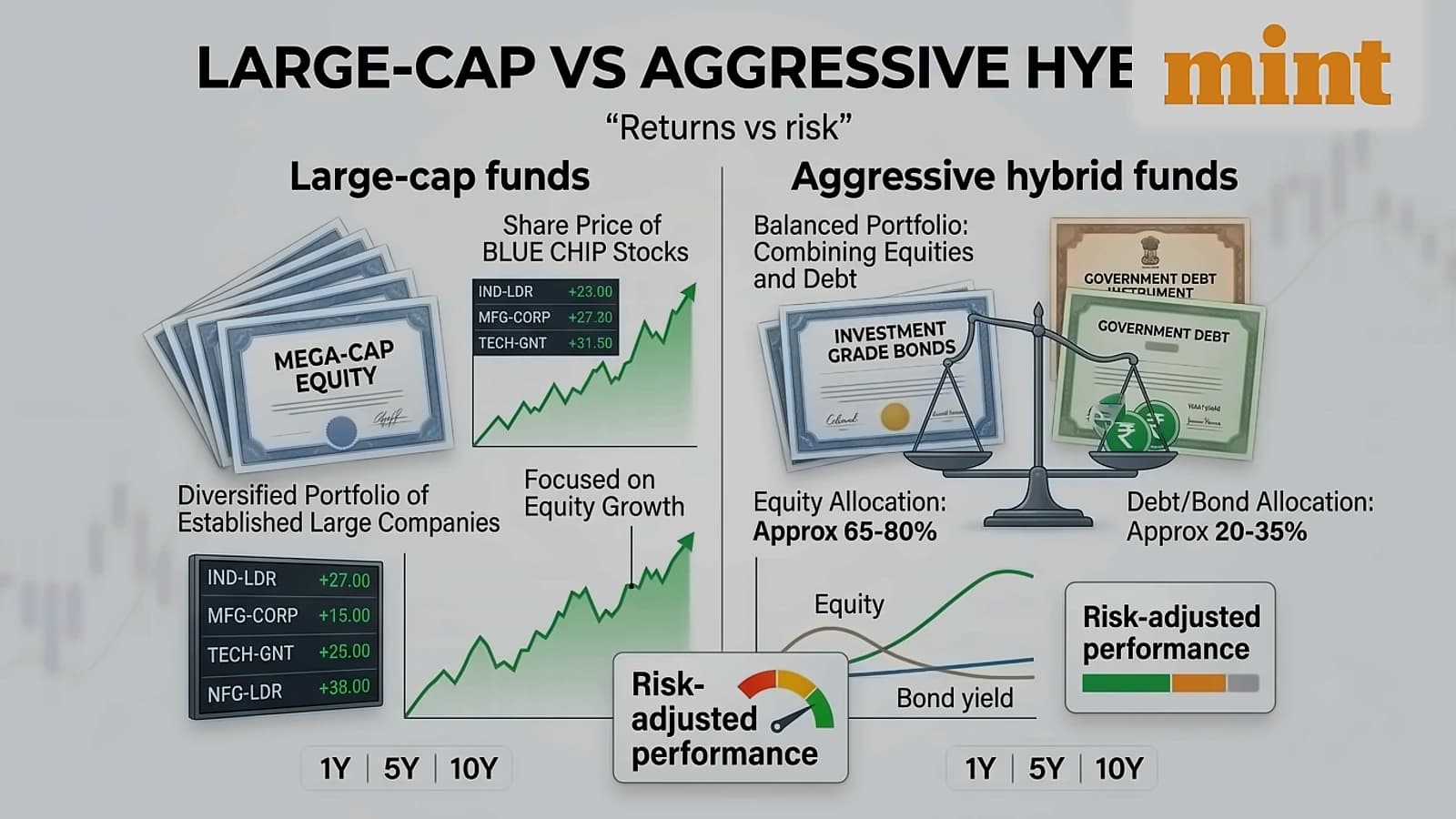
As reported by Mint, the equity portfolios of these categories show significant differences in stock exposure. Large-cap funds maintain 92.99% exposure to large-cap stocks, while aggressive hybrid funds have considerably lower exposure at 61.00%. The remaining allocation varies substantially, with aggressive hybrid funds showing 23.08% exposure to mid-cap stocks and 17.89% to small-cap stocks, compared to 7.71% and 4.78% respectively for large-cap funds. Under SEBI's categorisation, aggressive hybrid funds invest 65–80% of their total assets in equity with the remaining 20–35% in debt instruments, while large-cap funds must invest at least 80% of their total assets in large-cap stocks.
According to Mint analysis, the Sharpe ratio reveals that aggressive hybrid funds generated a higher amount of excess return per unit of volatility than large-cap funds. The category-level Sharpe ratio was 0.57 for aggressive hybrid funds compared with 0.44 for large-cap funds, indicating that the aggressive hybrid category delivered better risk-adjusted performance. This metric measures excess return earned for each unit of volatility, with a higher ratio indicating superior risk-adjusted performance. The comparison shows that aggressive hybrid funds have delivered similar or higher category-average returns while recording a higher Sharpe ratio.
Balanced advantage funds represent a specialized hybrid mutual fund category that operates under SEBI regulations as dynamic asset allocation schemes. These funds differ from traditional hybrid categories by not following fixed allocation ratios - instead, fund managers continuously track market levels, valuations, interest rates, and economic signals to adjust equity exposure as needed. The funds are classified as all-weather funds as they aim to perform reasonably well across different market phases, with equity exposure reduced during uncertain or overheated markets and increased when markets offer better value. These funds are suitable for investors with moderate risk appetite and those seeking lower volatility than pure equity funds, with investment duration of 3 years or more recommended.