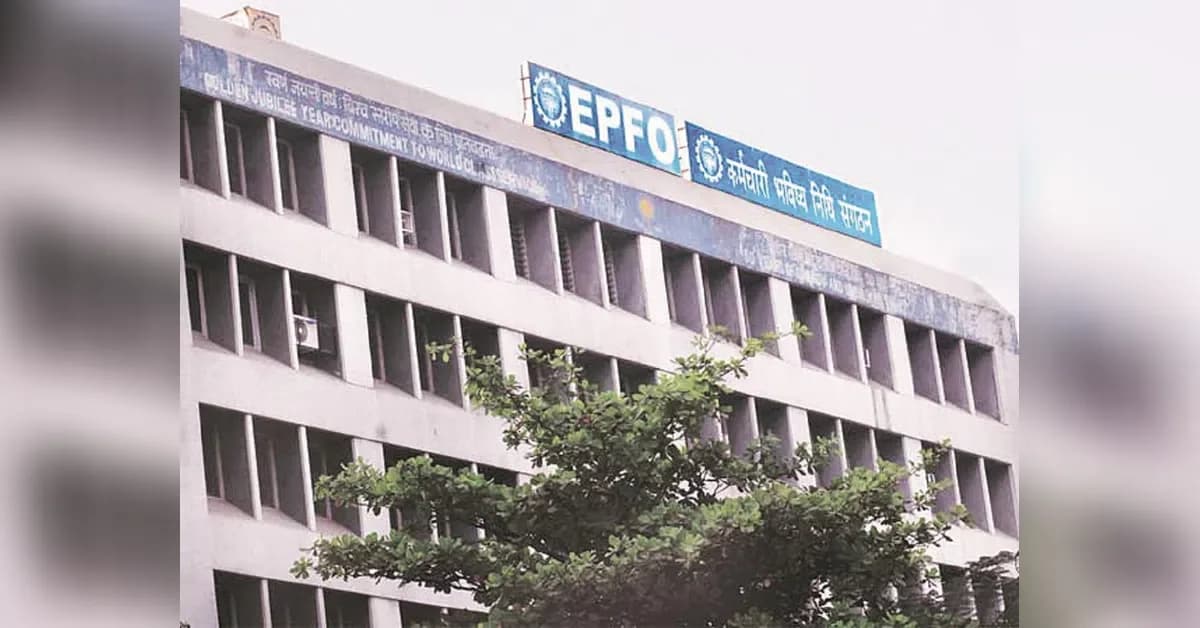
The Employees' Provident Fund Organisation (EPFO) is implementing comprehensive capacity building initiatives for officials overseeing its investment portfolio worth over ₹25 trillion. According to reports from Business Standard, this move follows the Reserve Bank of India's advice to strengthen the organisation's fund management and investment practices. The retirement fund manager oversees savings belonging to around 300 million formal-sector workers and faces pressure to deliver returns even when yields on core fixed-income investments are lower. An EPFO spokesperson emphasized the organisation's commitment to ensuring prudent, transparent and professional management of funds entrusted to it, stating that EPFO continuously reviews and strengthens its investment governance framework in line with government notified patterns and regulatory requirements.
The RBI had advised the Centre to consider measures to strengthen EPFO's accounting, risk management, portfolio management and internal governance after the ministry sought its expertise to identify gaps in the retirement fund body's investment framework. As reported by Business Standard, the central bank flagged concerns over asset allocation, accounting treatment and the use of common investment patterns across schemes with different liability profiles. The RBI recommended EPFO move towards asset-allocation rules based on outstanding stock of investments rather than only incremental annual flows, and suggested that investment strategies should better reflect the distinct liabilities of EPFO's three different schemes — Provident Fund, Pension and Insurance. The central bank also advised enhancing EPFO's expertise in critical areas of accounting, treasury and portfolio management, as well as actuarial assessments.
According to Business Standard, EPFO's present investment pattern allocates 45-65% of fresh accretions to government securities, 20-45% to debt instruments, 5-15% to equities through index-linked investments, and up to 5% to short-term debt instruments. The training programmes are being organised in collaboration with the World Bank, the CFA Institute, and rating agency Crisil. An action taken report placed before the EPFO's Central Board of Trustees (CBT) indicates selected officers will be trained by the World Bank, while the CFA Institute has been approached to conduct an investment workshop. Crisil has been appointed as EPFO's consultant by the Central Board to support functions including selection and performance evaluation of portfolio managers, as well as capacity building of officials.
As reported by Business Standard, the formation of a high-powered committee has been cleared with approval from Union Labour and Employment Minister Mansukh Mandaviya to guide EPFO on investment-related matters. The committee will guide the organisation on investment-related matters and strengthen its institutional and professional capabilities. For FY26, EPFO declared an annual interest of 8.25% on members' EPF balances. An EPFO spokesperson noted that these RBI recommendations were tabled before the CBT, with the organisation remaining committed to safeguarding subscriber interests through robust investment governance framework and continuous strengthening of institutional capabilities.
According to Business Standard, EPFO has engaged the Indian Institute of Management (IIM) Kozhikode to review its exit policy for debt investments and the Interest Stabilisation Reserve (ISR) mechanism. The exit policy governs the organisation's approach to existing debt investments, while the ISR is a reserve used to smooth interest payouts to subscribers by absorbing fluctuations in investment income across years. The proposals were discussed by EPFO's Investment Committee, which directed that the IIM Kozhikode studies be completed in a time-bound manner and that regular progress updates be placed before the committee. The committee also asked Crisil to undertake analytical work on environmental, social and governance (ESG) investments and investment benchmark methodology, with EPFO noting that deliberations and studies for policy formulation are still in progress.