The National Stock Exchange (NSE) IPO officially opens for public subscription on September 17, 2026, with the biggest stock exchange of India declaring a price band of ₹1,700 to ₹1,785 per equity share. According to latest reports, the IPO has an issue size of ₹22,569 crore with a lot size of 8 shares and minimum investment of ₹14,280. The book-building issue is now the second-largest IPO in India after Hyundai Motor India's IPO, with the NSE share price currently trading at ₹1,945 in the grey market, representing a ₹160 premium to the upper price band. As per The Times of India, the IPO values India's largest stock exchange at nearly $46 billion at the upper price band, making NSE the world's most expensive stock exchange with a valuation of ₹4.42 lakh crore. The exchange commands a valuation multiple of 42.9x FY26 earnings, significantly higher than most major global exchanges including Nasdaq, CME Group, ICE, HKEX and LSEG.
The NSE IPO Grey Market Premium (GMP) stands at ₹125 per share as of September 17, 2026, representing a ₹35 decline from yesterday's GMP of ₹160. According to market reports, the GMP has shown significant volatility over the past week, moving from ₹218 on September 11 to ₹145 on September 16, with a recovery to around ₹148 by 3 p.m. on Thursday. Despite the intra-day recovery, the GMP remains significantly below the level seen a week earlier, indicating a decline of nearly 32% over the period. The grey market premium is an unofficial indicator of the premium investors may be willing to pay over an IPO's issue price before the shares are listed, though it does not guarantee that the stock will list at a premium. The IPO is scheduled to open on September 17, 2026 and close on September 21, 2026, with allotment date on September 22, 2026 and listing expected on September 24, 2026 on both BSE and NSE.
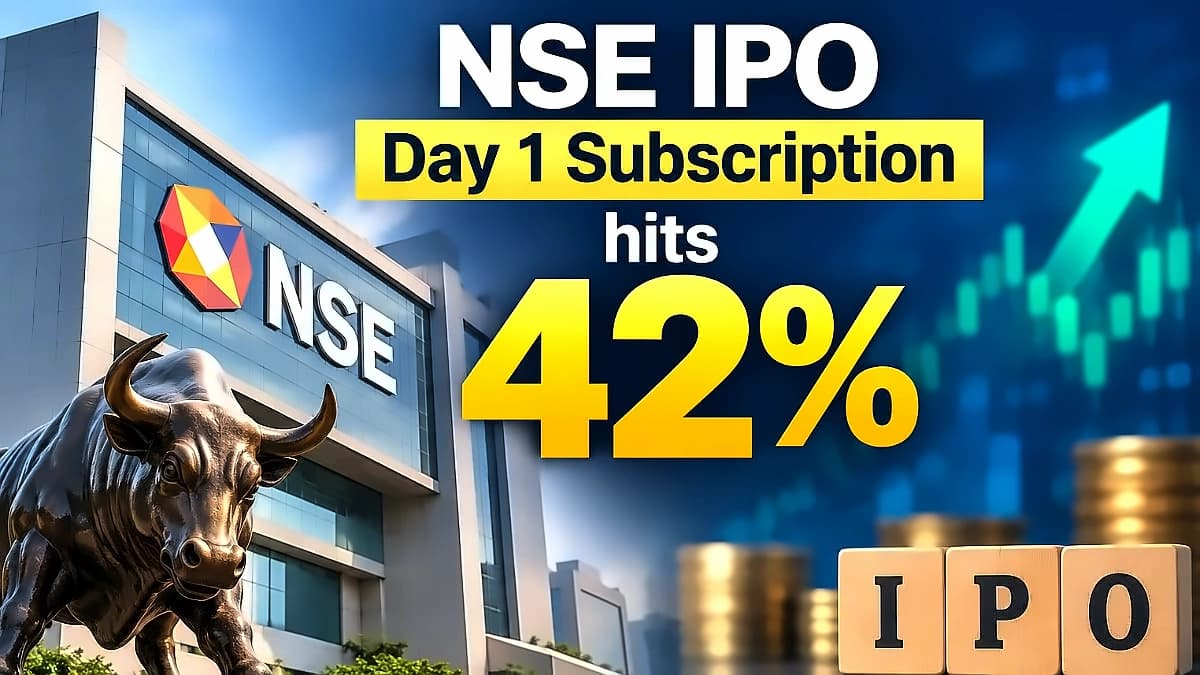
NSE IPO subscription status shows modest response with 0.30 times subscription by 1:20 PM on day one, indicating tepid investor interest despite the ₹22,569 crore issue size. This subdued response comes after NSE successfully raised ₹6,746 crore from anchor investors on the day before the IPO opened, demonstrating strong institutional confidence. The anchor book included state-owned Life Insurance Corporation of India (LIC), Goldman Sachs and Fidelity, along with sovereign wealth funds GIC Singapore, Abu Dhabi Investment Authority (ADIA) and Norges Bank. Additional participants included Eastspring and HSBC Global Asset Management. The issue involves 23 existing investors, including State Bank of India, Canada Pension Plan Investment Board, Aranda Investments, The New India Assurance Company, SBI Capital Markets and Bank of Baroda. As per The Times of India, the 7% GMP points to moderate expectations for the listing, with the premium not indicating the aggressive levels often associated with smaller issues.
NSE reported revenue from operations of ₹16,601.31 crore in FY26, compared with ₹17,140.67 crore in FY25, marking a decline of more than 3% year-on-year. According to market reports, revenue from transaction charges, one of NSE's key sources of income, also declined during the period, falling to ₹13,057.01 crore in FY26 from ₹13,635.76 crore in FY25, representing a year-on-year decline of around 4%. The issue is entirely an offer for sale (OFS), meaning that the proceeds from the share sale will go to existing shareholders rather than to NSE itself. Apart from the subdued grey market sentiment, investors are also likely to closely assess NSE's recent financial performance while evaluating the issue, with the declining revenue figures contributing to the muted investor response.
Market experts remain divided on whether NSE's all-OFS structure could limit listing gains, particularly as more than ₹22,000 crore worth of existing shares come into the public market at once. Anish Maheshwari, CEO and MD of VSure Investment Affairs, noted that the structure by itself should not be seen as an overhang because NSE is already a mature and highly cash-generative company. "I also wouldn't see the 100% OFS as an overhang by itself. NSE is already a mature, cash-generating business, so fresh capital is not the central investment thesis here," Maheshwari said. Shruti Jain, Chief Strategy Officer at Arihant Capital Markets, also argued that the distinction between a fresh issue and an OFS is unlikely to determine NSE's listing performance, adding that "historically also, several OFS, including BSE itself which is the closest competitor, listed with strong gains despite being an OFS." However, Prathamesh Kadival, Research Analyst at Bonanza, warned that the large supply of shares may cap gains on listing, stating that "the entire issue is an Offer for Sale, with shareholders such as SBI and Bank of Baroda trimming their stakes, the large supply of shares may cap the gains on listing."