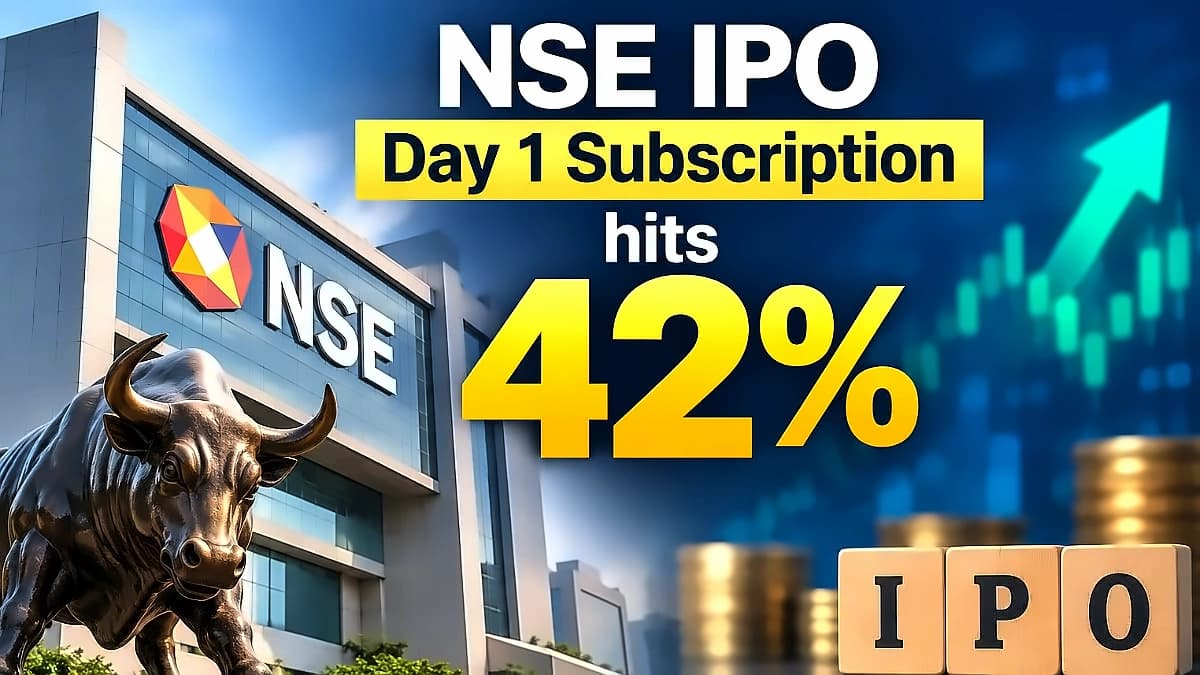
The **National Stock Exchange of India (NSE) IPO achieved **1.47 times subscription on the final day of bidding on September 21, with investors placing bids for 12.99 crore shares against 8.86 crore shares on offer. According to latest Business Standard data, the subscription pattern reveals strong investor response across categories, with non-institutional investors leading at 2.34 times subscription and retail investors quota subscribed 0.88 times, while qualified institutional buyers quota was subscribed 1.83 times. The bidding window for the NSE IPO was open from September 17 to September 21, with allotment expected to be finalised on September 22, and shares tentatively scheduled to list on the BSE on September 24. The offering is India's second-largest public issue after Hyundai Motor India's ₹27,870-crore IPO in 2024, surpassing the ₹21,000 crore offering of LIC in 2022, but remaining below Hyundai Motor India's record public offer. The NSE IPO size stands at ₹22,569 crore, making it a book-build issue of ₹22,561.57 crore entirely through an offer for sale (OFS) of 12.64 crore shares. The minimum lot size for retail investors is 8 shares, requiring a minimum amount of ₹14,280 at the upper price band.
The **NSE IPO's grey market premium has shown signs of recovery, trading at a premium of up to 3.14% in grey market, representing a significant improvement from the previous low of ₹48-50. According to Business Standard, NSE shares are currently trading at ₹1,841 in the grey market, implying a grey market premium (GMP) of ₹56 over the upper end of the price band. This recovery from the multi-month lows suggests investor sentiment may be stabilizing after the sharp decline from ₹285 when the price band was announced on September 17. The GMP had previously fallen from ₹285 to ₹125 over the past 10 days, but the latest recovery to ₹56 represents a potential listing gain of around 3% on the morning of September 21. The estimated listing price for NSE IPO is ₹1,833 (cap price + today's GMP), with the expected percentage gain per share coming down to 2.7%. As per CNBC TV18, the fall in GMP suggests that listing expectations have become more sober, with the IPO's size and structure making it harder to stretch extreme listing gains. However, GMP is unofficial and does not guarantee the actual listing price.
The NSE IPO received strong anchor investor support on September 16, raising ₹6,746.2 crore from several marquee domestic and global investors, with the Life Insurance Corporation of India (LIC) emerging as the largest player. According to CNBC TV18, ahead of the IPO opening, NSE raised ₹6,746.2 crore from anchor investors, with the exchange allotting 3,77,93,739 equity shares to anchor investors at ₹1,785 per share. The anchor allocation attracted participation from 98 mutual fund schemes and 27 life insurance companies, comprising 189 investors. The anchor allocation attracted demand for nearly ₹1.2 lakh crore, or around 20 times the size of the allocation, demonstrating strong institutional interest in the exchange's expansion. The company has allocated 3.77 crore equity shares to 189 anchor investors at the upper end of the price band, seeking a valuation of ₹4.42 lakh crore. At the upper price band of ₹1,785, NSE is valued at 42.9 times FY26 earnings, compared to BSE's trading at 54.3 times FY26 diluted earnings. The exchange has reserved shares worth ₹70 crore for its employees, who will be offered those shares at a discount of ₹170 per share to the final issue price. The valuation sought by the exchange will likely see it enter the list of top 15 companies in terms of market capitalisation. Kotak Mahindra Capital Company, JM Financial, Morgan Stanley India Company, Citigroup Global Markets India, HSBC Securities and Capital Markets (India), JP Morgan India, SBI Capital Markets, Anand Rathi Advisors, Avendus Capital, Axis Capital, DAM Capital Advisors, Equirus Capital, HDFC Bank, ICICI Securities, IDBI Capital Markets & Securities, IIFL Capital Services, Motilal Oswal Investment Advisors, Nuvama Wealth Management, Pantomath Capital Advisors and 360 ONE WAM are acting as the merchant bankers for managing the NSE IPO.
Religare Broking has assigned a 'Neutral' rating to the NSE IPO, citing a balanced outlook despite strong fundamentals. According to Religare Broking, "NSE's IPO presents a balanced outlook, with financial performance in FY26 impacted by regulatory changes and moderation in trading activity, while operational metrics remained resilient, supported by increasing investor participation, fund mobilisation and market presence. At a P/E of 42.9x, the valuation reflects the company's established market position and future growth potential, while leaving limited room for earnings disappointments. Regulatory developments, including SEBI measures on options trading, remain key factors influencing trading volumes and transaction-based income." Arun Kejriwal, Founder of Kejriwal Research and Investment Services, advised that investors should not apply for the NSE IPO by just having a look at the falling GMP or low subscription status, but should apply by analysing the company's fundamentals. He emphasized that "NSE is not like any other IPO; it is the listing of a company's shares, which reflects India's GDP." Prasenjit Paul, Fund Manager at 129 Wealth & Head of Research at Paul Asset, noted that "NSE is a fundamentally strong, cash-generating business with a clear competitive advantage, but investors should still focus on the price being paid for its earnings. At ₹1,785, the valuation is around 43 times FY26 earnings, which looks justified, though not cheap." He emphasized that future growth can come from deeper capital-market participation, cash-market activity, new products, data, indices and GIFT City rather than further market-share gains alone. The key risk remains its dependence on derivatives, with options transaction fees contributing significantly to revenue. Analyst views on the NSE IPO have largely been positive, although some brokerages have taken a more cautious stance, with Religare maintaining a 'Neutral' view on the issue.
NSE is India's largest stock exchange in terms of total turnover across key asset classes, with a 93.05% market share in the cash market, 99.72% in equity futures, 68.48% in equity options, 100% in exchange-traded currency futures and 100% in exchange-traded currency options, based on total premium turnover as of the three-month period ended June 2026. However, market experts are raising concerns about the exchange's business model vulnerabilities. Shruti Jain, Chief Strategy Officer at Arihant Capital Markets, noted that NSE is a high-quality business for long-term investors, but warned that investors need to remain aware of its sensitivity to volumes. She emphasized that "NSE is a high-quality business for long-term investors, but you need to maintain a degree of caution given its sensitivity to market volumes." Dr Ravi Singh, Chief Research Officer at Master Capital Services, had also flagged the same risk, stating that NSE is a strong business, but investors should watch the valuation and its dependence on derivatives. The primary concern is nearly 79% of NSE's revenue comes from transaction charges, leaving earnings vulnerable to market volatility and regulatory tightening on derivatives. Avinash Gorakshakar, Founder and Head Research at Avinash Mentor Research Services, warned that because of the massive size and lack of a fresh-issue growth engine, upside on listing may be more measured than in smaller, high-growth IPOs. The derivatives dependency is particularly concerning, as a large part of NSE's earnings has been driven by the post-Covid options boom, and if derivatives volumes cool because of tighter Sebi rules, the earnings engine could slow significantly. Anuj Gupta, a SEBI-registered market expert, noted that despite the large size, the NSE IPO had been subscribed within two days of bidding, which is enough to understand the buzz around this mega offer. He advised that due to the larger size, chances of share allotment are quite high, and hence, one should subscribe to the NSE IPO.