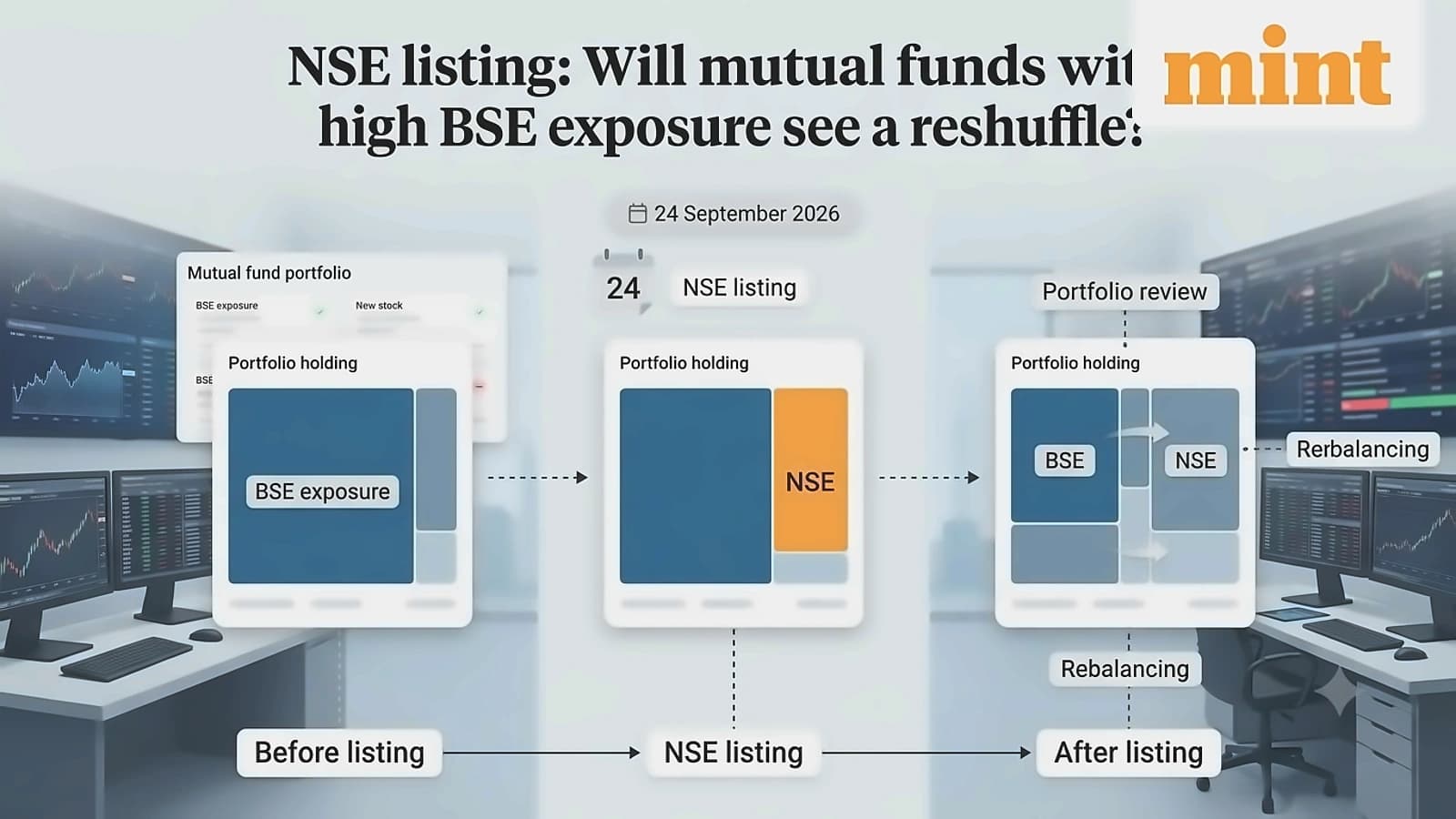
NSE shares will make their stock market debut today, September 24, 2026, at 10 AM on BSE following the successful completion of India's second-largest public issue. As per The Financial Express, NSE shares will be transferred to the Demat accounts of successful allottees on Wednesday, September 23, with refunds processed on the same day for unsuccessful investors. The ₹22,569 crore NSE IPO was subscribed 5.71 times overall during the three-day bidding period, with investors bidding for 505.81 million shares against 88.6 million shares on offer. The shares are scheduled to list on both BSE and NSE, with NSE shares proposed to be listed on BSE at 10 AM.
The IPO achieved 5.71 times overall subscription during the three-day bidding period, making it the second-largest in India's history and the biggest public issue of 2026. As reported by The Financial Express, the QIB portion was subscribed 12.68 times, while the non-institutional investor portion received 6.55 times subscription. Among non-institutional investors, the segment for bids above ₹10 lakh was subscribed 7.78 times, while the segment for bids above ₹2 lakh and up to ₹10 lakh was subscribed 4.09 times. The retail portion was subscribed 1.39 times, and the employee portion achieved 2.39 times subscription. The price band was fixed at ₹1,700-₹1,785 per equity share, with NSE valued at around ₹4.41 lakh crore at the upper end of the price band. The issue involves the sale of up to 12,64,36,550 shares, representing about 5.11% of NSE's equity.
The NSE IPO is currently trading at a grey market premium of ₹43 per share as of September 23, 2026, showing a sharp decline from the previous day's ₹66. According to The Financial Express, this implies an indicative price of around ₹1,828 against the final issue price of ₹1,785. The grey market premium signals a modest listing gain over the upper price band, though the grey market is unofficial and does not guarantee the actual listing price. At the current GMP of ₹43, the estimated listing price stands at ₹1,828 per share, signalling a potential 2.4% premium listing on BSE. The NSE IPO had a price band of ₹1,700-1,785 per share, with a lot size of eight shares, and the minimum application amount for a retail investor at the upper end was ₹14,280. The entire issue comprised an offer for sale (OFS) of 12.64 crore equity shares by existing shareholders, with NSE not receiving any fresh capital as proceeds will go to selling shareholders.

A key aspect of the NSE listing is that NSE won't be trading on the NSE - instead, it will debut on the Bombay Stock Exchange (BSE). As per The Financial Express, this is due to regulatory restrictions under the Securities Contracts (Regulation) (Stock Exchanges and Clearing Corporations) Regulations that don't allow a recognised stock exchange to list its own shares on its own trading system. This regulatory framework ensures fair market access and prevents potential conflicts of interest. The listing on BSE represents a unique situation where India's largest stock exchange makes its market debut on a rival exchange platform, highlighting the importance of regulatory compliance in capital market operations.
NSE operates a business closely linked to financial-market regulations, with transaction charges contributing nearly 79% of FY26 revenue. During the quarter ended June 2026, India's largest stock exchange continued to account for a large share of trading activity in the country. As reported by The Financial Express, NSE handled 93.05% of the cash market, 99.72% of equity futures, and 68.48% of equity options based on relevant turnover measures. The exchange supports 132.4 million unique registered investors, 1,328 trading members and 3,005 listed entities with market capitalisation of about ₹474.1 trillion. The exchange's dominant market position, significantly higher revenue and profitability, and long-term structural growth in Indian capital markets provide additional comfort to investors despite near-term regulatory headwinds to derivatives volumes.