The National Stock Exchange of India (NSE) is set to launch its initial public offering on September 17, 2026, with the issue closing on September 21, 2026. According to the latest IPO details, the price band has been set at ₹1,700-1,785 per share with a lot size of 8 shares, making the minimum investment ₹14,280. The tentative listing date is September 24, 2026 on BSE, with allotment status available from September 22, 2026. This represents an offer for sale of 12,64,36,650 equity shares, aggregating up to ₹22,562 crores from 22 existing shareholders including State Bank of India, Canada Pension Plan Investment Board, and several public-sector insurers.
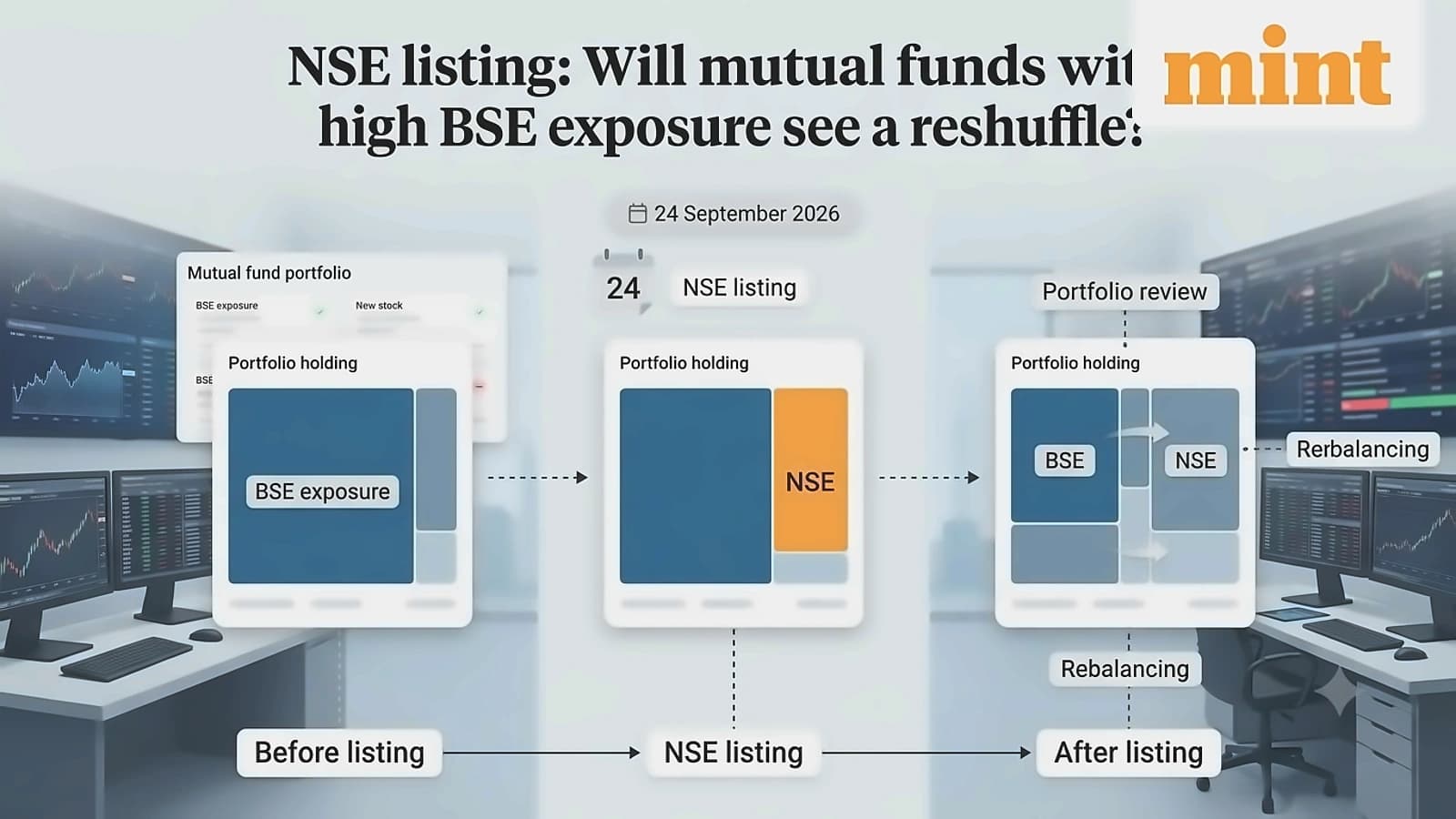
As India's largest stock exchange, NSE serves over 261 million registered investor accounts and 129 million unique investors through 1,328 trading members and 3,005 listed companies, with a total listed market capitalization of around ₹474 trillion. The exchange holds a dominant market share of 99.79% in cash market turnover and 99.48% in equity options, while reporting a consolidated profit after tax of ₹10,302 crore for FY2026. The upcoming listing will bring a new listed stock into India's capital-market ecosystem, potentially affecting mutual funds that currently hold its listed rival, BSE.
Several funds tracking the Nifty Capital Markets index currently have sizeable allocations to BSE. The top holdings include Tata Nifty Capital Markets Index Fund at 16.87%, Motilal Oswal Nifty Capital Market Index Fund at 16.84%, Groww Nifty Capital Markets ETF at 16.81%, and Axis Nifty Capital Markets Index Fund at 16.81%. However, the upcoming NSE listing does not automatically mean these Nifty-linked funds will replace BSE with NSE. According to Harsh Vardhan Dawar, Founder of Wealth Cafe, NSE shares will list exclusively on BSE, not on its own exchange, entering through BSE's own index family and global benchmarks instead.
BSE features prominently in several active financial-services and thematic funds, with Edelweiss Financial Services Fund holding the highest allocation at 5.32%. Other schemes with significant BSE exposure include Invesco India Financial Services Fund at 3.85%, Axis Services Opportunities Fund at 3.50%, and LIC MF Banking & Financial Services Fund at 3.26%. Dawar noted that active mutual funds will definitely add an allocation to NSE, as they now have an alternative to BSE for capital-market infrastructure segment exposure. All thematic mutual funds investing in the 'Financial Services' sector will have a sizable allocation to NSE in their portfolio.
BSE is also present in diversified active equity portfolios, with ICICI Prudential Mid Cap Fund holding the highest allocation at 3.95%. Other diversified funds with significant BSE exposure include Invesco India Mid Cap Fund at 3.22%, Samco Mid Cap Fund at 3.19%, and 360 ONE Focused Equity Fund at 2.74%. Dawar expects that NSE will debut as either a dominant mid-cap or entry-level large-cap entity, potentially causing a major reshuffle if it falls under the mid-cap category. Some active fund managers may have already reduced their BSE exposure or kept cash aside to allocate to NSE after the listing.
Adil Chacko, Executive Director of Anand Rathi Wealth Limited, advised investors to avoid making investment decisions solely based on changes in underlying portfolio composition, as portfolio changes are part of the fund manager's investment process. As reported by Mint, investors should evaluate whether the scheme continues to be aligned with their investment objective, risk profile, and overall asset-allocation strategy. The NSE IPO is priced at ₹1,785 per share, compared with ₹2,000-₹2,100 at which it was trading in the unlisted market last month, with Dawar expecting certain listing gains given the price gap. The strong performance of BSE stock, which has delivered an 8-year CAGR of 50.3% compared to Nifty 50's 12.0%, bodes well for NSE's listing prospects, though similar stellar returns cannot be expected.