The National Stock Exchange of India Ltd. board has officially approved plans to undertake an initial public offering (IPO) through an offer for sale (OFS) by existing shareholders. As reported by The Hindu BusinessLine and The Times of India, this development comes after NSE recently received a no-objection from market regulator SEBI to proceed with its IPO, ending a decade-long wait for approval. The board also approved the reconstitution of its IPO Committee, which will carry out activities specifically delegated by the governing board for facilitating the IPO process. The reconstituted committee will be chaired by Tablesh Pandey and will include public interest directors Srinivas Injeti, Prof Mamata Biswal, Abhilasha Kumari, and Prof Sivakumar, along with NSE Managing Director and CEO Ashish Chauhan. This specialised committee is expected to act as the central authority overseeing the listing exercise, with one of the key items on the agenda being the formation of a dedicated IPO committee. According to Moneycontrol, the formal IPO process is set to begin next week under the guidance of the IPO committee, with the committee spearheading the listing process beginning with finalising criteria for appointing merchant bankers and legal advisors who will prepare the draft red herring prospectus (DRHP).
The proposed IPO has been scaled up to approximately ₹23,000 crore from the earlier estimates, representing a significant increase in the offering size. As reported by Moneycontrol, around 4.5% of NSE's equity may come up for sale at the current price of around ₹2,000 per share. The offering will be subject to regulatory approvals, market conditions, and other relevant factors, with the exchange stating in a regulatory filing that the IPO will be an offer for sale by existing shareholders. NSE is targeting the filing of the DRHP by end-March or early April, with sources indicating that if September quarter audited numbers are used, the filing could happen by March-end, otherwise it may be delayed to April with December quarter audited numbers. The formal pitch process for merchant bankers is expected to begin once selection criteria are finalised, with eligible merchant bankers being formally briefed to trigger the pitch process, or 'beauty parade'.
NSE's listing ambitions date back to 2016, when it first filed draft documents to raise around ₹10,000 crore through an offer for sale by existing shareholders. However, the plan was put on hold after SEBI withheld approval due to regulatory concerns linked to governance issues and the controversial co-location case. The co-location matter centred on allegations that certain brokers received preferential access to NSE's trading systems, giving them an unfair market advantage. In 2025, after years of legal proceedings, NSE offered to pay ₹1,388 crore to settle charges related to the co-location controversy and move forward with its listing plans. The settlement application proved to be a turning point, eventually leading to SEBI chairman Tuhin Kanta Pandey confirming that the regulator had granted in-principle approval to NSE's settlement application in the unfair market access case. Pandey had indicated that the NOC could be issued within about a month, following the regulator's grant of 'in-principle' approval to NSE's settlement application in June 2025. The regulator's clearance effectively signals the end of one of the most closely watched regulatory sagas in India's capital markets history.
Separately, the board approved the incorporation of a coal exchange subsidiary, aligning with the Ministry of Coal's proposed Coal Regulations, 2025. As reported by Moneycontrol, the new entity, proposed to be named National Coal Exchange, Bharat Coal Exchange, or India Coal Exchange, will be set up as a regulated platform for electronic trading of physical coal. NSE plans to infuse up to ₹100 crore into the coal exchange subsidiary to meet the minimum net-worth requirements under the proposed rules, with the exchange initially holding a minimum 60% stake and the remaining shareholding expected to be distributed among other shareholders. The subsidiary will require approval from the Securities and Exchange Board of India (SEBI) and subsequent licensing from the Coal Controller Organisation. The coal exchange aims to bring greater transparency, efficiency, and standardised price discovery to India's coal market, which currently operates through fragmented and largely opaque channels, with the platform enabling electronic trading of physical coal and potentially facilitating derivative products in the future, subject to regulatory approval.
NSE's latest financial results for the quarter ended December 2025 show strong performance, with consolidated net profit rising 15% sequentially to ₹2,409 crore and revenue from operations increasing 7% to ₹3,925 crore, as reported by Mint. NSE's operating earnings before interest, taxes, depreciation and amortization (EBITDA) almost doubled to ₹2,851 crore, while the margin against the topline widened to 73% from the September quarter's 40%. The margin improvement was driven by other expenses falling to ₹542 crore from ₹1,811 crore due to a one-time provisioning in the prior quarter. NSE shares are trading at ₹2,150 in the grey market, attributing a staggering valuation of approximately ₹5.3 lakh crore. This positions NSE as the fourth most valuable exchange globally among its listed peers, according to Bloomberg data, and underscores its importance in India's financial landscape, especially considering its dominance in the derivatives market, commanding over 75% of this sector.
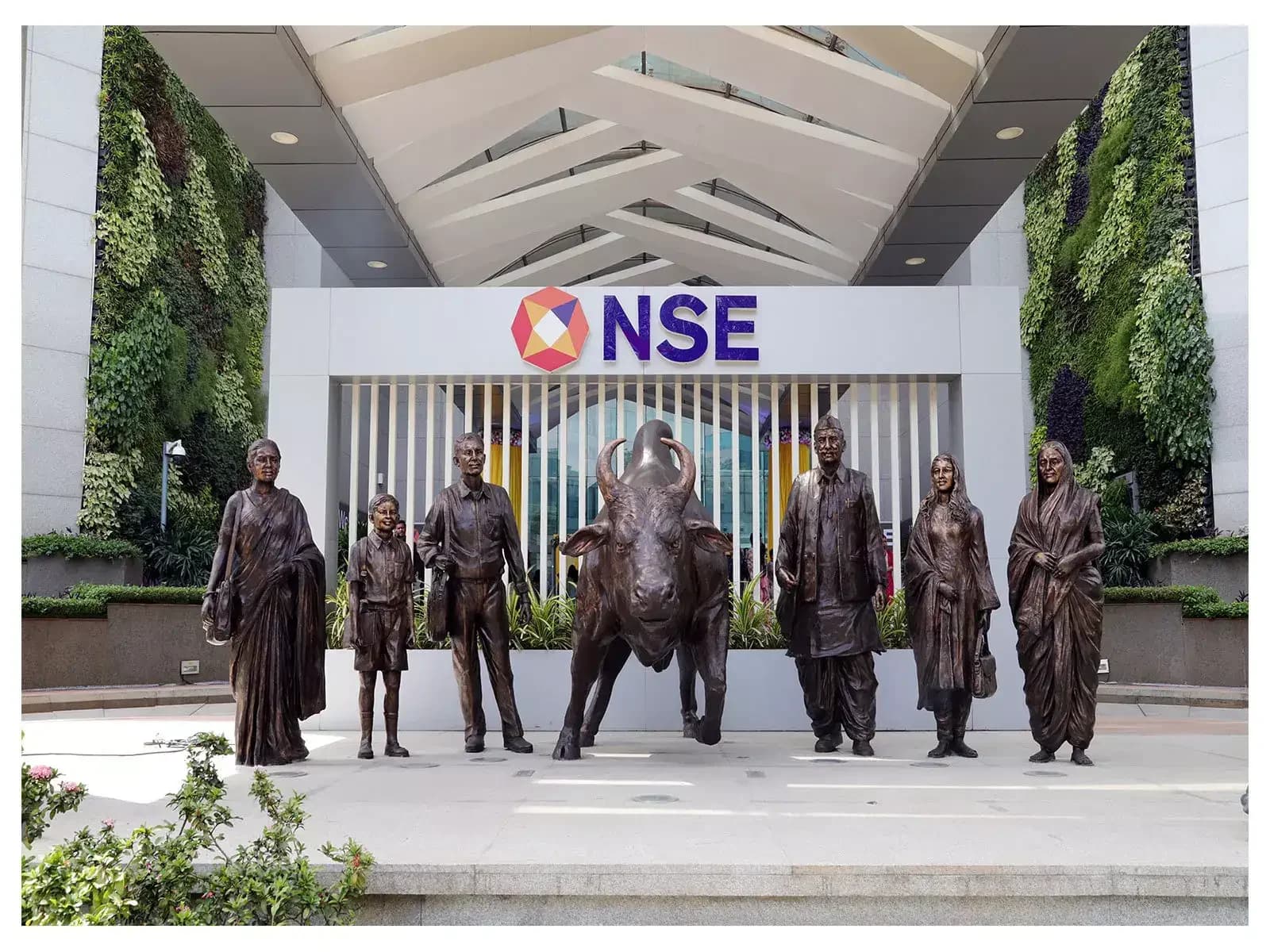
Existing shareholders are likely to dilute 4-5% stake via an offer for sale in the NSE IPO, according to sources cited by NDTV Profit. The company counts around 1.77 lakh shareholders on its roster. Public sector entities hold 31.29% stake in NSE as of March 31, making them the largest shareholder bloc. Life Insurance Corporation of India is the single largest PSU shareholder with a 10.72% stake, while state-owned banks together hold 4.56%, taking total PSU participation to 14 entities. The exchange is likely to file its draft red-herring prospectus (DRHP) in 3-4 months, and the listing is expected in around 7-8 months, according to sources reported by NDTV Profit. NSE managing director and chief executive Ashish Kumar Chauhan had earlier described the in-principle approval as a positive development, stating that once they receive the NOC, they will follow the conditions mentioned in the intimation and begin preparations for filing the draft red herring prospectus (DRHP), which could take up to four months after receiving SEBI's NOC. The public issue itself could hit the markets around 7-8 months after the NOC, according to Chauhan's earlier statements.