HD Fire Protect opened its ₹712 crore IPO on October 13 with a price band of ₹258–271, and bidding closes on October 15. The issue is a pure offer for sale (OFS): the company raises nothing, while two promoters sell shares they acquired at almost no cost. The business has a niche position and unusually high returns. What investors have to weigh is the valuation, the payout history and the structure of the sale.
What the company does
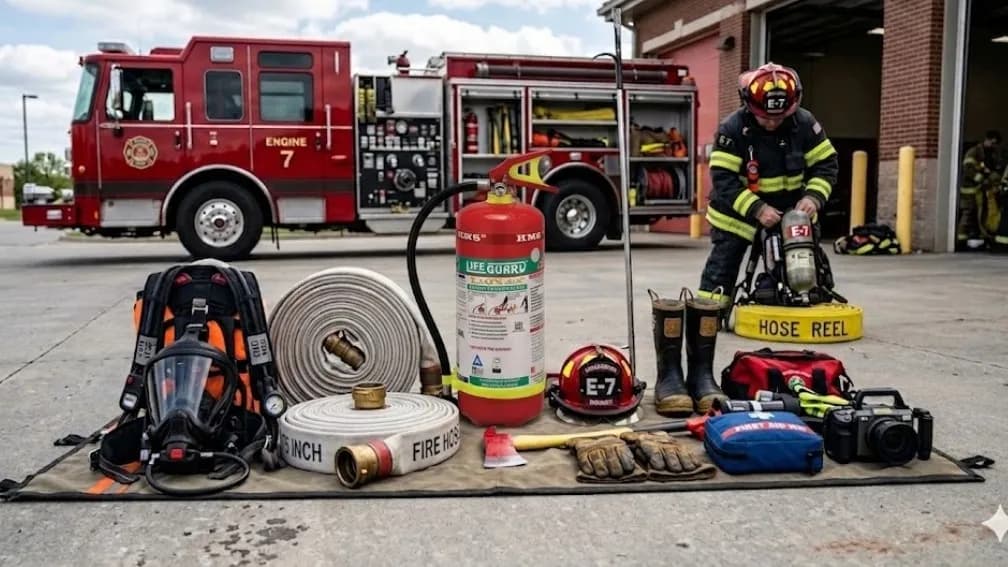
HD Fire Protect makes fire suppression equipment: sprinklers, alarm and deluge valves, foam systems, monitors, water spray nozzles, pre-action and gas suppression systems. Its customers are data centres, oil & gas, petrochemicals, power and industrial companies.
According to CRISIL, it is India's second-largest fire protection equipment manufacturer by operating income (FY25) and its largest exporter by value. No market share percentage is disclosed in the offer document, and multinational and branded players hold about 70% of the market.
About 65% of FY26 revenue came from the domestic market and 35% from exports. Three categories account for roughly three-quarters of sales: sprinklers (34%), deluge systems (22%) and foam (19%). Foam is the fastest-growing line, with a roughly 28% CAGR between FY24 and FY26, while gas suppression has been wound down to nil revenue.
The Jalgaon plant holds 9COM approval, which lets it receive Saudi Aramco RFQs. Sales come through short-term purchase orders rather than long-term contracts.
The numbers
| Particulars (₹ crore) | FY24 | FY25 | FY26 | Q1FY27 |
|---|
| Revenue | 372.95 | 432.80 | 489.28 | 109.05 |
| EBITDA margin | 28.6% | 31.9% | 30.8% | 27.3% |
| PAT | 87.92 | 109.72 | 116.79 | 23.87 |
| ROE | 28.4% | 29.6% | 30.2% | 6.1% |
| Operating cash flow | 63.77 | 98.32 | 92.49 | 47.2 |
| Order book | 75.29 | 70.35 | 134.45 | 158.60 |
Returns are the story here. ROE is above 30% and ROCE is about 40%. The company has no borrowings.
Growth is moderate, and profit growth has slowed. Revenue grew 13% in FY26 against 16% in FY25. PAT grew only 6.4% in FY26 after 24.8% the year before. The EBITDA margin peaked in FY25 and slipped to 27.3% in Q1FY27.
The order book is the best forward indicator. It was ₹70.3 crore in March 2025 and ₹158.6 crore by June 2026, which covers about four months of FY26 revenue. The company reports no order cancellations in any period, but it cautions that the order book is no guarantee of future revenue.
Working capital is lengthening
Beneath the headline returns, the cash cycle is stretching. The cash conversion cycle was 83 days in FY25, 102 in FY26 and 112 in Q1FY27. Inventory days rose from 77 to 109 over that period, and receivable days rose from 45 to 61. Payable days stretched from 39 to 58 and offset part of the rise.
The 112-day figure uses a 90-day basis for the quarter, so it isn't a clean trend. Still, this is a business that runs on short-cycle orders, and it is now holding more inventory and waiting longer to get paid. Q1FY27 operating cash flow was strong at ₹47.2 crore, driven mainly by a ₹36.4 crore inflow from trade receivables. Payables added ₹18.5 crore, while inventory took ₹18.1 crore.
Capacity
There is room to grow. Jalgaon lines ran at roughly 63–81% utilisation in FY26 (gas suppression sat idle). Thane's water spray nozzle line ran at 94%. A new manufacturing unit and warehouse at Wagle Estate, Thane, is due by November 2026, though the offer document describes it mainly in terms of inventory handling and storage. Purchases of property, plant and equipment were ₹4.1 crore in FY26, but capital work-in-progress took a further ₹13.7 crore, or about ₹17.9 crore in all. With no IPO proceeds coming in, future spending will be funded internally.
Who is selling
The sellers are the company's promoters. Promoters hold 95.33% before the issue. Harish Dharamshi (56.13%) and his wife Kusum Dharamshi (17.83%) are offering 0.89 crore and 1.73 crore shares at average costs of ₹0.05 and ₹0.09 per share. By our calculation from the offer size, promoters will hold about 80% after the issue, or about 85% together with the promoter group.
The shareholder base is entirely retail-style: no institution holds 1% or more of the company, and all six holders above 1% are individuals.
Valuation
The price tag is full. At the ₹271 cap, the P/E is 40.7x FY26 EPS of ₹6.66. It is also about 12.6x book value, 9.7x sales and 31–32x EBITDA, all calculated from the company's filed figures. At June 30, 2026 the company held about ₹30.5 crore of cash and bank deposits plus ₹126.7 crore of investments, mostly quoted. That is about ₹1.5 bn, or under 4% of market cap at the cap price. At ₹258, P/E is 38.7x.
| Company | P/E | RoNW | Total income (₹ cr) |
|---|
| Azad Engineering | 145.7x | 8.7% | 648.6 |
| KSB | 55.7x | 16.1% | 2,754.9 |
| Ingersoll-Rand (India) | 51.4x | 20.4% | 1,430.8 |
| Elgi Equipment | 44.7x | 19.3% | 4,068.5 |
| Kirloskar Pneumatic | 17.2x | 20.4% | 1,814.5 |
| HD Fire | ~40.7x | 31.1% | 505.1 |
On the company's own peer comparison, the average is 62.95x. The median is about 51x, calculated from the table. HD Fire sits below both, with a much higher return on net worth.
But the comparison is weak. There is no listed pure-play fire protection company in India, so these are capital goods peers.
Azad Engineering, at 145.7x, inflates the average. Excluding it, the other four peers average about 42x.
The multiple is not a discount on trailing profit. FY26 PAT growth was 6%. Annualising Q1FY27 PAT gives about 50x at ₹271, though Q1 may be seasonal.
Red flags
Payouts above profit, ahead of an exit. The RHP's dividend disclosures list an interim dividend of ₹54.56 crore and a final dividend of ₹105.14 crore for FY25, followed by an interim dividend of ₹35.05 crore for FY26. The cash flow statement records ₹140.18 crore in dividends paid during FY26, against a profit after tax of ₹116.79 crore; a payout of roughly 120%. The figures broadly align with the FY25 final and FY26 interim dividends.
However, the RHP's treatment of a separate ₹3-per-share special final dividend, worth about ₹52.57 crore, is inconsistent: one section says the cash outflow will occur in FY27, while the risk factors describe it as declared and paid for FY26. Its payment timing therefore remains unclear. Total equity fell to ₹377.1 crore in FY26 from ₹397.2 crore, while bank deposits maturing within 12 months declined from ₹68.4 crore in FY24 to ₹23.7 crore.
| Particulars (₹ crore) | FY25 | FY26 |
|---|
| Related party transactions (RPT) | 85.30 | 161.96 |
| Director remuneration (four promoter directors) | 29.09 | 20.02 |
| Dividends paid to related parties (equal to total dividends paid per cash flow statement) | 56.15 | 140.18 |
| Remuneration plus dividends | 85.24 | 160.20 |
| PAT | 109.72 | 116.79 |
| Dividends paid as % of PAT | 51% | 120% |
Related party transactions jumped from 19.7% to 33.1% of revenue. The sum of remuneration and dividends comes within about ₹1.8 crore of the reported FY26 total. The company gives no explanation of its own for the RPT rise; this reconciliation is derived from its tables and is not a company statement. It shows the spike is mostly payouts to the owners, not a hidden operating transaction. Director pay itself fell in FY26.
Nothing for the company. The OFS raises no money for growth or deleveraging. Promoters and the promoter group hold about 85% after listing, so there is no change in control.
Slowing earnings and margins. FY26 PAT growth was 6.4%, and Q1 FY27 margins were the lowest of the four periods.
Order-driven revenue. There are no committed-volume contracts. Customer concentration is rising: the top 10 customers were 27.57% of Q1 FY27 revenue, against 23.69% for FY26. The customer count fell to 2,066 from 2,114 in FY24.
Contingent liabilities. They rose to ₹9.61 crore in June 2026 from ₹5.54 crore in March 2026, mainly bank guarantees and export obligations. They are small relative to net worth.
Disclosure inconsistencies. FY26 EBITDA is ₹155.19 crore in the CRISIL industry section and ₹150.46 crore in the restated financials. FY25 EBITDA differs between the two as well (₹141.02 crore against ₹138.01 crore). The FY26 special dividend is also described as "declared and paid" in the risk factors, while the financial statements put the cash outflow in FY27.
Governance and legal. No criminal, civil or regulatory proceedings are pending against the company or the promoters. The company does have three tax proceedings (one direct, two indirect totalling ₹0.04 crore). It also has a material tax matter: a writ petition in the Bombay High Court after CBDT rejected its application to condone the delay in opting for the new tax regime. Two criminal complaints are pending against one independent director, Sudha Ravi, in her capacity as a director of Alkem Laboratories. Both are in High Courts, with interim relief or a stay. The auditors have not qualified their report.
Conclusion
HD Fire Protect is a high-return, debt-free niche manufacturer. It is India's second-largest in its category and its largest exporter by value, with ROE above 30% and an order book that has more than doubled since March 2025. At the ₹271 cap, the IPO values it at about 40.7x FY26 earnings. That is below the peer average of 62.95x in the offer document.
Ultimately, the case for the IPO rests on whether the strong order book turns into faster profit growth, which would be needed to justify a valuation that already assumes sustained double-digit earnings growth. This is an analysis of the filed data, not a recommendation to subscribe or avoid.
Disclaimer: This AI-generated analysis, based on RHP/DRHP information, is for informational purposes only. Investors should conduct due diligence and consult financial advisors before making investment decisions. Past performance does not guarantee future results, and all investments carry inherent risks including potential loss of principal.