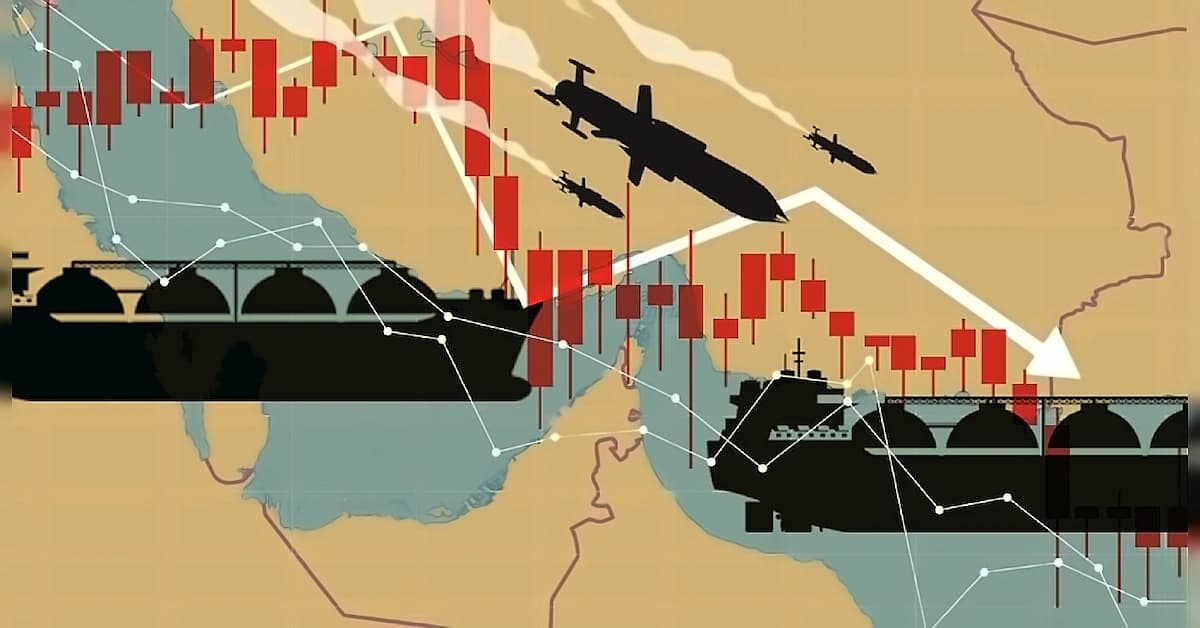
Jefferies has turned cautious on India's travel sector as the Iran-Middle East war hurts international traffic, lifts fuel costs and weakens foreign tourist arrivals. According to The Economic Times, the brokerage has trimmed earnings for airlines, hotels and travel-tech names, while maintaining BUY ratings on GMR Airports, IndiGo and key hotel stocks. IndiGo is flagged as the most directly hit stock in Jefferies' travel coverage, given its heavy Middle East exposure and sensitivity to aviation turbine fuel and currency moves. ME-linked traffic forms ~45% of IndiGo's international capacity (~15-17% of total traffic), leaving the carrier vulnerable to airspace closures, rerouting and intermittent suspensions.
Brent crude traded near $113 per barrel on Monday, up roughly 55% in March - the largest monthly surge in the contract's history, surpassing the 46% gain recorded during the first Gulf War in September 1990. The Energy Select Sector SPDR Fund is the only S&P 500 sector in the green this month, while the United States Oil Fund has tracked crude's historic March run. Bettors on Polymarket give 71% odds that U.S. forces enter Iran by April 30, which would mean a significant escalation in the war. A separate contract on regime change before 2027 sits at just 34%, with traders pricing a grind, not a swift collapse. Kalshi's recession market has jumped above 34%, its highest this year.
Jefferies warns of near-term risk from softer foreign tourist arrivals (FTAs) and disruption to international traffic-led MICE demand, with any weakness only partly cushioned by domestic substitution. As reported by The Economic Times, FTAs account for ~20-50% of business for IHCL, ITC Hotels, Chalet & Leela, making them particularly vulnerable. The industry's RevPAR growth is set to moderate to 5-7% in Q4 (vs 12-13% in Q3) and slip to low single-digit YoY growth in Q1, before recovering thereafter. City hotels and drive-to leisure destinations benefit as high airfares curb long-haul trips and support shorter domestic holidays. Jefferies has cut Indian Hotels target price to ₹800 from ₹900, ITC Hotels' target to ₹210 from ₹250, and Chalet Hotels target price lowered to ₹910 from ₹1,075.

The US-Israel-Iran war has created a perfect storm for global stock markets, with the Sensex and Nifty down over 12% from their lifetime highs. According to The Times of India, investors have lost several lakh crore as the combined market capitalisation of BSE-listed firms has declined by over ₹30 lakh crore since the start of the Middle East conflict. The market correction has been severe, with global crude oil prices rising and India's huge import dependence causing all positive drivers of the stock market to take a back seat. A depreciating rupee, flight of foreign capital, and prospects of impact on industry and earnings have investors running for cover.
Financial experts recommend different allocation strategies based on investment horizons. As reported by The Times of India, for investors with 6 months to 1 year horizon, equity exposure may not be appropriate as markets can remain unpredictable. The recommended allocation includes 100% debt for short-term goals, 70% equity and 30% debt for medium-term goals (1-3 years), and 80% equity and 20% debt for long-term goals beyond 3 years. Within equity portions, experts suggest 50-55% large caps, 20-25% mid caps, and remaining to small caps to ride market cycles smoothly.