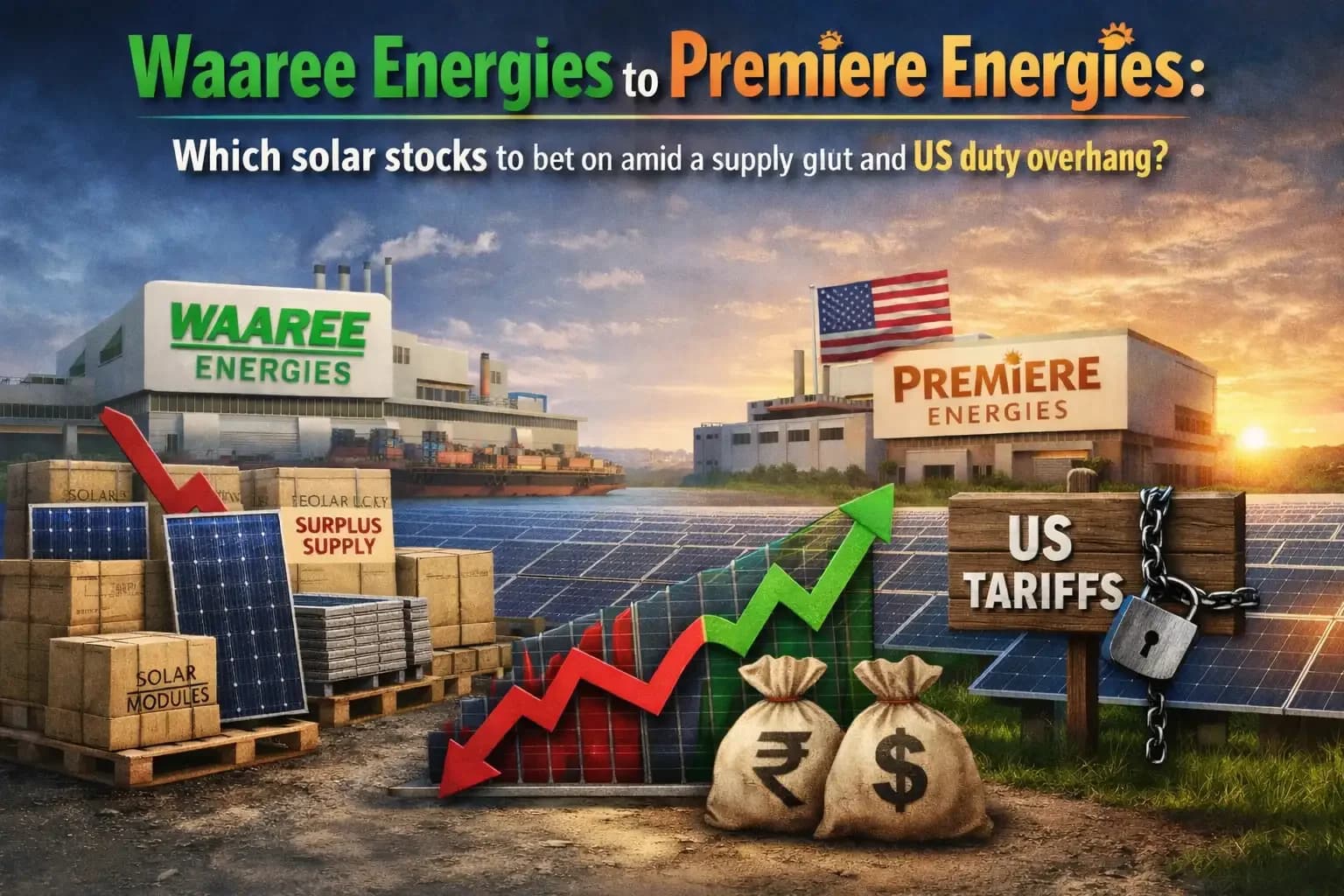
Indian solar stocks have experienced significant declines over the past six months due to oversupply concerns and trade policy uncertainties. According to reports from The Economic Times, Waaree Energies shares are down about 15% while Premier Energies has declined roughly 14% during this period. The sector has been under pressure as investors reassess margins and export visibility in a market facing oversupply challenges. Websol Energy has seen a massive slump of nearly 60% in the same timeframe, reflecting broader market concerns about the sector's near-term prospects.
The solar industry is grappling with a significant supply glut that has created pricing pressure across the sector. As reported by The Economic Times, domestic module manufacturing capacity has expanded rapidly to cross 160 GW, while annual installations remain closer to 40-45 GW. This mismatch has led to intense pricing pressure and margin compression as manufacturers compete for limited market demand. The US market has historically accounted for a significant portion of India's solar exports, with shipments worth about ₹34,000 crore between April 2023 and November 2025.
The latest development came on February 24, when the US Department of Commerce announced a preliminary countervailing duty of 126% on certain solar imports from India. According to The Economic Times, the tariff applies only if modules use solar cells manufactured in India, limiting the impact for companies like Waaree Energies, which earns roughly a third of its revenue from the US, as it does not use Indian-made solar cells for US supplies. Premier Energies, which derives only about 1% of revenue from overseas markets, remains largely insulated from the duty impact.
Market experts suggest that companies with differentiated business models are better positioned to navigate the current challenges. As reported by The Economic Times, integrated players with backward integration into cells and wafers are better positioned to manage costs, while module manufacturing remains cyclical and exposed to global trade regimes. Renewable power producers operating under long-term power purchase agreements are less exposed to module price swings, benefiting from contracted revenue streams rather than manufacturing margins. EPC and project developers face intermediate exposure, with their revenues depending on installation demand rather than module spreads.
Despite near-term stress, analysts maintain that the long-term renewable energy story remains intact. According to The Economic Times, India's target of 500 GW of non-fossil capacity by 2030, corporate decarbonisation goals and policy support such as PLI schemes provide a strong structural backdrop for the sector. Motilal Oswal has set a target price of ₹3,514 on Waaree Energies and ₹1,000 on Premier Energies, citing the domestic module business valuation at 13x FY28E EBITDA and the US module business at 12x FY28E EBITDA respectively. The sector is expected to favor companies with scale, integration, financial discipline and diversified markets as it transitions through the current oversupply and tariff challenges.