OpenAI has announced a $750 billion AI infrastructure investment starting with Project Camellia in Georgia, representing one of the largest technology investments in history. The $20 billion data center requires 3.2 GW of electricity and has secured a 50% tax cut from Georgia authorities. According to recent reports, Georgia Power's electricity delivery is scheduled to begin in 2028, though OpenAI has not specified when it will activate its first GPU at the site. The activation might occur before 2028, especially since OpenAI has brought on Brett Mayo to oversee data center construction, who previously managed the Colossus data center at xAI in Memphis. This massive expenditure follows indications that OpenAI's Stargate data center initiative has encountered delays, with the company stating it will cover 'the full cost of the infrastructure and electric-service costs' for the new facility.
India's power and electrical equipment stocks have emerged as key AI proxy plays, delivering exceptional returns this year. According to reports from The Economic Times, Hitachi Energy India has doubled investor money so far this year, while Kirloskar Oil Engines is up 76%. GE Vernova T&D India has gained 40%, Voltamp Transformers has risen 38%, Siemens Energy India is up 28% and Cummins India has advanced 26%. The rally demonstrates how quickly the AI theme has moved into the power ecosystem, with investors looking beyond software and chips to companies benefiting from rising electricity demand. The latest developments with OpenAI's massive infrastructure investment provide additional validation for these stock movements, as the company's commitment to hundreds of billions in concrete, power lines, and server racks over the next six years creates substantial opportunities across the power sector.
The power sector's AI opportunity stems from massive electricity consumption by data centres. As reported by The Economic Times, Paresh Bhagat, Chairman of Mangal Keshav Financial, estimates that 1 GW of data-centre capacity could require nearly 1.5 GW of 24x7 power and close to 6 GW of renewable capacity after factoring in intermittency and storage. This creates a multi-year opportunity across generation, transmission, transformers, cables, switchgear and grid modernisation. The AI boom has made the long-term case for India's power ecosystem stronger, as AI data centres consume far more electricity than traditional data centres, requiring reliable, round-the-clock electricity, transformers, cables, switchgear, grid connections, backup power and transmission infrastructure. The Georgia project specifically requires 3.2 GW of electricity, highlighting the scale of power requirements for major AI facilities.
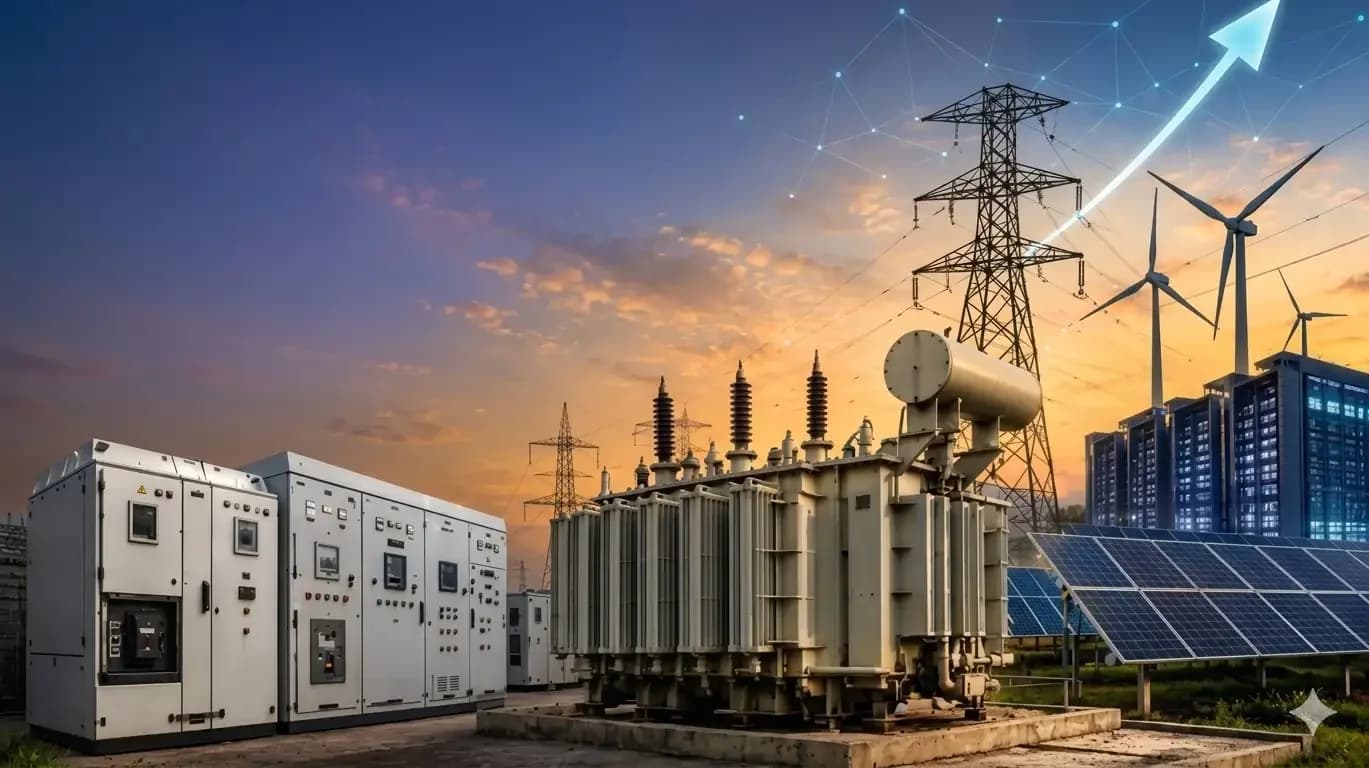
According to Balaji Rao Mudili, Research Analyst at Bonanza, reported by The Economic Times, India is not yet building AI data centres at the same scale as the US, but the country is moving in that direction. Large companies like Reliance, Adani, Tata and global cloud providers are investing in data centres, which will need reliable electricity supply. Equipment makers have attracted stronger interest because order inflows from data centres, transmission expansion and renewables can show up more directly in earnings. However, regulated utilities have been more subdued as their returns are often capped under regulatory frameworks. Hitachi Energy India and GE Vernova T&D India are already pricing in the theme on expectations of strong order-book growth, while PSU players such as NTPC and Power Grid have underperformed because their return on equity is largely fixed under a regulated framework. The Georgia project's 50% tax cut and one-third of Georgia Power's new 9,885 MW capacity demonstrates the significant incentives available to major AI infrastructure projects.
As reported by The Economic Times, analysts emphasize that a strong industry tailwind doesn't automatically make every stock a good buy at any price. Investors should separate companies genuinely benefiting from data-centre and grid-related capex from those only riding the AI narrative. Key factors to monitor include order-book quality, execution capability, capacity utilisation, margin sustainability, balance-sheet strength and cash-flow conversion. The power sector may remain one of the clearest AI proxy plays in India, but after strong runs in major names, analysts say investors need to be more selective, with entry price being crucial for investment success. Investors should study order-book growth, execution ability, expansion plans and balance-sheet strength before buying into the theme, as some stocks have already priced in optimistic growth expectations. The Georgia project's natural gas-heavy approach (5.8 GW of natural gas generation) and one-quarter from simple-cycle turbines may face regulatory scrutiny, while the $750 billion total investment creates both opportunities and risks for the broader power sector.
According to The Economic Times analysis, investors can track companies across different parts of the electricity value chain, including Adani Power, NTPC, Tata Power and Power Grid Corporation of India. Hitachi Energy and Siemens Energy India are names to watch in data-centre power and HVDC, while Kirloskar Oil Engines and Cummins India are linked to gensets. Polycab and KEI Industries are cable plays, Voltamp Transformers is linked to transformer demand, and Apar Industries has exposure to conductors and transformer oils. Analysts recommend tracking the pace of data-centre buildout, order inflows for companies linked to data-centre power infrastructure, project execution and government spending to identify genuine beneficiaries of the AI boom. The Georgia project's $20 billion investment and 3.2 GW electricity requirement specifically highlight opportunities for companies specializing in large-scale electrical work, cooling systems, and power infrastructure.