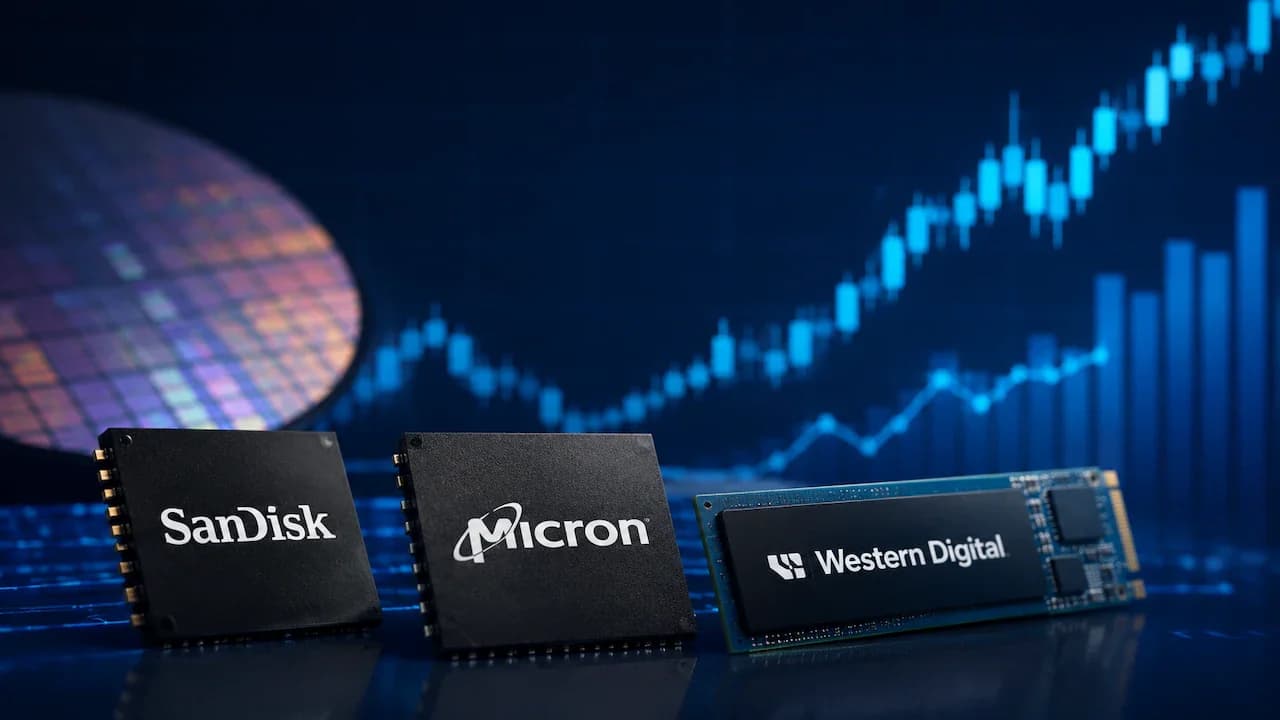
Memory stocks have demonstrated resilience by outperforming major hyperscalers as tech investors show signs of 'AI fatigue' and rotate into cheaper value names. According to Jefferies, the brokerage believes the AI capex race is far from over, but investors are moving away from AI-linked semiconductor stocks due to apparent fatigue with the AI trade. The KOSPI index has fallen 22% from its June 19 peak, which Jefferies classified as both 'natural and healthy', indicating a correction that reflects broader market dynamics. Memory makers including SanDisk, Micron, and SK Hynix have outperformed hyperscalers like Amazon, Meta Platforms, Alphabet, and others during this period, suggesting that investors are finding value in the memory sector's fundamental strength.
Memory stocks experienced significant selling pressure on Friday as SK Hynix made its highly anticipated U.S. market debut, with major players posting sharp declines. SanDisk plunged nearly 5% to $1,773.51, Micron traded 2.3% lower at $967.76, Western Digital Corp. slid 1.9% to $564.98, and Microchip Technology Inc. fell nearly 2% to $87.01. The decline came as investors reassessed the memory sector's valuations following SK Hynix's market debut, which has been positioned as a key catalyst for the AI and memory boom. Intel Corp. slumped 4% to a low of $108.17, while Qualcomm Inc. and Broadcom Inc. were down over 1% to $187.95 and $387.93, respectively. The selling pressure reflects broader concerns about memory sector valuations despite the ongoing AI infrastructure boom.
SK Hynix's $24.5-28 billion U.S. listing has been more than seven times oversubscribed, marking one of the most successful semiconductor IPOs in recent memory. The South Korean memory chip giant raised a record $26.5 billion through share sales, making it the largest ADR (American Depositary Receipts) listing ever. The South Korean memory chip giant is raising approximately $24.5 billion through the sale of 177.9 million American depositary receipts, with the offering scheduled for July 10. According to Bloomberg, the deal has attracted global long-only funds, sovereign wealth funds and specialist technology investors, with firms including Baillie Gifford, Coatue Management and Situational Awareness Partners indicating interest in buying up to $7 billion worth of shares. The proceeds will fund new manufacturing capacity and advanced chipmaking equipment to meet booming AI demand, positioning SK Hynix to capitalize on the artificial intelligence infrastructure boom.
Micron Technology announced on Thursday that it is accelerating its planned U.S. fab and technology investments, plus increasing its expected spending forecast to more than $250 billion through 2035, which is driven by surging AI-related demand for memory. As reported by Investing.com India, Micron Technology anticipates that its increase in U.S. investments will support its long-term goal of producing 40% of its DRAM in the U.S. while creating additional good-paying direct and indirect jobs. President Trump has previously praised Micron Technology for expanding its production in the U.S., with the company's accelerated timeline helping to boost the broader memory sector alongside SK Hynix's successful IPO.
Memory stocks have declined in recent days, raising concerns among investors that the AI trade may be losing steam and that a broader downturn could be underway. As reported by Reuters, analysts said investor expectations for the semiconductor sector remain largely intact as the earnings season is still in its early stages. Investor sentiment also received a boost from optimism surrounding SK Hynix's planned U.S. listing, with the recovery coming after memory chip supply is expected to stay tight through the third quarter, supporting earnings and encouraging bargain buying after Tuesday's sharp correction. However, the market is already asking uncomfortable questions about whether memory makers can finally break the old boom-bust curse, or are they merely standing at the sunniest point of another cycle. Samsung's 8% drop despite a preliminary earnings beat was another warning flare, with investors demanding proof that tomorrow's earnings will not vanish when supply catches up.