India's rapidly expanding solar sector is creating a substantial recycling opportunity that could be worth ₹3,700 crore by 2047. According to the Council on Energy, Environment and Water (CEEW), India could generate over 11 million tons of solar waste by 2047, with the potential to meet up to 38% of future material needs through recycling. The near-term scale is already materializing, as CEEW estimates that cumulative waste from India's existing and new solar capacity deployed between FY24 and FY30 could reach 600 kilotonnes by 2030. Of this, waste from existing installed solar capacity alone is estimated at 340 kilotonnes, while another 260 kilotonnes could come from capacity added during this decade. If recovered materials are successfully reused, the solar sector could avoid about 37 million tons of carbon emissions.
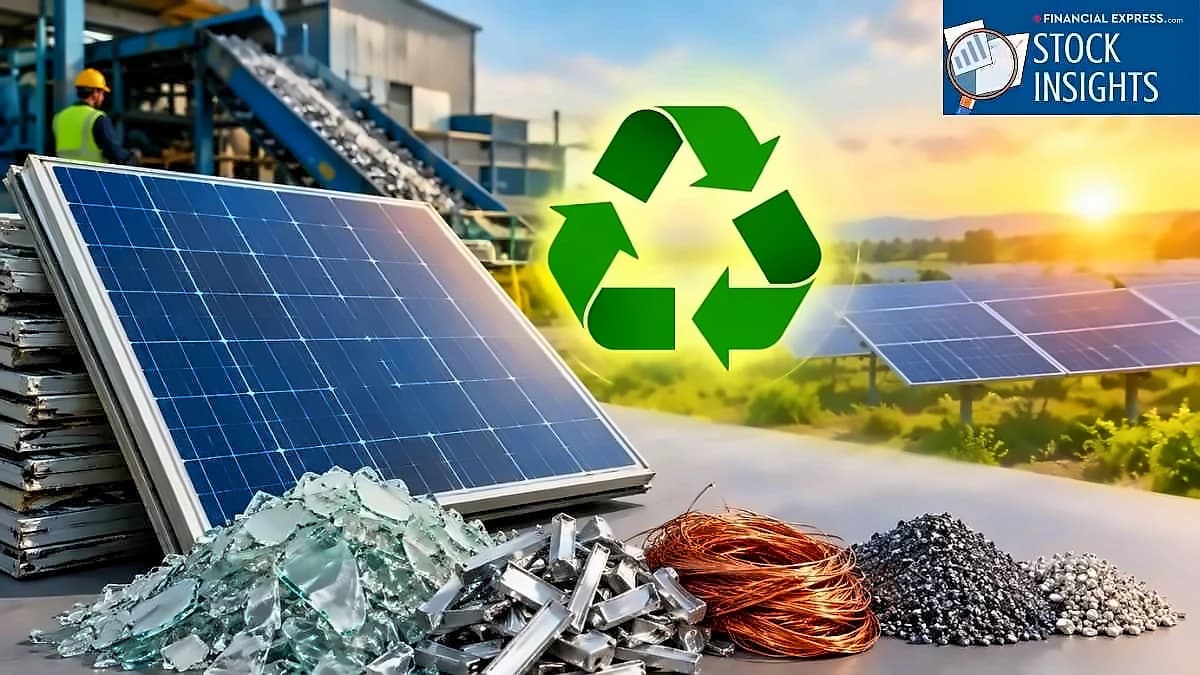
The solar recycling opportunity spans three distinct layers with different economics and maturity levels. Direct solar-panel recycling involves collecting and processing end-of-life photovoltaic modules, while indirect solar exposure focuses on recovering materials such as copper and aluminium used across solar infrastructure. Adjacent energy-storage recycling targets lithium-ion batteries used in solar-plus-storage systems. A typical crystalline-silicon solar module contains about 8% aluminium and 1% copper by weight, making both metals important recovery streams. The Energy and Resources Institute (TERI) estimates India's photovoltaic waste could rise from around 6 lakh tonnes in 2030 to 1.9 crore tonnes by 2050 under a high solar-growth scenario. CEEW's analysis shows how economics could change if modules are available to recyclers at zero cost, with mechanical and chemical recycling potentially generating positive financial benefits, while EPR certificate trading could further improve returns.
Jain Resource Recycling Limited (JRRL) is positioning itself for solar recycling through its subsidiary Jain Green Technologies Private Limited, which is developing a ₹95 crore copper manufacturing facility at SIPCOT Industrial Estate, Gummidipoondi, with a planned capacity of 9,000 tonnes per annum. The facility will use electrolytic refining to produce high-purity copper cathodes, with potential downstream expansion into wire rods and busbars. The plant is also planned to have an in-house rooftop solar power facility, enabling renewable electricity to support the manufacturing process and the production of green copper cathodes. JRRL has separately disclosed the procurement of 2.6 MW of solar power. The company reported consolidated Q1 FY27 revenue from operations of ₹2,724.5 crore, up 75.9% YoY, with PAT rising 22.8% YoY to ₹69.4 crore. Copper & Copper Ingots generated ₹1,837.3 crore, accounting for roughly 67% of consolidated revenue. The company identifies solar-panel recycling as a potential new recycling vertical alongside e-waste processing, automotive tyre recycling, and international scrapyard acquisitions.
Gravita India Limited has established a comprehensive recycling platform spanning lead, aluminium, plastics, waste tyres, and since January 2026, lithium-ion batteries. The company reported consolidated Q1 FY27 revenue of ₹1,475.06 crore, up 41.8% YoY, with PAT increasing 14.3% YoY to ₹106.37 crore. Its entry into lithium-ion battery recycling through a ₹14 crore investment in Mundra provides exposure to energy-storage systems, including solar storage. By FY25, Gravita had 1,805 kW of solar power capacity at its Indian manufacturing facilities, which generated 1.96 million units of solar electricity during FY25 and helped avoid 1,390 tonnes of CO₂ emissions. In August 2026, Gravita announced plans to establish a copper recycling plant in Mundra, Gujarat, and in May 2026, another in Mandvi, Gujarat. The company has also entered into definitive agreements concerning Rashtriya Metal Industries Limited, further expanding its non-ferrous-metal platform.
India's solar recycling framework is transitioning from voluntary activities to regulated waste management. The E-Waste (Management) Rules, 2022 cover solar photovoltaic modules, requiring producers to register on the CPCB portal and maintain inventory. The Battery Waste Management Rules, 2022 establish EPR obligations for lithium-ion batteries, with recycled-content requirements beginning from FY2026-27. The Ministry of New and Renewable Energy (MNRE) has identified solar PV recycling as a priority under its RE-RTD Programme, supporting research projects for material recovery. However, CEEW notes that current EPR targets under the E-Waste Rules are not applicable to solar-module recycling, requiring dedicated collection and recycling targets for the solar sector. The eventual profitability of solar recycling will depend heavily on who bears collection costs, how waste is priced, the value of recovered materials, and whether policy creates an additional revenue stream through EPR mechanisms.