Global AI-focused funds are experiencing significant volatility despite strong underlying growth momentum. Asia's major multi-strategy funds suffered sharp July losses as an AI-linked stock selloff across Japan, South Korea and China erased much of their 2026 gains. According to Reuters, concerns over AI spending and Middle East tensions hit semiconductor stocks, with some funds losing 3%-9%, while Goldman Sachs estimated a record 15.2% monthly decline for Asia's primary stock-picking hedge funds. However, recent developments suggest a potential recovery as second quarter earnings results revealed year-over-year cloud revenue growth at 48% for the top three cloud providers, with remaining obligations and backlogs near $1.7 trillion indicating sustained demand. The hyperscalers have obliged with nearly $791 billion of capital expenditures in 2026 alone, with annual spending expected to exceed $1 trillion next year and beyond - four times the level seen before the AI boom. This shift in investor sentiment reflects growing confidence in AI's commercial viability and multi-year growth prospects.
Fund managers are positioning India's manufacturing sector for significant growth as artificial intelligence adoption expands across electronics, automobiles, pharmaceuticals, industrial manufacturing, logistics and warehousing. According to reports from NDTV Profit, companies are deploying AI technology for predictive maintenance, computer-vision-based quality checks, robotics, digital twins, supply-chain optimization and manufacturing operations. As reported by NDTV Profit, Mihir Vora, chief investment officer at Trust Mutual Fund, stated that "Power, infrastructure and China+1 manufacturing are now a larger bet, with the increasing AI-adoption at factories." The investment case extends beyond companies adding manufacturing capacity to businesses supplying power, infrastructure, industrial equipment and technology to expanding operations. As fund managers note, "They are not just cyclical opportunities, they are structural, long-term themes," with the combination of rising capital expenditure, China+1 supply-chain diversification and increasing AI adoption in factories broadening the investment opportunity significantly.
Several large manufacturers have already implemented AI across their operations, demonstrating the technology's practical applications. As reported by NDTV Profit, Tata Steel uses AI-based predictive maintenance across more than 10,000 sensor points to reduce unplanned downtime, while Tata Motors employs computer vision to detect small defects on assembly lines and AI-directed robotics for material handling. Hindustan Unilever has converted five manufacturing plants in India into World Economic Forum Lighthouse sites, and Reliance Industries uses machine-learning models to analyze temperature and crude quality in real time to optimize refining yields. Asian Paints uses AI-based demand forecasting at the postal-code level to manage distribution costs and inventory. The International Federation of Robotics ranks India seventh globally for annual industrial robot installations, with the domestic industrial robotics market estimated to reach about $264 million by 2028. A study by the Ministry of Electronics and Information Technology, the Ministry of Micro, Small and Medium Enterprises and the National Institute for Smart Government evaluated more than 350 MSME manufacturing units across textile, pharmaceutical and electronics clusters, focusing on modernizing older operations to improve unit economics and global export compliance.
India's capital expenditure cycle is experiencing a dramatic transformation with infrastructure capital expenditure projected to rise to ₹90-100 lakh crore between FY26 and FY30, representing approximately 60% higher than the ₹59 lakh crore spent between FY21 and FY25. According to Crisil Intelligence reports cited by NDTV Profit, roads, renewable power and urban development are driving this expansion. The Ministry of Finance's public-private partnership pipeline comprises 852 projects worth roughly ₹17 lakh crore, providing private investors with multi-year visibility. Public capital expenditure has been raised to ₹12.2 lakh crore for FY27 from ₹11.2 lakh crore in the previous year, compared with around ₹2 lakh crore in FY15. As fund managers explain, "Today, the backdrop is very different. Government spending remains strong, private sector balance sheets are healthier, bank lending capacity has improved, and corporate capex intentions are gradually picking up." The investment cycle follows almost a decade of subdued capital expenditure after 2011, with conditions now supporting sustained growth.
The manufacturing technology expansion coincides with global supply chain diversification, creating significant opportunities across multiple sectors. According to NDTV Profit, the China+1 opportunity spans engineering, textiles, chemicals, electronics, machinery, electrical equipment, pharmaceuticals and auto components. Recent trade developments also strengthen this opportunity, with agreements with major trading partners improving market access, enhancing export competitiveness and accelerating India's integration into global supply chains. However, as reported by NDTV Profit, the opportunity depends on more than automation or manufacturing capacity, requiring factories capable of meeting global requirements on productivity, quality, reliability and traceability. "India's rise in global manufacturing rankings has been supported by supply-chain diversification," said Vaibhav Koul, managing director at Protiviti Member Firm for India. "The opportunity for India lies in combining its strengths in engineering talent, digital infrastructure, AI capabilities, and manufacturing incentives to build globally competitive smart factories," he added. The IndiaAI Mission, with a budget of ₹10,372 crore, supports this technological transformation alongside government programs including Make in India and production-linked incentive schemes.
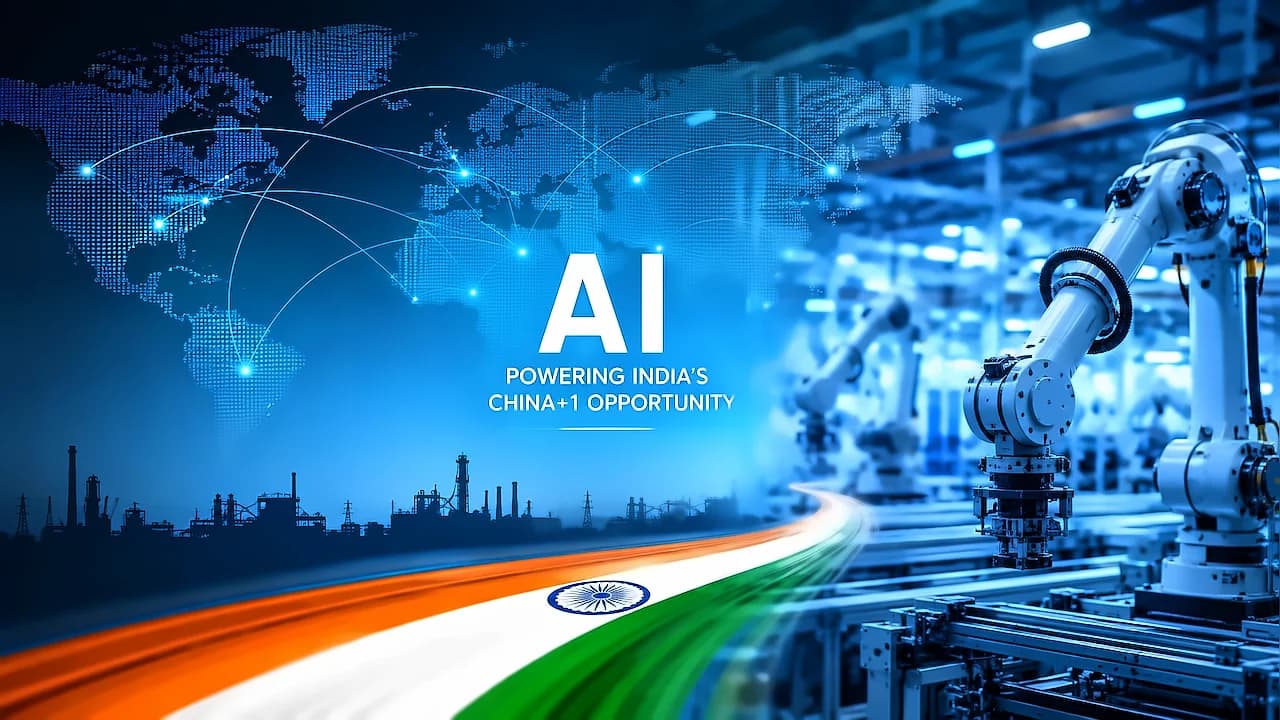
India's AI adoption is showing significant progress across manufacturing sectors, with Nasscom's AI Adoption Index 2.0 covering 500 companies across seven sectors, putting India's AI maturity score at 2.47 on a four-point scale in 2024. According to NDTV Profit, this represents an improvement from 2.45 two years earlier, with the number of companies at advanced adoption stage doubling during the period. Industrials and automobiles are among four sectors expected to account for roughly 60% of AI's net new economic value addition in India. The domestic industrial robotics market is estimated to reach about $264 million by 2028, while industrial sensors account for around 40% of smart-factory investment. A study by multiple government ministries evaluated more than 350 MSME manufacturing units, focusing on modernizing older operations to improve unit economics and global export compliance. Industrial AI across MSMEs could also support manufacturing's contribution towards India's $35 trillion economic goal by 2047. Power demand is also rising as manufacturing expands and digitisation increases electricity requirements, with electricity consumption from data centres projected to grow about 15% annually through 2030.