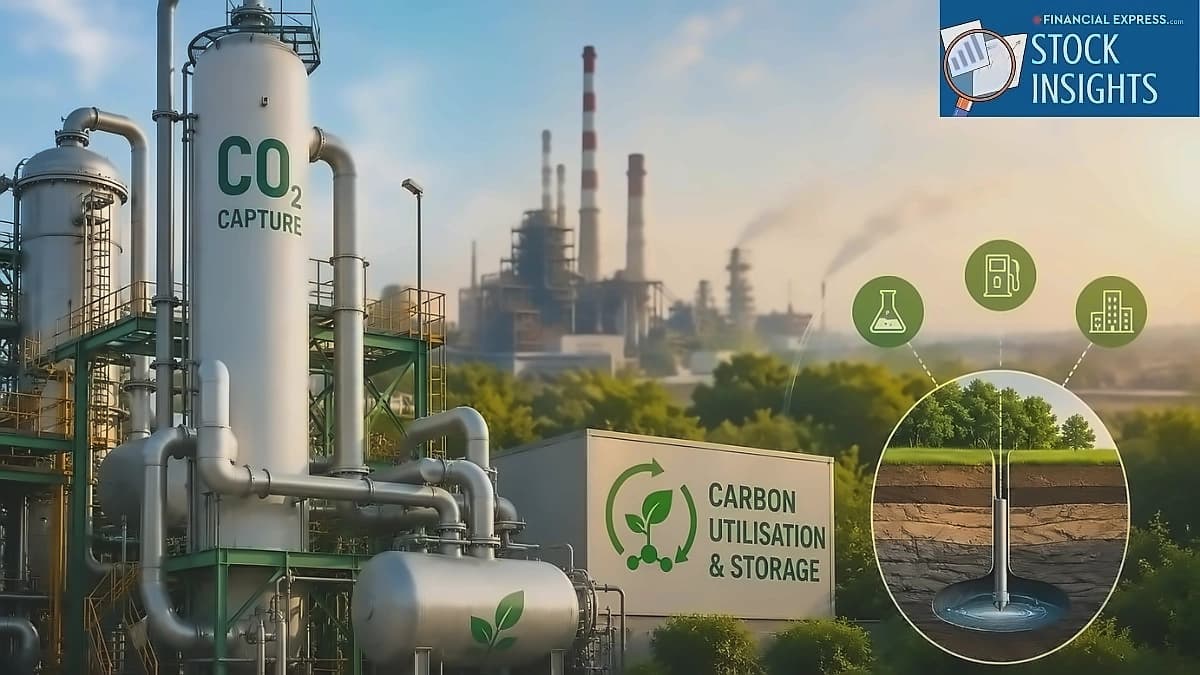
India has announced a ₹20,000 crore outlay over five years to accelerate Carbon Capture, Utilisation and Storage (CCUS) deployment as part of its net-zero 2070 target. According to reports from The Financial Express, India is the world's third-largest carbon dioxide emitter after China and the United States, with energy-related emissions approaching 3 billion tonnes annually. The programme is expected to support both pilot and commercial-scale carbon capture projects across key industries, with a large share of emissions coming from polluting sectors such as power, steel, cement and refineries. The technology captures carbon dioxide before it enters the atmosphere, either storing it permanently underground or converting it into products such as chemicals, fuels and building materials.
Thermax has positioned carbon capture as a critical component of its energy transition portfolio, focusing on indigenous technology development. As reported by The Financial Express, the company has initiated a new technology development and demonstration project focused on CCUS, officially sanctioned by the Department of Science and Technology. The company has built strong academic partnerships through an MoU with the Indian Institute of Technology Delhi (IITD) and another with Hindustan Petroleum Corporation Limited (HPCL). Thermax's CCU initiative aims to develop indigenous technology capable of converting captured CO₂ into value-added products like methanol and dimethyl ether, with the company's total order book standing at ₹13,604 crore as of March 2026. The company's revenue grew by 3.1% year-on-year to ₹10,694 crore with operating profit increasing to ₹1,293.3 crore and margins improving to 12%.
JSW Steel operates a 100 Tonnes Per Day (TPD) CCU facility at its Salav Works, capturing CO₂ and refining it into commercial-grade products for the food and beverage industry. According to The Financial Express, the company has signed a joint study agreement with Carbon Clean for deploying CycloneCC modular technology at the Vijayanagar Integrated Steel Plant, which has the potential to reduce 1.0 lakh tonnes of CO₂ annually. This will be the largest-ever use of this unique technology in the global steelmaking industry. JSW Steel grew by 10% to ₹1,85,470 crore driven by its highest-ever production and sales volumes, with total sales volume increasing by 12% to 29.63 million tonnes. The company aims to achieve its long-term goal of becoming net-neutral in carbon emissions by 2050 and has signed an MoU with IIT Kharagpur to conduct pilot-scale studies for developing low-cost CCUS technologies.
CMR Green Technologies holds a substantial 2.7 lakh tonnes of carbon credits as of April 2026, with an additional 70,000-80,000 tons accumulating annually. As reported by The Financial Express, the company ranks 6th globally in the S&P Global Corporate Sustainability Index for aluminum and holds a 42-45% market share in the cast alloy segment for Indian automotive industry. CMR reported strong FY26 performance with revenue growing 30% to ₹8,640 crore and net profit surging 47.3% to ₹228 crore. The company is the largest domestic recycled aluminium company in India with an annual installed capacity of 6.15 lakh MT per annum, about 4X larger than its nearest domestic competitor. CMR's involvement with carbon credits began in 2015 when its Bhiwadi facility was officially accredited by the United Nations Framework Convention on Climate Change, with management expecting to monetize this entire stockpile as environmental regulations tighten globally.
The three companies are positioned across different segments of the carbon value chain - Thermax in technology development, JSW Steel in industrial deployment, and CMR Green in carbon credit creation. According to The Financial Express, all three companies trade at premiums to industry median multiples, with Thermax showing the highest ROCE at 13.9% and CMR Green maintaining strong ROE at 15.0%. Thermax's revenue is weighted toward green hydrogen and biofuels alongside CCU, while JSW Steel trades at a discount relative to its historical median valuation. The government's ₹20,000 crore CCUS strategy is expected to create opportunities across the entire carbon value chain as India scales up carbon capture and develops its carbon market, with these companies positioned to benefit from the growing focus on carbon management and decarbonisation initiatives.