Wipro's artificial intelligence initiatives have delivered significant productivity gains, with AI initiatives boosting productivity equivalent to 20,000 employee outputs, according to Chief Technology Officer Sandhya Arun. The company is shifting towards a 'human-AI operating model' as more than 100,000 employees receive advanced AI-related training and certifications. As reported by Business Standard, Arun explained that workers are being redeployed within the company rather than facing layoffs, with engineers managing multiple AI agents across different projects. The transformation comes as India's $315 billion software services industry grapples with AI adoption reshaping hiring, software development, and client contracts. Wipro, with about 243,000 employees in June, is implementing this comprehensive AI strategy with the same engineer managing a bunch of agents, deployed on other projects or being trained for some other role.
JPMorgan has retained its 'Underweight' rating on Wipro with a significantly lower price target of ₹155 per share, implying a 10.43% downside from the stock's closing price of ₹173.06 on Monday. This represents a further decline from Goldman Sachs' existing 'Sell' rating with ₹172 target, highlighting mounting pressure on the IT services company. The stock has already tumbled over 35% year-to-date in 2026, settling 1.89% lower on Monday. Among the 44 analysts covering Wipro, only eight have 'Buy' ratings, 16 have 'Hold' ratings, and 20 have 'Sell' calls on the stock.
The AI transformation extends across India's major IT companies, with TCS planning to build a team of up to 8,900 forward-deployed engineers while Infosys targets about 6,000 over the next few years. According to Business Standard, these engineers work directly with clients to accelerate AI adoption. Wipro is also expanding its forward-deployed engineering workforce to align with industry peers, though specific targets remain undisclosed. Arun cautioned against focusing too heavily on forward-deployed engineers, emphasizing that the broader challenge is ensuring engineers across the organisation develop the skills needed to work effectively with AI systems. As reported by Business Standard, Wipro's forward-deployed workforce would likely be in line with peers, indicating the company's commitment to matching industry standards.
AI-led deflation on contract renewals has been playing out for four to six quarters and Wipro expects this trend to continue for another four to six quarters as it works through the company's broader portfolio. According to JPMorgan, enterprises are moving from experimenting with artificial intelligence to focusing on returns on investment, with companies expecting 25%-35% productivity gains from AI adoption. Wipro said this step-up in productivity benefits differentiates AI from previous technology shifts. While the overall demand environment remains strong, vendor churn and productivity pass-throughs have weighed on Wipro's net performance, with a significant portion of the company's portfolio already going through vendor churn.
Arun emphasized a fundamental shift in how companies should measure AI impact, stating that the shift has to be from productivity to outcomes. According to Business Standard, she argued that AI should be evaluated on whether it improves customer experience, creates new revenue opportunities and helps deliver business goals. Wipro currently remains the only company among India's top four IT firms that does not disclose its AI revenue, according to Manoj Chandra Jha, principal analyst at Nord-IQ Research. The company is in the earlier, cost-absorbing phase of AI monetisation compared to peers, with the real test being whether AI deals eventually translate into revenue growth and margin recovery.
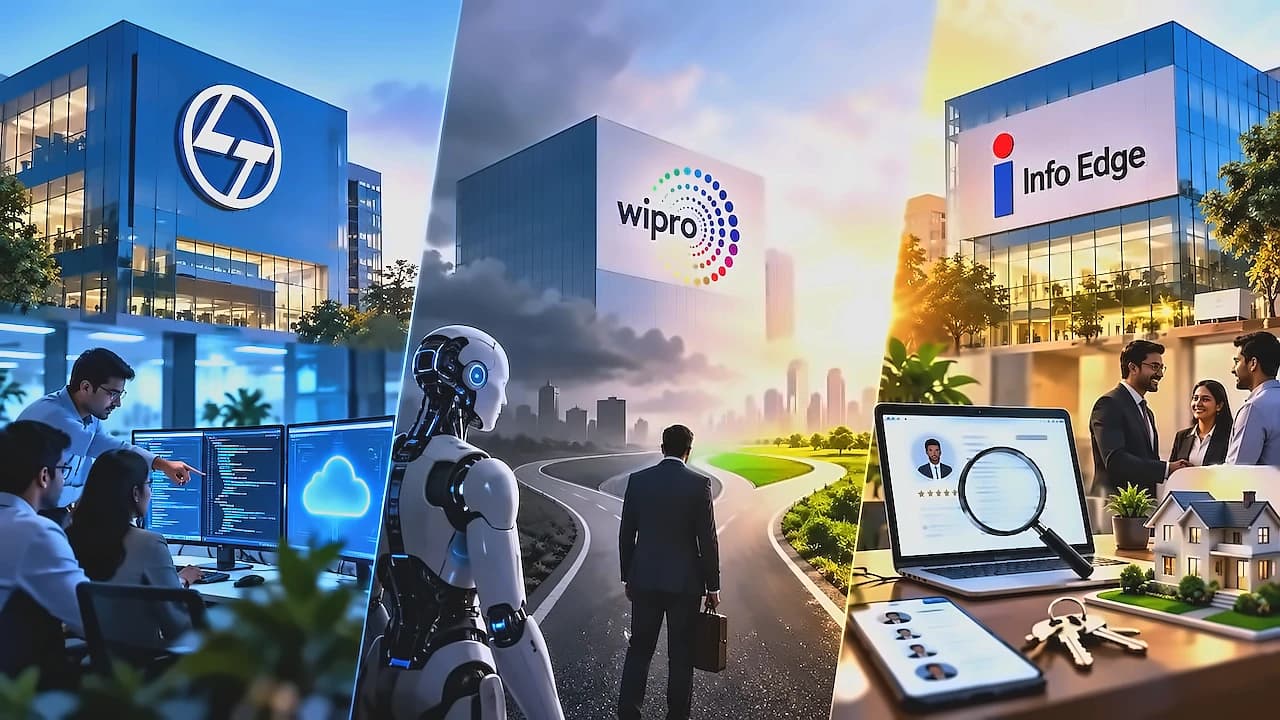
Goldman Sachs has identified three distinct paths for Indian IT companies as artificial intelligence reshapes technology spending patterns. According to reports from Goldman Sachs, LTM expects growth to hold steady with margin improvements, while Wipro continues facing subdued near-term growth and AI-related pressure. Info Edge, meanwhile, is benefiting from premium hiring, new products, and a strengthening real estate classifieds business. The near-term picture for LTM is more about steady growth and margin recovery than major acceleration, with management acknowledging some pockets of industry demand pressure from AI while also highlighting several areas where growth opportunities remain.
Goldman Sachs maintains a 'Buy' rating on Info Edge with a target price of ₹1,410, highlighting multiple growth engines across its portfolio. The recruitment business continues to benefit from premium hiring growing 25-30% year-on-year, with AI-powered recruitment product AI-Rex gaining traction among nearly 400 paid clients. The business remains diversified across IT, technology, BPO, GCCs and non-IT segments. Info Edge's JobHai platform, launched in May 2026, is targeting a doubling of revenue in FY27 compared with FY26, while the real estate classifieds business continues to lead the market in traffic and supply with management expecting 20-25% sustainable annual billings growth.