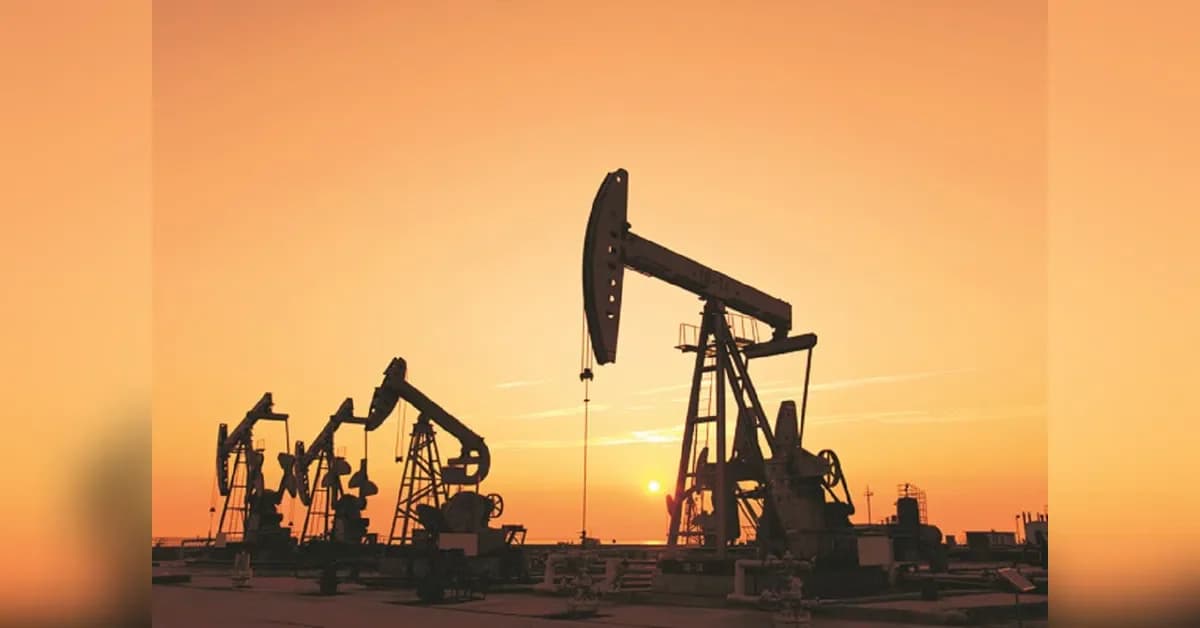
Oil prices extended their decline on Friday, heading for a steep 9% weekly loss as shipping through the Strait of Hormuz gradually returns to normal following the US-Iran peace agreement. Brent crude futures fell 43 cents, or 0.54% to $79.42 a barrel as of 0328 GMT, while US West Texas Intermediate crude slipped 17 cents, or 0.22% to $76.43 a barrel, according to The Hindu. The latest decline has erased nearly all of the gains sparked by the conflict that began in February, when the US and Israel launched attacks on Iran over its nuclear programme. The US Central Command said it had lifted restrictions on traffic to and from Iranian ports and coastal areas, while the Joint Maritime Information Center advised vessels transiting the strait to follow a route closer to Oman's coastline to reduce the risk from mines. Both benchmarks touched their lowest since early March on Thursday as several tankers, including three Saudi-flagged vessels with 6 million barrels of crude onboard, sailed through the strait hours after US President Donald Trump signed a deal with Iran to end their war. As per The Hindu, the front-month July contract was down 30 cents at $75.55 a barrel with the contract expiring on Monday, June 22.
The Middle East crude market has weakened sharply this week, slipping into discounts after the United States and Iran agreed a framework deal to reopen the crucial Strait of Hormuz, brightening the global supply outlook. According to Reuters data, benchmark Dubai's premium to swaps slipped into a discount of 46 cents on Tuesday, the first contango structure since January, after hitting pre-war levels of $2.06 per barrel on Monday. Spot Oman and Murban differentials flipped into discounts of 67 and 49 cents, respectively on Tuesday. The decline reflects market expectations that the interim peace deal, expected to be signed on Friday, will allow Iran to resume oil exports and restore maritime traffic through the Strait of Hormuz. Analysts expect the deal to release more than 85 million barrels of oil stranded in West Asia into global markets, with the agreement also including the lifting of US sanctions on Iranian oil, which would add more supply. Tankers carrying previously stranded cargoes started moving through the waterway on Thursday, while Kuwait said it would begin increasing production, as reported by The Economic Times.
Goldman Sachs has significantly lowered its oil price forecasts following the breakthrough US-Iran agreement that raised expectations for the Strait of Hormuz reopening. According to Goldman Sachs Chief India Economist Santanu Sengupta, the brokerage now expects Brent crude to average $80 per barrel in Q4 2026, down from its earlier forecast of $90, while 2027 Brent forecast has been cut to $75 per barrel from $80. As per Goldman Sachs, the price effect is already better than what they had anticipated when they still had oil assumptions at around $90 a barrel. The revision follows President Donald Trump's announcement of an interim agreement aimed at lifting the US blockade and restoring shipping through the Strait of Hormuz.
The collapse in Middle East crude prices has reopened arbitrage opportunities to destinations beyond Asia. About four to five Very Large Crude Carriers carrying Abu Dhabi's Murban and Das crude were heading to Europe, according to one trader, who added that the cargoes belong to Exxon Mobil. Another trader estimated 13 million to 15 million barrels of Middle East crude, including Upper Zakum, Murban, Oman and Iraqi Basrah Medium, are being shipped to the U.S. and Europe by oil majors Exxon and TotalEnergies. Murban has become cheaper than U.S. West Texas Intermediate crude (WTI) for European buyers as demand in Asia is weak, with the arbitrage for U.S. WTI to Asia also closing since early June. The shipments became economical for Europe after weak Asian demand and falling Middle East crude premiums narrowed the price gap with competing Atlantic Basin supplies.
Despite the recent decline in oil prices, a complete reopening of Hormuz is expected to be a complex process that will require careful coordination of vessel movements, the restart of oil wells, repairs to infrastructure and agreement on de-mining operations. Vice President JD Vance sought to ease concerns that Iran could eventually charge tolls for vessels using the strait, while noting that the 60-day timeline for resolving key issues under the memorandum of understanding had formally begun. Analysts warn that shipping operations through the Strait of Hormuz could take several months to return to normal levels, with some shipowners remaining wary of operating conditions in the strait and the wider Persian Gulf. Global oil inventories were depleted during the extended disruption and will take time to rebuild, with stockpiles potentially continuing to fall before fresh Gulf supplies begin reaching international markets. Saudi Aramco Chief Executive Officer Amin Nasser cautioned that disruptions could delay a return to stability in global oil markets until 2027, with prolonged interruptions potentially affecting nearly 100 million barrels of oil supply each week. Prior to the war, roughly one-fifth of the world's oil and liquefied natural gas transited through the strait, and analysts have suggested trade could return to normal in the coming months if the US-Iran deal holds. However, Israel has continued its war against Hezbollah in Lebanon, raising questions about whether the US-Iran peace agreement will hold, as noted by The Hindu. U.S. Vice-President J.D. Vance pulled out of a planned trip to meet Iranian negotiators in Switzerland on Friday (June 19), adding to market concerns about the deal's sustainability.