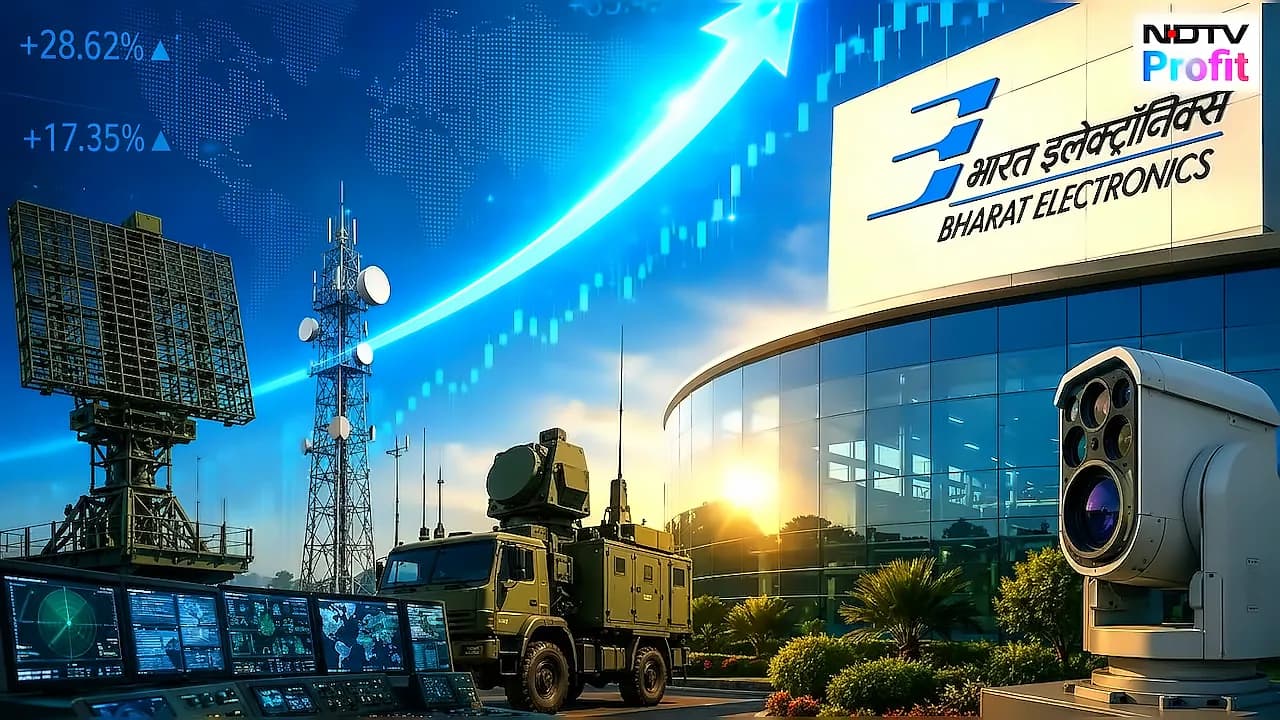
Shares of Bharat Electronics Ltd. (BEL) closed 4.56% higher at ₹397.10 on Wednesday, November 4, delivering a 9.17% return in one week and 6.86% return in two weeks. The stock has demonstrated exceptional long-term performance, delivering a 490.75% return over five years and 192.20% returns in three years. The defence PSU stock touched its 52-week high of ₹473.25 per share on March 6, 2025, while hitting a 52-week low of ₹354.55 on October 23, 2026, before the recent rally. According to Motilal Oswal Financial Services, the firm has reiterated its 'Buy' rating and revised its target price to ₹540 from the earlier target of ₹530, citing strong Q2 results that beat revenue, EBITDA and PAT estimates. The upgrade comes after BEL reported a 19.6% annual increase in net profit for Q2 FY27, with the stock currently trading at PE of 40x/34x/30x on FY27E/FY28E/FY29E. ICICI Securities has now joined the bullish sentiment, upgrading BEL to BUY from Add with a target price of ₹446, based on 40x FY28E EPS. Nomura has also raised its target price to ₹520 from ₹500, maintaining its 'Buy' rating and citing the company's strong order pipeline across multiple defence segments.

As reported by Motilal Oswal Financial Services, BEL posted a strong set of results in Q2, beating revenue, EBITDA and PAT estimates. The company reported a 26% year-on-year increase in revenue and management reiterated strong FY27 guidance, with the stock currently trading at PE of 40x/34x/30x on FY27E/FY28E/FY29E. The company's order book stood at ₹687 billion at the end of Q2FY27, with order inflow of ₹38 billion during the second quarter. According to MOFSL, BEL's base order inflows fell 31% Y-o-Y as ordering is yet to ramp up meaningfully from the Ministry of Defence, with a large order such as QRSAM, worth ₹300 billion, delayed and the company hoping to receive it at the next CCS meeting. The company is also hopeful of a large order worth ₹200 billion from next-generation corvettes. ICICI Securities notes that OB additions of ₹550bn largely depend upon QRSAM orders (₹300bn) – likely to arrive by Dec'26, with the company expected to marginally surpass its guidance given a sizeable TAM. Nomura highlights that BEL received order inflows of ₹75 billion in 1HFY27, while management retained its guidance of securing at least ₹550 billion in orders during FY27.
According to Motilal Oswal Financial Services, BEL expects revenue/EBITDA/PAT CAGR of 15%/14%/15% over FY26-29. The company is witnessing increasing traction in drones and counter-drone systems, with larger orders expected over the next 1-2 years. The ~₹200 billion NGC opportunity is expected to translate into staggered orders from GSL and GRSE, largely by FY27-end. Key order prospects including Shatrughat, Samaghat and HAMMER, along with P-75I (potentially deferred to FY28) provide additional order pipeline visibility. Missile electronics, seekers, electronic warfare and cybersecurity remain key medium-to-long-term growth areas, with management expecting to meet its FY27 guidance supported by improving delivery performance and supply-chain readiness. Nomura highlights a sizeable opportunity pipeline for the second half of FY27, including weapons, sensors and navigation systems for next-generation corvettes, with the estimated opportunity revised upwards to around ₹200 billion from ₹80-100 billion earlier. Other opportunities include Shatrughat-Samaghat electronic warfare platforms worth ₹90 billion, HAMMER precision-guided munitions worth ₹25 billion and Shakti phase IV worth ₹20 billion. The brokerage believes BEL is entering a phase of substantial contract acquisitions, with order momentum expected to remain strong beyond FY27, supported by annual base order inflows of ₹160-200 billion from maintenance contract renewals and recurring subsystem orders.
Multiple brokerages have maintained bullish stances on BEL following the strong results, with Motilal Oswal Financial Services holding the most optimistic target at ₹540. Nomura holds the most bullish target at ₹520, flagging large order wins across multiple verticals and BEL being on track to meet its FY27 order intake target of at least ₹55,000 crore. Citi and UBS have buy targets of ₹515 and ₹500 respectively, pointing to a potential ₹30,000 crore QRSAM order and an over ₹20,000 crore Next Generation Corvette electronics opportunity as near-term catalysts. Jefferies with a target of ₹490 expects the QRSAM award by March 2027 and sees missiles and drones as long-term growth levers. Kotak maintains a more conservative add rating with a target of ₹420. At current levels, the stock trades at 40x/34x/30x P/E on FY27E/FY28E/FY29E, with brokerages projecting upside ranging from 7% to 35% from the current price. The sell side of the order book remains dominant at 63%, suggesting some caution in the near term. Nomura expects BEL's order book to nearly double over FY26-29 to ₹1.36 trillion and models an EPS CAGR of around 17% over the period, with the stock trading at 33 times and 29 times its FY28 and FY29 estimated earnings respectively.
According to Motilal Oswal Financial Services, BEL's Q2 FY27 results showed revenue from operations of ₹73 billion, against ₹57.64 billion a year ago. For the first half of FY27, revenue grew 25.97% to ₹12,824 crore. Profit after tax for H1 FY27 rose 14.81% to ₹2,589 crore, while the company's order book stood at ₹687.2 billion providing healthy execution visibility. The stock had hit a 52-week low of ₹354.55 on October 23 but has since rebounded sharply, demonstrating strong investor confidence in the company's recovery trajectory. With Wednesday's gains, BEL shares have advanced nearly 7% over the past three trading sessions, significantly outperforming the Nifty 50's 0.38% return during the same period. Nomura reports that BEL reported a second-quarter FY27 profit after tax of ₹15.4 billion, beating Nomura's estimate by 11% and consensus estimates by 15%. Management retained its FY27 revenue growth guidance of 15% or higher and EBITDA margin guidance of 28% or higher, against Nomura's estimates of 17.4% and 28.6% respectively. Management said its focus on indigenisation was likely to make margins sustainable and provide a strong hedge against material cost escalations, adding it was not alarmed by the QRSAM order delay and execution could be faster than user expectations once the order was received.