Defence Minister Rajnath Singh announced that India's domestic defence production has nearly quadrupled over the last decade, reaching approximately ₹1.80 lakh crore in 2025. As reported by Business Standard, this represents a dramatic transformation from ₹46,000 crore in 2014 to the current levels. Singh emphasized that defence exports have surged from around ₹1,000 crore in 2014 to nearly ₹39,000 crore, demonstrating the country's progress towards complete self-reliance in the defence sector. The government has set an ambitious target of achieving defence exports worth ₹50,000 crore by 2028-29, with Singh noting that "India's defence sector has now taken firm steps towards complete self-reliance". The latest reforms announced by the government are expected to further accelerate this growth trajectory by reducing procedural barriers for defence exports.
The Department of Defence Production has announced significant reforms to simplify defence export procedures, including widening the scope of the Open General Export Licence (OGEL) to cover all countries except sensitive and restricted destinations. Under the revised Defence Export Standard Operating Procedure (SOP), stakeholder consultation will no longer be required for exports of non-lethal defence items to most destinations, enabling Indian companies to showcase their products and pursue international opportunities more expeditiously. The OGEL validity has been extended to three years from two years, reducing the frequency of renewals and related compliance requirements. The coverage of OGEL has been expanded from 41 countries to all countries, barring negative or sensitive nations and countries facing UN Security Council sanctions or arms embargoes. These reforms are expected to particularly benefit Indian defence manufacturers and MSMEs by helping them respond faster to international tenders and exhibitions, access a wider range of global markets and reduce repetitive authorisation requirements.
The ₹300 billion QRSAM deal represents a major opportunity for defence manufacturers, with the proposal cleared by the Defence Acquisition Council in July 2025 and the Army issuing the tender in September 2025. The deal, which was expected to be signed by March 2026 but has been delayed, is now reportedly moving towards CCS approval in September 2026. Bharat Electronics Limited (BEL) stands out as the lead system integrator and prime contractor for QRSAM, with key roles in radars, electronics, and command-and-control systems. The company completed QRSAM-related projects during FY26, including a missile checkout facility and development initiatives. MTAR Tech has delivered exceptional performance with 194% returns in 2026, significantly outperforming other defence stocks, while Solar Industries India has shown strong financial performance with revenue growing at a 12.4% CAGR and net profit increasing by 28.9% over the past three years.
Bharat Dynamics Limited (BDL) has demonstrated stable revenue performance with net profit growth of 6.1% CAGR between FY23 and FY26. As reported by The Financial Express, revenue remained broadly stable at ₹2,489 crore in FY23 compared with ₹2,442 crore in FY26. The company specializes in manufacturing missiles, torpedoes, anti-tank guided missiles (ATGMs) and other weapon systems, with products including Akash, MRSAM, QRSAM, Astra, NAG and Amogha ATGMs, along with Varunastra and TAL torpedoes. Recent market performance shows defence heavyweights like BDL gaining up to 9% in a month, reflecting strong investor confidence in the sector.
Bharat Electronics Limited (BEL), established in 1954 as a Navratna defence PSU, has demonstrated strong financial performance with revenue growing at a 15.9% CAGR over the past three years. According to Equitymaster, the company's revenue increased from ₹177,344 crore in FY23 to ₹276,101 crore in FY26, while net profit grew at a 27% CAGR during the same period. The company's portfolio includes radars, communication systems, electronic warfare equipment, and command-and-control systems, with involvement in major defence programmes including QRSAM, LCA Mk II, AMCA, Project Kusha, and counter-drone systems. BEL's key role in QRSAM makes it a stock to watch given the deal's expected CCS approval in September 2026.
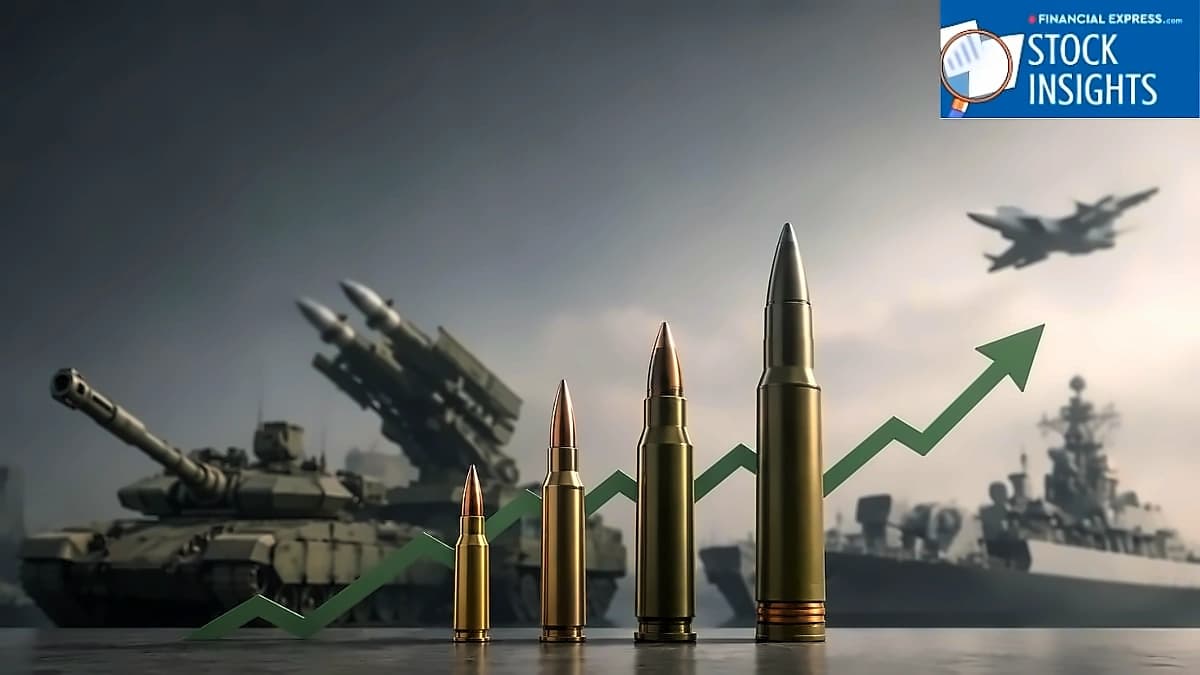
India is undergoing a "once-in-a-generation transformation" from being one of the world's biggest defence importers to a global defence manufacturing hub. According to Ashika Institutional Equities, India's defence exports have scaled at a ~40% CAGR over FY14–FY26 to reach ₹38,400 crore, with the government targeting ₹50,000 crore+ by FY29 (~9% CAGR). However, AIE projects a steeper trajectory, expecting defence exports to cross the ₹75,000 crore milestone by FY30 with a CAGR of ~18%. The international order pipeline remains robust, with Akash missile exports to Armenia at ₹6,000 crore and BrahMos systems to the Philippines at ₹3,200 crore, along with expanding pipelines across Vietnam and Indonesia. The Defence Ministry's recent launch of the sixth indigenisation list containing 405 items with an estimated business potential of ₹3,070 crore has provided additional momentum to the sector. The new reforms are expected to further accelerate this growth by reducing procedural barriers and enabling faster access to global markets.