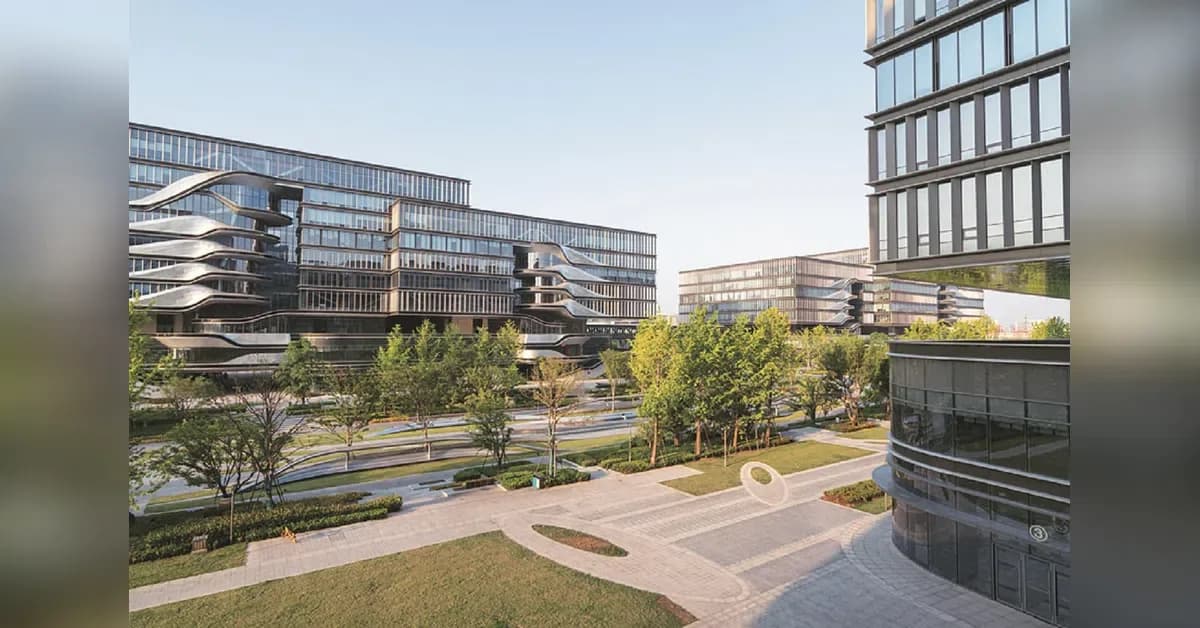
India's real estate sector witnessed record-breaking capital inflows totalling $9.5 billion in Q3 2026, as rising investor demand for data centres prompted foreign investors to make a strong comeback. According to the latest report by CBRE Group, equity capital inflows in real estate, data centre, and hospitality sectors stood at $9.5 billion in the July-September quarter, marking a more than two-fold jump from $4.4 billion in the year-ago period. Foreign investors accounted for around 59 per cent of total inflows during the quarter, with investors from the US alone contributing 90 per cent of foreign capital inflows, followed by investors from Canada, Singapore and Japan. The quarter also saw increased participation from institutional investors, which accounted for around 79 per cent of total inflows, up 28 per cent compared with the previous quarter. The surge also means that India's real estate sector has already attracted $18.6 billion during the first nine months of 2026, nearly twice the corresponding period of 2025.
The upswing in capital inflows is attributed to rising investor appetite for data centres and continued capital deployment into built-up office assets and land/development sites. As reported by CBRE Group, data centres alone accounted for 57 per cent of total equity capital inflows during Q3 2026, signaling a significant shift in investor focus. Data centres, built-up office assets and land/development sites together accounted for nearly 91% of Q3 2026 inflows, according to CBRE. Data centres in particular saw a multi-fold increase in investment compared with both the previous quarter and the year-ago period. The latest investment cycle is not being driven by a single property segment, with about 72% of total capital deployed in site/land acquisitions going towards office, residential, and data centre developments.
India's tourism landscape is experiencing a fundamental transformation as improved highway connectivity is reshaping travel itineraries across the country. The Delhi-Mumbai Expressway now links destinations such as Jaipur, Ranthambore, Sariska and Ahmedabad, creating broader tourism circuits instead of treating each destination as standalone trips. Similarly, the Samruddhi Mahamarg connects Shirdi, Nashik, Trimbakeshwar and the Ajanta and Ellora caves, while the Bundelkhand Expressway brings Khajuraho, Orchha, Chitrakoot and Jhansi into a connected circuit. Hotel occupancy across India's organised sector increased to 64.1% in 2025 from 42% in 2021, with Goa recording 75-80% occupancy and Jaipur achieving 62-67%. Bengaluru led RevPAR growth at 20-25% year-on-year, demonstrating the strength of India's tourism recovery. The report highlights that economy, upper-midscale and midscale hotels account for nearly 60% of India's branded room stock, indicating that tourism expansion is not limited to luxury segments.
Mumbai, followed by Delhi-NCR and Chennai, accounted for a cumulative share of about 53 per cent of investment inflows during the quarter. According to CBRE Group, multi-city transactions also contributed about 15% of total investments. The report added that about 72% of total capital deployed in site/land acquisitions went towards office, residential, and data centre developments, with the rest committed to mixed-use, hotel, retail, and industrial & logistics projects. India's real estate investment landscape continues to strengthen, with investors deploying capital across both established and emerging asset classes. "This is a landmark quarter for India's real estate capital markets," said Anshuman Magazine, Chairman and CEO, India, South-East Asia, Middle East and Africa at CBRE Group. "Global investors have returned with conviction, and institutional capital is now flowing well beyond offices and land into data centres. It reflects how deep and diverse India's real estate market has become, and we expect this confidence to carry through the rest of the year."
The domestic real estate share market has shown notable performance metrics, with the Nifty Realty Index soaring by over 40% in the past year (as on November 14, 2024). According to Samco Securities, earnings are projected to grow by 27% annually as the sector remains robust. Macrotech Developers Ltd. emerges as a standout performer with a market cap of ₹104,872.12 crore, strong financial metrics including ROE of 15.16% and ROCE of 19.71%, and impressive EPS of ₹33.46. Godrej Properties Ltd. maintains its position with a market cap of ₹50,899.35 crore and EPS of ₹52.53, while Oberoi Realty Ltd. shows exceptional performance with EPS of ₹70.96 and a low debt-equity ratio of 0.127. The sector benefits from more than 40 listed entities operating in the space, presenting numerous investment opportunities for long-term investors.