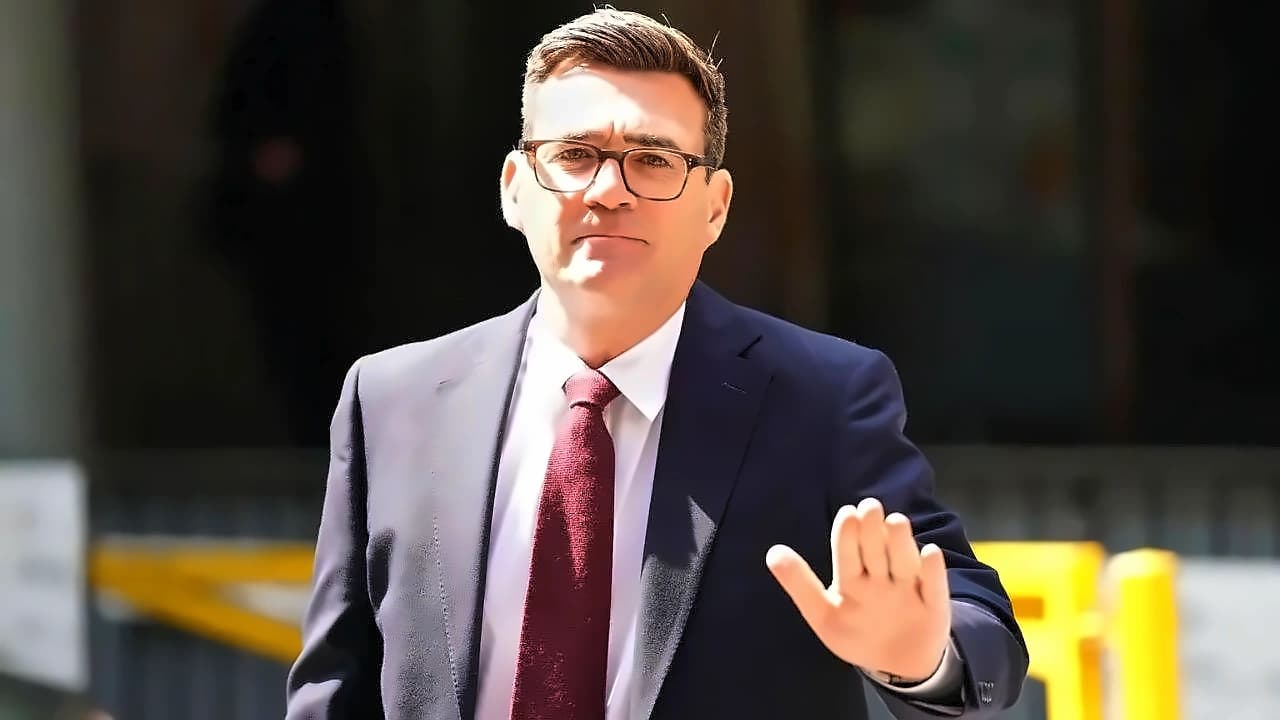
British Prime Minister Andy Burnham formally took charge as UK prime minister on Monday after being elected unopposed as Labour Party leader, succeeding Keir Starmer. According to reports from The Times of India, Burnham, 56, was elected in the same week that the Comprehensive Economic and Trade Agreement (CETA) between India and the UK came into force on July 15, providing a strong foundation for bilateral relations under his leadership. In his inaugural address outside 10 Downing Street, Burnham acknowledged the political instability that brought him to office, stating "I am acutely conscious that I am the sixth person in the last 10 years to walk up this street, the seventh Prime Minister since 2016." As per Business Standard, Burnham pledged to restore stability, devolve power away from Westminster and address the country's cost-of-living crisis. His elevation to the premiership comes after he returned to Parliament through a by-election in June 2026, having previously served as Mayor of Greater Manchester from 2017 to 2026.
Vishakha Yaduvanshi, Consul General of India in Manchester, highlighted Burnham's consistent support for stronger India-North England ties. As reported by The Times of India, she noted that Burnham's 2019 visit to India, meeting with former Indian High Commissioner Vikram Doraiswami in December 2025, and virtual participation in the India-North England Opportunity Summit in March 2026 reflected his long-standing commitment to strengthening bilateral ties. The Consul General views the Consulate's opening in March last year as a landmark moment that spotlights the tremendous potential of the north of England – "its industries, academia and sporting ethos" – within the India-UK relationship. Yaduvanshi emphasized that "his [Burnham's] 2019 visit to India, meeting with the former Indian high commissioner [Vikram Doraiswami] in December 2025, and his virtual participation in the India-North England Opportunity Summit [March 2026] reflect a longstanding commitment to this partnership." As the first head of India's new diplomatic mission in the UK, Yaduvanshi noted that "over this past year, we have valued close engagement with the Greater Manchester authorities, particularly Andy Burnham, whose energy and warm support has done much to strengthen India-North-England ties."
Rajesh Agrawal, chair of Labour Friends of India (LFIN), emphasized Burnham's track record in strengthening India-UK business links through direct flights between India and Manchester and improving connectivity. According to The Times of India, Agrawal noted that Burnham understands growth comes from longer-term relationships, working to strengthen links through businesses, universities, innovation and improved connectivity. Burnham has spoken of "fond memories" from his visit that took in Mumbai, Bengaluru and Delhi seven years ago, coordinated by the Manchester India Partnership (MIP) – an organisation set up for businesses and universities to engage with India. He highlighted "digital technology, engineering, advanced manufacturing, healthcare and academia" as well as "opportunities for tourism, sport and cultural collaboration" as priority areas for cooperation. As reported by Business Standard, Burnham has emphasized that "India is a key market in Greater Manchester's internationalisation strategy as it presents significant opportunities to the city-region, but these opportunities are mutual, and Greater Manchester is also helping India with its own economic growth plans." Having worked closely with Burnham during his previous tenure as Labour's deputy mayor of London, Agrawal feels the incoming PM's domestic devolution agenda will find synergies in India's federal set-up, noting "He's a big fan of devolution and empowering different regions, and India is of course a federal structure with many states. So, I also see him engaging more with regional governments."
Rahul Roy-Chaudhury, Senior Fellow for South Asia at London-based think tank International Institute for Strategic Studies (IISS), foresees "continuity" in the India-UK relationship because it "has not been better in over a decade" with back-to-back prime ministerial visits last year and the entry into force of CETA on Wednesday. As reported by The Times of India, Roy-Chaudhury believes the new prime minister inherits one of the strongest phases in India-UK relations in more than a decade. "New PM Andy Burnham has an opportunity to deepen these improved India-UK ties, deliver on the prosperity agenda and ensure a landmark dividend on bilateral defence and strategic cooperation with India, which looks to diversify its defence relationships while modernising its armed forces capability and boosting defence manufacturing in order to export to the world." The institute also called for steps to sustain the relationship, stating it would be "prudent to establish an India Task Force and/or appoint an India Trade Envoy, to maintain the current momentum."
Lord Karan Bilimoria, Cobra Beer founder and co-chair of the India All Party Parliamentary Group, expressed confidence that Burnham would continue to "prioritise India" and hoped the political instability bringing in the UK's seventh prime minister in 10 years would give way to steadiness. As reported by PTI, he said "Stability for at least for the next three years until the next general election, so that businesses in the UK and in India can invest in each other's countries... which will create jobs on both sides." Bilimoria emphasized the need to double trade from nearly ₹50 billion pounds to ₹100 billion pounds by 2030, stating "We need to double our trade, going from nearly 50 billion pounds today to 100 billion pounds by 2030... I'm very confident of a very bright future for the UK and India from now onwards." Tech entrepreneur and Labour peer Uday Nagaraju said the incoming UK PM "inherits an exceptionally strong" bilateral relationship and is expected to build on it, noting "It would also be combined with Andy Burnham's own characteristic focus, based on his work in Manchester on regional growth, skills, infrastructure, and bringing government and business together." He added that "the next stage [for India-UK ties] will be about converting the trade agreement into investment, exports, jobs, research partnerships, and opportunities for smaller companies in both countries."