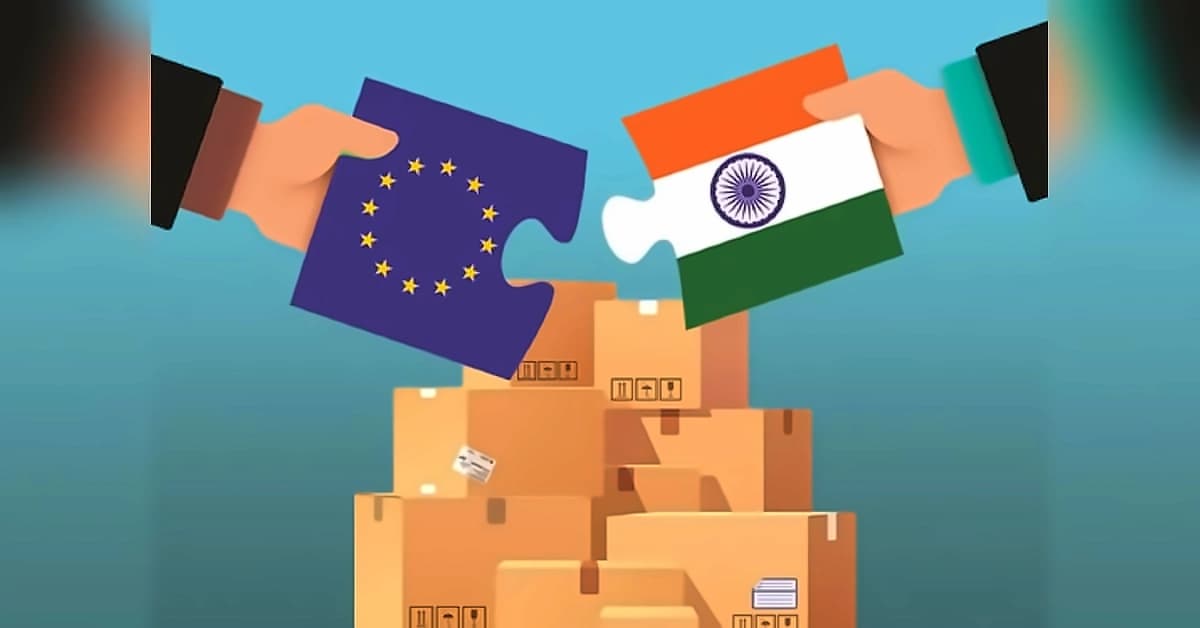
The India-EU Free Trade Agreement negotiations were successfully concluded on January 27, 2026 and are now moving through legal revision, translation and approval stages, according to the European Commission. Prime Minister Narendra Modi addressed the European Round Table for Industry (ERT) in Gothenburg, Sweden on May 17, 2026, describing the agreement as a landmark and transformative economic partnership that would create major new opportunities for both sides. Modi emphasized that stronger India-Europe cooperation would help create a more stable and balanced global economic order, with the agreement reflecting growing confidence and trust between the two regions. The Prime Minister stressed that India and Europe share common interests in promoting democratic values and open markets amid growing global uncertainty and increasing emphasis on resilient supply chains.
The automotive sector, which remained one of the thorniest sticking points in India-EU trade talks due to India's historically high import duties on vehicles, has been successfully navigated through quota-based solutions. As reported by Additional Secretary Darpan Jain at the FICCI conference, rather than hurting the domestic industry, the final EU FTA will act as a catalyst for growth, resulting in more automotive manufacturing shifting to India and seamlessly integrating Indian manufacturers into lucrative European supply chains. Prices of imported European cars are widely expected to come down after India agreed to gradually reduce duty under its FTA with the EU to 10% from 110% for 2.5 lakh vehicles a year, over six times more offered to the UK. Jain emphasized that "It will result in more investments into India...will result in more manufacturing of automobiles in India and exporting to third countries. So India will be integrated into the EU's value chain."
The India-EU Free Trade Agreement is set to deliver deep concessions for India while safeguarding vulnerable domestic sectors, according to Darpan Jain, Additional Secretary at Commerce Ministry and India's Chief Negotiator for the India-EU FTA. Speaking at the FICCI conference, Jain outlined significant wins for India from the EU trade deal. Substantial duty cuts are likely ahead for agricultural products and seafood, opening up a massive market for Indian exporters. The Additional Commerce Secretary assured that India's defensive interests remain intact, with the EU respecting India's domestic sensitivities and ensuring that protected sectors like dairy and poultry are shielded from aggressive foreign competition. As per Jain, "India has provided quota-based, long-phased solutions in the sector so that there are concessions also to the EU but at the same time the Indian industry also gets adequate protection."
One of the biggest challenges for the Indian heavy industry has been the EU's Carbon Border Adjustment Mechanism (CBAM), a carbon tax on imports like steel and aluminum. According to Jain's announcement at the FICCI event, India has tackled this hurdle through a trust-based mechanism. Under the negotiated terms of the EU FTA, India has secured Most-Favoured Nation (MFN) status in dealing with CBAM. A dedicated, institutionalized dialogue mechanism on CBAM has been established to smoothly resolve future regulatory friction, addressing a key concern for Indian heavy industry participants.
The India-EU trade agreement is expected to significantly expand bilateral cooperation beyond traditional trade, with India already having Social Security Agreements (SSAs) with 14 out of 27 EU member countries, according to Jain. "Seven we are negotiating and 6 more are being planned," he stated, noting that these pacts help avoid double contribution to social security funds by Indian professionals working for limited periods in European Union member nations. Additionally, Indian exporters can benefit from the EU's over 40 free trade agreements involving 70 nations. FICCI Secretary General Anant Swarup highlighted that "The EU alone accounts for about 12% of India's total merchandise trade," emphasizing the need to convert these agreements into practical gains for industry, especially for exporters, MSMEs and service providers.