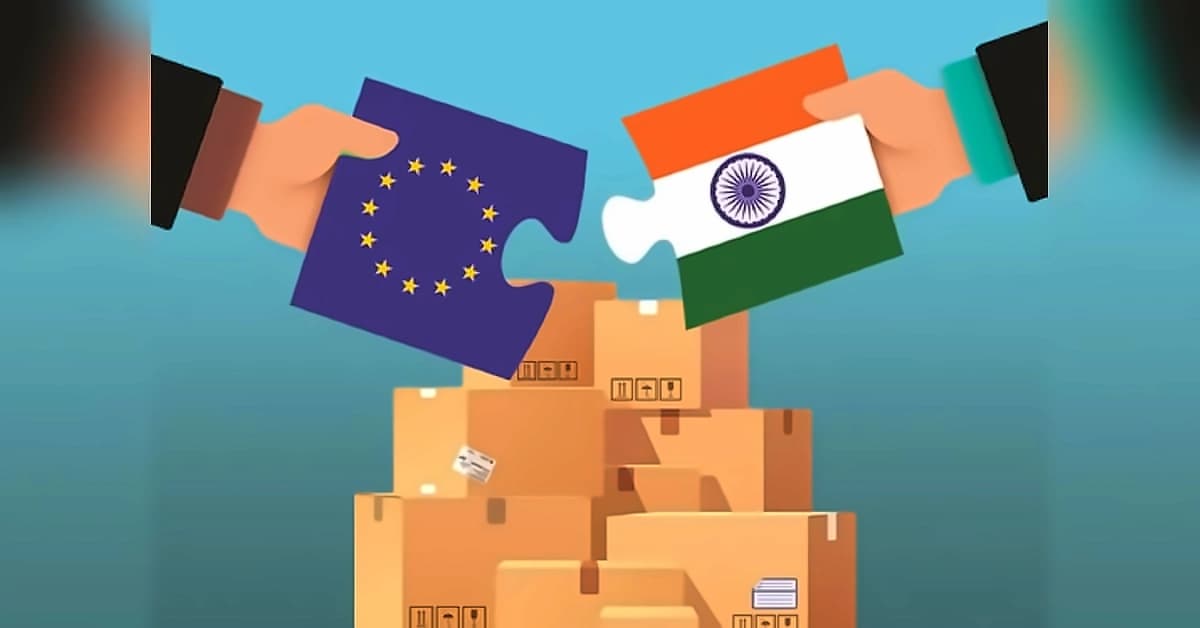
The European Commission on Friday formally submitted its proposal to the European Council to sign and conclude the Free Trade Agreement with India, marking a major step toward implementing the ambitious pact - widely termed the 'mother of all deals'. According to the European Commission, if authorized by the Council, this will be the largest trade agreement ever concluded by both the EU and India. The move follows a fast-track procedure announced earlier this year by EU Commissioner for Trade and Economic Security Maros Sefcovic to speed up implementation of FTAs amid geopolitical uncertainty and growing pressure on the global trading system. As per News18 reports, the Commission's proposals will now require Council approval for signature, with the agreement subsequently needing the European Parliament's consent before it can be formally concluded and enter into force. The EU's Ambassador-designate to India and Bhutan Jean-Eric Paquet celebrated the achievement, stating this would "clear the path for early approval" and noting that the full text of the agreement was now being made public. Commerce and industry minister Piyush Goyal confirmed on September 4 that all 27 EU member states backed the pact, calling the unanimity unusual by the bloc's standards and emphasizing that there has been "not one murmur of dissent against the India-EU FTA". Trade Commissioner Maroš Šefčovič emphasized that the Commission was putting the agreement before the Council for signature and conclusion in record time, stating their focus has been clear from the start to ensure businesses and citizens feel tangible benefits as quickly as possible.
Under the trade deal, India has offered tariff concessions on 86 per cent of tariff lines, while the EU has offered liberalisation on 97 per cent of tariff lines, according to Business Standard reports. The agreement will improve market access, reduce tariffs, tackle unnecessary barriers to trade, and provide predictable rules for trade and investment between the EU and India. According to EU Commission data, tariffs would be eliminated or reduced on 96% of EU goods exports to India, with the tariff cuts expected to save European exporters around €4 billion annually in duties. For India, approximately 93% of its shipments will enjoy duty-free access to the EU, benefiting sectors like textiles, engineering, pharmaceuticals, and agriculture. The deal is designed to make it easier for European companies to enter and compete in the Indian market, while consumers could benefit from greater choice and more competitive prices. As per EU Commission reports, 'This agreement brings together two of the world's largest economies - a market of 2 billion people and around a quarter of global GDP', with Commissioner Maros Sefcovic emphasizing their focus on ensuring businesses and citizens feel tangible benefits as quickly as possible. Earlier estimates suggested the agreement could almost double European exports to India by 2032, with the Commission arguing that completing trade deals faster has become more important than ever in the current geopolitical climate.
The agreement significantly expands EU access to India's services market, including financial services and maritime transport, with the Commission describing it as India's most ambitious financial-services opening in any trade pact so far. The services chapter is backed by four annexes covering the entry and temporary stay of natural persons, professional services, financial services and telecommunication services, with the mobility annex particularly closely watched in India for what it offers to IT and professional services workers. The deal includes stronger enforcement of intellectual property rights covering copyright, trademarks, designs, trade secrets and plant varieties, along with a dedicated sustainable development chapter addressing climate, labour and gender provisions. The Commission noted that separate negotiations on a Geographical Indications agreement and an Investment Protection Agreement between the EU and India are continuing alongside the FTA.
Negotiators concluded the FTA on January 27, 2026, at the 16th India-EU Summit in New Delhi, with talks first launched in 2007, suspended in 2013, and relaunched in 2022. The final text published on the Commission's trade portal runs to 20 chapters and more than a dozen annexes. The agreement is expected to double EU goods exports to India by 2032 and give the EU tariff concessions India has not extended to any other trade partner. Tariffs on automobiles will come down gradually from 110% to as low as 10%, while tariffs on car parts will be eliminated entirely over five to ten years. Tariffs of up to 44% on machinery, 22% on chemicals and 11% on pharmaceuticals will also be mostly removed. On the agricultural side, average tariffs above 36% will be reduced, with wine tariffs cut from 150% to 75% at entry into force and eventually to 20%, while olive oil tariffs will be phased out from 45% to zero over five years. Sensitive sectors including beef, chicken meat, rice, sugar and ethanol have been excluded from liberalisation to protect farmers on both sides, with all imports still needing to meet EU food-safety standards. Additionally, imports of European luxury cars and wines into India will become less expensive under the new framework. The Council's authorisation, once granted, would clear the way for the formal signing ceremony that both sides have targeted before the close of 2026, with only once all approval steps are complete will it become clear how many European companies can actually make the most of the new terms.
The draft pact provides significant concessions for European cars under the proposed India-EU free trade agreement, with the agreement expected to be signed by the end of this year and could come into force next year, as reported by PTI. European carmakers will get a first-year quota of 100,000 ICE and hybrid cars, while Indian-origin vehicles priced up to €50,000 will get access to a 250,000-unit EU quota. The concessions will apply only to passenger vehicles priced at Euro 15,000 (around ₹16.6 lakh) or more, with cars below that threshold continuing to face existing tariffs. For vehicles priced between Euro 15,000 and Euro 35,000 (around ₹16.6 lakh to ₹38.8 lakh), the in-quota duty will fall from 110% to 35% in the first year and then to 10% by the fifth year. For cars priced above Euro 35,000, the duty will fall from the existing most-favoured-nation tariff of 66% to 30% in the first year and eventually to 10%. The overall quota for ICE and hybrid passenger cars will rise from 1 lakh units in the first year to 1.6 lakh vehicles from the 10th year, with 43,000 vehicles reserved for cars priced above Euro 50,000 from the fifth year. India will also gradually lower tariffs on EU cars imported outside the quota, with out-of-quota duties eventually falling to 35% for cars between Euro 15,000 and Euro 50,000 and 30% for cars above Euro 50,000. EVs, wine and farm products will receive concessions from the fifth year, with battery-electric vehicles and plug-in hybrids priced at Euro 20,000 (around ₹22 lakh) or more eligible for CBU quotas starting at 20,000 units in the fifth year, rising to 90,000 units from the 14th year. The quota is not a ceiling on European car imports: Vehicles can continue to enter India beyond it at the applicable out-of-quota duty, which also declines over time, with India also capping a single model at 15% of the aggregate passenger-car CBU quota, subject to a maximum of 25,000 units a year.
The draft pact provides India with a significant steel export quota of 694,853 tonnes annually under the FTA, with overall access to 1.64 million tonnes of steel exports annually to the European Union. According to the draft agreement published by the EU, 946,616 tonnes would be available under the most-favoured-nation (MFN) framework, while another 694,853 tonnes would be reserved specifically for India under the FTA. The quotas cover several steel categories, including hot-rolled and cold-rolled sheets, metallic- and organic-coated products, stainless steel, rebars, wire rods, pipes and tubes. The biggest quota has been set aside for non-alloy and other alloy hot-rolled sheets and strips with an annual limit of 5,09,605 tonnes, with 2,99,197 tonnes under MFN quota and 2,10,408 tonnes covered by FTA provision. Cold-rolled sheets have a quota of 2,18,658 tonnes, while metallic-coated sheets have been allocated 1,97,860 tonnes. Other significant quotas include 1,86,038 tonnes for organic-coated sheets and 1,81,835 tonnes for non-alloy and other alloy quarto plates. Most of India's quota is allocated to flat-steel products, with hot-rolled sheets and strips receiving the largest allocation of 5,09,605 tons. The additional quota will become available once the India-EU FTA enters into force, expected by year end, and will remain subject to product coverage, rules of origin and quota availability. The combined quota is equivalent to about 68.4% of India's 2.4 million tons of steel exports to the EU in 2025, up from 39.4% under the existing quota, as reported by The Hindu BusinessLine. However, steel shipments above the quota will be subject to the EU's 50% tariff, according to a Global Trade Research Initiative (GTRI) analysis, and the preferential quota does not exempt Indian steel from the EU's Carbon Border Adjustment Mechanism, which applies to all steel imports, and which GTRI estimates could average around 35% of the value once fully phased in.