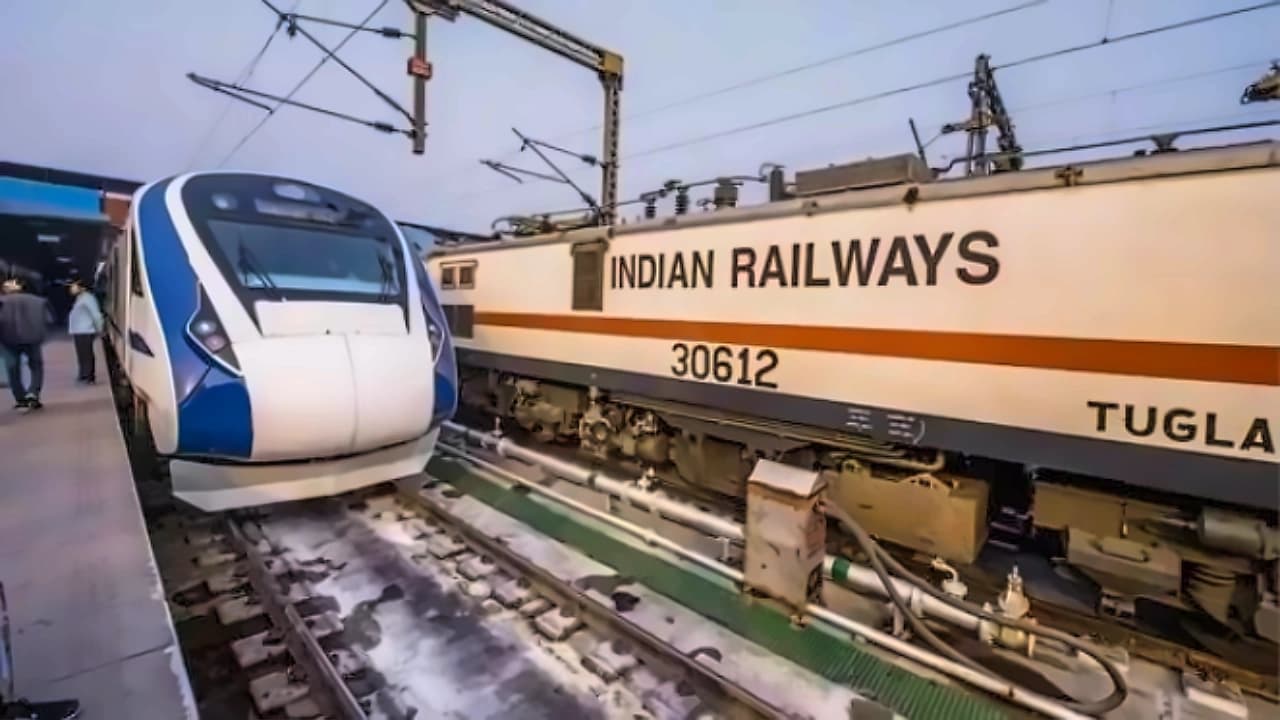
Indian Railways has achieved a significant financial milestone by repaying ₹1.93 trillion towards principal and interest on debt owed to its dedicated borrowing arm and the Ministry of Finance over the past five financial years, as announced by Union Minister Ashwini Vaishnaw in Parliament. The national transporter paid ₹93,000 crore in interest since 2021-22 and roughly ₹1 trillion in principal during this period. The Ministry of Railways had also taken a ₹79,000 crore special loan from the Ministry of Finance during Covid-19, which has now been fully repaid. As per the minister, the national transporter has stayed away from the borrowing market in recent years due to ballooning debt and India's capital expenditure-led economic revival strategy since the onset of Covid-19.
Indian Railways has utilized more than ₹1.14 trillion, or 39%, of its ₹2.93 trillion FY27 Budget grant by July 2026, according to Railway Minister Ashwini Vaishnaw's written reply in Parliament. As per the Ministry of Railways, expenditure of ₹1,14,973 crore had been incurred by July against the total Budget grant of ₹2,93,030 crore for the current financial year. The minister informed Parliament that during recent years, the Government of India has given adequate support to Indian Railways from Gross Budgetary Support, which has been utilized for infrastructure projects and Rolling Stocks that were previously financed through Extra Budgetary Resources. This substantial spending demonstrates the railways' commitment to infrastructure development and capacity enhancement initiatives across the network.
The ministry has implemented multiple measures over the past 12 years to increase railway network speed potential, including 60 kg rails, wider-base concrete sleepers, thick-web switches and weldable cast manganese steel (CMS) crossings. As reported by the minister, about 81% of railway tracks on Indian Railways have been upgraded to 110 kmph and above, with the proportion increasing from about 40% in 2014 to around 81% in 2026. Additionally, two major routes - New Delhi-Mumbai and New Delhi-Howrah of the Golden Quadrilateral - have been taken up for enhancing speed potential to 160 kmph under Mission Raftaar.
Funds utilized for works related to the Automatic Train Protection (ATP) system, Kavach, stood at ₹3,875 crore up to June 2026, with the current financial year allocation set at ₹2,066 crore. The indigenously developed Kavach system has now been successfully commissioned on 2,633 route kilometres as of July 31, 2026, with 1,423 route kilometres covered on the Delhi-Mumbai route and 1,210 route kilometres on the Delhi-Howrah route. Kavach Version 4.0, approved in July 2024, incorporates improved location accuracy, better signalling interfaces and enhanced communication capabilities for large-scale deployment. The system has been fitted on 6,290 locomotives with installation underway on another 7,190 locomotives and 1,200 EMU/MEMU rakes. Notably, Kavach trials at 160 kmph have been successfully conducted on the Chipyana Buzurg-Tundla section of the Delhi-Howrah route using a Vande Bharat trainset. The system provides real-time signalling information to loco pilots and automatically applies brakes if trains cross red signals, go above permitted speed or enter conflicting routes.
The average commissioning of new railway tracks has doubled from 4.2 km per day during the 2009-14 period to 8.32 km per day at present, demonstrating significant progress in network expansion. According to the minister's statement, 514 railway infrastructure projects covering a total length of 40,000 km and costing around ₹8.31 trillion have been sanctioned as of April 1, 2026, including 169 new line projects, 29 gauge conversion projects and 316 doubling projects. Of these projects, 12,583 km have already been commissioned, with trackside implementation work completed on 21,794 route kilometres and infrastructure including 11,547 km of optical fibre cable, 1,721 telecom towers, 1,009 station data centres and 7,726 route kilometres of trackside equipment already installed. Indian Railways has commissioned 36,429 km of new track between 2014 and 2026, compared with 7,599 km during 2009-14, showcasing the accelerated pace of network expansion.
Safety remains the highest priority for Indian Railways, with expenditure on safety-related activities increasing steadily over the years. The allocation has risen from ₹39,200 crore in 2013-14 to ₹1,20,389 crore in 2026-27, contributing to a significant decline in railway accidents. The government said capacity building remains an integral part of railway operations, with approximately six lakh railway employees undergoing training every year through Centralised Training Institutes, Zonal and Divisional Training Institutes, specialised training centres and Gati Shakti Vishwavidyalaya. Training programmes cover railway operations, freight logistics, digital technologies, safety, multimodal transportation and customer service, with regular updates to incorporate emerging technologies and evolving operational requirements.