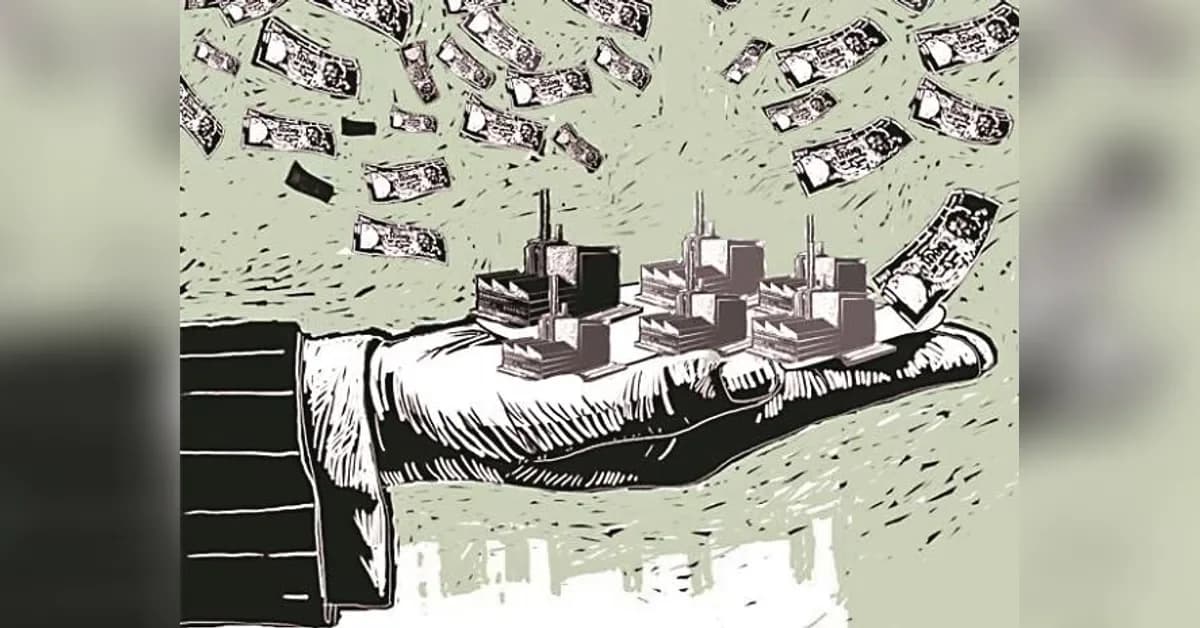
Power distribution companies achieved a significant financial turnaround in FY25, posting a profit of ₹2,701 crore against a loss of ₹25,553 crore in the previous financial year. According to reports from Business Standard, this profitability improvement appears strong on the surface, but closer analysis reveals deeper structural challenges. Without government subsidies, most discoms would post sizeable losses, with exceptions being discoms in Gujarat and the privatisation success stories of Odisha and Delhi. As noted by S&P Global Ratings, state subsidies and grants have become an increasing proportion of government spending, raising sustainability concerns for these transfers. The outsize role of subsidies in discoms' profitability is particularly concerning, with S&P Global Ratings' Credit Analyst Neel Gopalakrishnan highlighting that these power sector transfers are an increasing proportion of government spending, putting the sustainability of such transfers at risk.
Despite improved reported bottomlines, the underlying financial health of state discoms remains concerning. According to S&P Global Ratings analysis, EBITDA-level losses over the past three years are about 40-50% higher compared with the three previous years. The EBITDA of 18 large discoms grew from ₹0.18 trillion in FY2020 to ₹1 trillion in FY2025, but when stripped of subsidies, their EBITDA-level losses widened from ₹1.25 trillion in FY2020 to more than ₹2 trillion in FY2025. State government subsidies, grants and other financial support to discoms have increased 2.4 times from fiscal 2019 to fiscal 2025, now making up more than 7% of state government revenues compared to about 5% in fiscal 2019. As noted by S&P Global Ratings, the stronger financials are largely backed by increased government subsidies, larger grants, and ad hoc cash injections, with steady improvements in discoms' earnings before interest, taxes, depreciation, and amortisation (EBITDA) and liquidity only partly due to improving operational efficiencies.
Government measures have significantly improved discom operational performance over recent years. The Late Payment Surcharge (LPSC) Rule introduced in 2022 brought in a system of payment of current dues and also liquidation of past dues, while the government introduced automatic pass-through of fuel costs for discoms in December 2022. Power procurement cost, of which fuel is the primary component, accounts for 70-80% of the total ACS and had been a major burden for utilities in their effort to bridge the gap between ACS and ARR. The new rule enabled automatic and monthly pass-through of fuel and power purchase adjustment surcharges (FPPAS) to consumers, reducing the need for prior approval from regulatory commissions. The improved health of discoms is also due in part to the efforts taken to speed up smart metering, and the implementation of the Revamped Distribution Sector Scheme (RDSS) launched in 2021. AT&C losses reduced by an average of 6 percentage points between fiscal 2019 and fiscal 2025, translating into estimated savings of about ₹700 billion across all discoms. The gap between average cost of supply (ACS) and average realized revenue (ARR) has narrowed from around ₹1 per kilowatt hour between 2019 and 2021 to about ₹0.1 per kilowatt hour in fiscal 2025.
Despite government reform initiatives including the Late Payment Surcharge (LPSC) Rule introduced in 2022 and automatic pass-through of fuel costs since December 2022, many utilities continue facing significant challenges. According to Vibhuti Garg from the Institute for Energy Economics and Financial Analysis (IEEFA), many utilities continue to face significant financial and operational challenges despite successive reform programmes such as the Ujwal DISCOM Assurance Yojana (UDAY) and the Revamped Distribution Sector Scheme (RDSS). Without deeper structural change in operational parameters, including electricity theft reduction, network improvements and addressing high payable days, real and meaningful reforms of discoms will remain elusive, experts note. S&P Global Ratings' Vernice Tan emphasizes that maintaining such high levels of transfers to state discoms may not be sustainable over the long run, given subsidies are increasing steadily in relation to state government revenues. The growing reliance on subsidies is not sustainable, given fiscal weakness for some states, with subsidies representing about 30% of discoms' revenues on average.