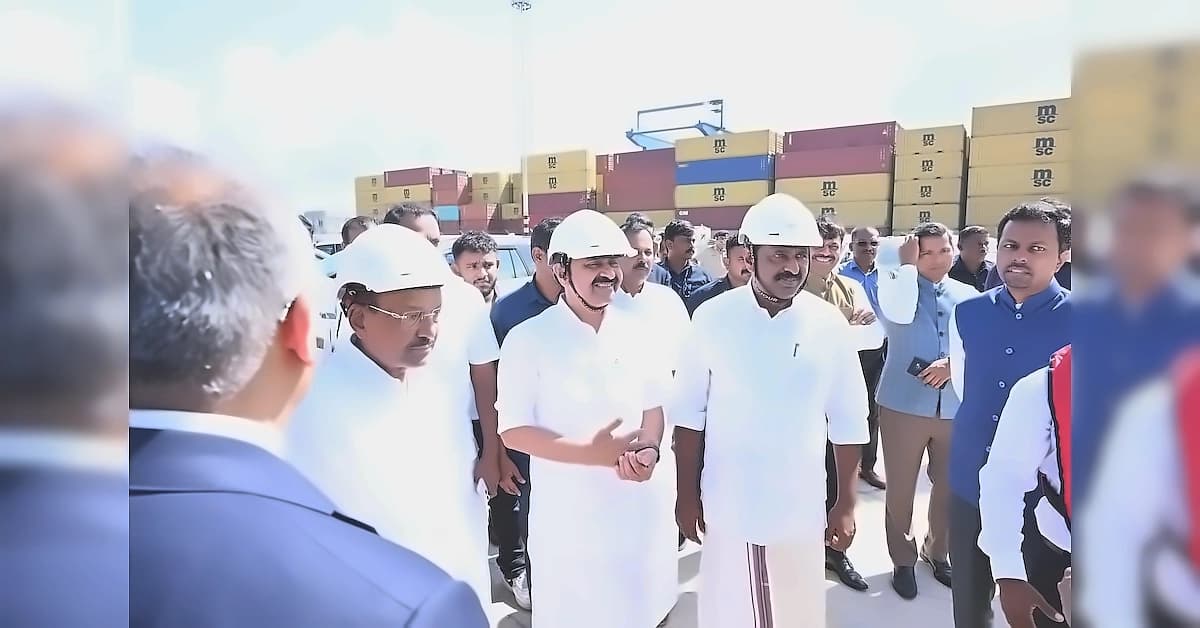
Chief Minister of Kerala V D Satheesan flagged off the first export container from Vizhinjam today, marking the commencement of full export-import (EXIM) operations from the international seaport. The ceremony took place in the presence of V.D. Satheesan, Chief Minister of Keralam and Chief Guest P.K. Kunhalikutty, Minister for Industries, Keralam; M. Vincent, MLA; Shyam Jagannathan, IAS, Director General of Maritime Administration, Government of India; maritime partners and other dignitaries. The first export container carried approximately 4,000kg of food products, including ready-to-eat items such as jackfruit chips, banana chips, tapioca chips, Kerala mixture, and Marayoor jaggery, as well as frozen Kerala sadhya, puttu powder, masala dosa, aviyal, curries, idli and sambar that can be stored for a year after freezing. As per the Chief Minister, Vizhinjam is now a gateway to the world and the challenge is to make the most of this opportunity through Mission Samudra.
The port's strategic location offers significant cost benefits for exporters, with several exporters from Tuticorin, Tiruppur, and Bengaluru showing interest in exporting from Vizhinjam, as they can save around ₹75,000 per container. As reported by Times of India, this cost reduction is attributed to the cut in freight transit time for exports from Vizhinjam, boosted by its deep draft that allows direct loading of containers onto motherships, and its proximity to international shipping routes. Suresh Mathew from Nilamels Exports explained that the usual period of 50 days for his exports to Spain would now be cut by about 20 days. The consignment will be shipped to Valencia aboard the Liberian-flagged container ship MSC Marie Leslie (IMO: 9968310), which is currently docked at the Jawaharlal Nehru Port in Mumbai and is expected to return to Vizhinjam on August 28.
According to Chief Minister V D Satheesan, Vizhinjam has established its place in the global shipping network at a speed that no other port in India can claim. The port now has direct sea connectivity with more than 110 major ports in 50 countries across six continents through regular and ad-hoc services. As of July 31, 2026, a total of 1,057 large vessels have called at Vizhinjam, handling more than 2.24 million TEUs. The port is located 10 nautical miles from major international shipping routes, has a natural 18–20 metre draft and the ability to handle Ultra Large Container Vessels (ULCVs). The port has already demonstrated its global scale capabilities, crossing 1 million TEUs in just 10 months and 2 million TEUs in 18 months, and handled MSC Irina, a 399.99-metre vessel with a capacity of 24,346 TEUs, the largest container vessel to visit India. MSC's initial plans for Vizhinjam's EXIM operations include exports from two services - the Himalaya Express (HEX), which will connect it to Las Palmas, Sines, Valencia, Barcelona and Gioia Tauro, and the India Africa Service (IAS), which will connect it with Coega, Pointe Noire, Abidjan, Tema, Lome, Cotonou and Kribi.
Alongside beginning the EXIM operations, the Kerala government will launch Mission Samudra, a port-led industrial and logistics development scheme built around the vision of a 'Port City'. The mission aims at attracting private investment exceeding 10 times the public investment by 2031 and generating large-scale sustainable employment. The programme envisions Vizhinjam at the centre of a wider Vizhinjam Maritime Economic Region, spanning eight industrial clusters, three new cities, and Kerala's 600-km coastline. The government expects around 45 new industrial units to be established in the first year and aims to increase the number to more than 1,500 by 2040, with plans to expand the industrial land area from 20 ha to more than 420 ha by 2040. The government will allocate ₹3,200 crore for land acquisition for the Ring Road, while discussions have already begun to bring in private investment. Mission Samudra is intended to link Vizhinjam with industrial and logistics infrastructure across the state, including Kinfra parks, NH 66, NH 544, the proposed outer ring road, National Waterway-3 and inland waterways.
The commencement of full EXIM operations represents a milestone in Kerala's development, enhancing global trade and local industry opportunities. As per the Chief Minister, the port's direct connectivity offers a major opportunity for Keralam's exporters, with the ability to transport goods to overseas destinations without transshipment expected to cut transit time and logistics costs significantly. The initial EXIM catchment covers Keralam, Tamil Nadu and Karnataka, giving businesses across South India more direct access to international shipping networks. Kerala's value-added marine exports are currently worth ₹2,074 crore, and the port is expected to provide a boost to the cashew industry in the Kollam-Thiruvananthapuram region, petrochemical exports from Kochi, and agro-processing and Ayurvedic industries in Palakkad. The shift to EXIM operations has wider implications for the efficiency of India's maritime trade, as this arrangement can reduce reliance on overseas transshipment hubs and shorten transit time. More than 75% of India's container transshipment cargo is currently handled through foreign ports, adding logistics costs and transit time, and Vizhinjam's EXIM operations will help address this structural dependence and strengthen India's ability to retain greater value from its maritime trade. With the Phase 2 investment, the Adani Group's cumulative investment in the Vizhinjam project will reach ₹30,000 crore, the largest investment committed by any business house in Kerala. The development is also expected to create more than 5,000 additional direct and indirect jobs, opening new opportunities across the wider maritime and logistics ecosystem.