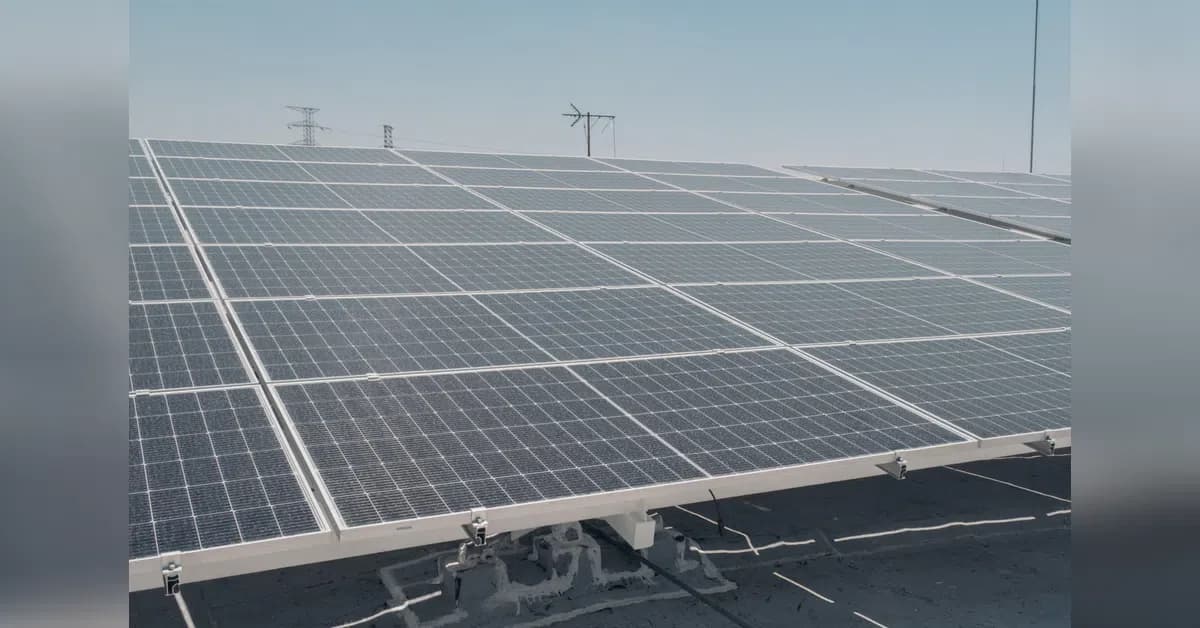
India achieved a record 2.7 GW of rooftop solar capacity in the January-March quarter, marking the sector's strongest-ever quarterly performance with a 125% year-on-year growth, according to Mercom India Research in its Q1 2026 India Rooftop Solar Market Report. The addition was 25% higher than the 2.2 GW installed in the previous quarter and more than double the 1.2 GW added in Q1 2025. The surge was primarily driven by robust residential demand under the PM Surya Ghar scheme and rapid adoption across large states, particularly Uttar Pradesh, with rooftop projects accounting for 18% of the country's total solar installations during the quarter. The strong quarterly additions pushed India's cumulative rooftop solar capacity to 23.5 GW as of March 2026, bringing it closer to the 40 GW target set by the government.
Gujarat, Maharashtra, Rajasthan, Kerala, and Uttar Pradesh account for nearly 82% of the country's installed rooftop solar capacity, as reported by Mercom India. These five states continue to lead rooftop solar adoption despite being covered by the same PM Surya Ghar scheme, while other states continue to lag despite being eligible for the same subsidies. According to Business Standard, several states including Gujarat, Rajasthan, and Haryana have supplemented the PM Surya Ghar scheme with additional incentives, dedicated portals, and simplified approval processes, making rooftop solar more attractive and easier to adopt. However, Bhawna Tyagi from CEEW explained that rooftop solar adoption is increasingly an "intent-to-action" challenge rather than a cost problem, with many households unaware of available financing options despite expressing interest in installing rooftop systems.

The residential segment accounted for 82% of total rooftop installations in the March quarter, demonstrating households' critical role in driving India's clean energy transition, according to Mercom India. The market continues to be dominated by consumer-owned projects, with installations under the capital expenditure (CAPEX) model accounting for 81% of additions, while the operational expenditure or RESCO model contributed the remaining 19%. The industrial, commercial, and government segments followed at 11%, 7%, and 0.4% of quarterly additions respectively. Installations during the quarter were driven by subsidy-backed systems, simplified approval processes, and increasing state-level implementation support under the PM Surya Ghar: Muft Bijli Yojana.
The PM Surya Ghar: Muft Bijli Yojana, launched in February 2024, targets installation of rooftop solar systems in 10 million homes with subsidies of up to ₹78,000 for systems of up to 3 kW capacity. Despite the record deployment, project pipeline activity weakened with rooftop solar tenders totalling 482 MW issued during the quarter, down more than 38% quarter-on-quarter, although still 32% higher than a year ago. Auction activity slowed even further, with only 269 MW auctioned during the quarter, representing a 67% decline from Q4 2025. According to CEEW survey findings, 73% of households that considered rooftop solar too expensive were unaware of financing options, highlighting the critical need for improved consumer awareness and information dissemination.
The Union Cabinet approved India's third Nationally Determined Contribution (NDC 3.0) in March, committing to a 47% reduction in emissions intensity of GDP and 60% non-fossil installed power capacity by 2035. As per Climate Compatible Futures, these targets cannot be met by a few high-performing states alone, requiring widespread adoption across all states. The next phase of India's rooftop solar expansion may require a shift from introducing new subsidies to improving implementation, with CEEW's Bhawna Tyagi noting that "there is significant potential to expand rooftop solar beyond these states, but doing so will require differentiated, state-specific strategies rather than a single national playbook." The success will depend on making rooftop solar "accessible, predictable, and user-friendly" for consumers nationwide, with focus shifting from subsidy introduction to implementation improvement and consumer awareness building.