India has achieved significant milestones in electronics manufacturing, becoming the world's second-largest mobile phone manufacturer with mobile phone production growing nine-fold over the past decade at a compound annual growth rate (CAGR) of 24%. According to reports from Business Standard, this growth has been driven by India's participation in global value chains, where different countries specialize in producing specific sub-assemblies and components. However, the country's domestic value addition in mobile phone manufacturing currently stands at 18-20%, compared with 38-40% in the world's largest mobile phone manufacturing country, as reported by Pankaj Mohindroo, chairman of the India Cellular and Electronics Association (ICEA).
Despite progress in final assembly, India continues to import many of the highest-value components that are essential for electronic devices. According to Business Standard reports, semiconductors remain India's biggest import dependency, with advanced display panels, memory chips, image sensors, and specialized electronic components also sourced from overseas. The country has built considerable strength in final assembly but much of the value embedded in these products continues to originate overseas. One area where India is trying to build capabilities faster is semiconductor assembly, testing and packaging (OSAT), which represents a meaningful and growing share of semiconductor value while requiring significantly lower investment and shorter timelines than semiconductor fabrication. As Ashok Mehta, chairman of Suchi Semicon, explains, "Fabs take several years and tens of billions of dollars; a world-class OSAT facility can be qualified and shipping in two to three years at a fraction of that investment."
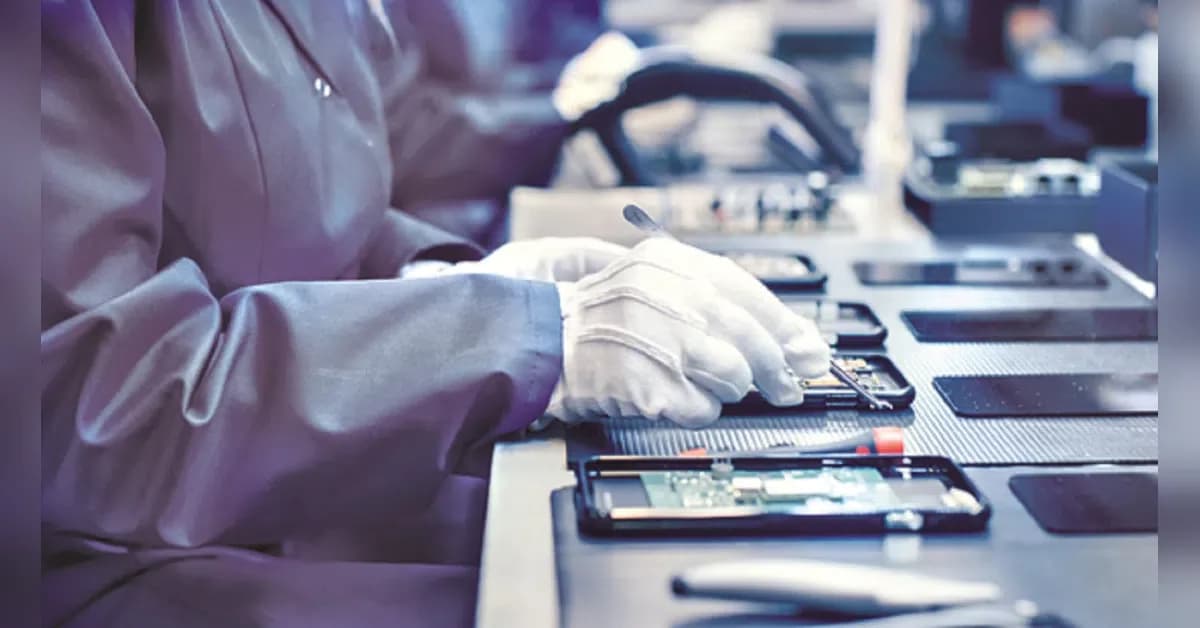
The government has announced several schemes to encourage domestic electronics manufacturing and reduce import dependencies. As reported by Business Standard, alongside production-linked incentive (PLI) schemes that attracted global manufacturers, New Delhi has announced the ₹62,500-crore Mobile Phone Manufacturing Scheme (MPMS) to encourage domestic component manufacturing, design capabilities and Indian brands. The government has also floated the final 10 gigawatt-hour (GWh) tender under the ₹18,100-crore Advanced Chemistry Cell (ACC) PLI scheme with revised eligibility norms and greater emphasis on battery efficiency. These initiatives aim to deepen India's manufacturing ecosystem rather than remain an assembly hub. According to ICEA, the Electronics Components Manufacturing Scheme (ECMS) and the newly announced MPMS are designed to encourage domestic production of display modules, camera modules, printed circuit boards and lithium-ion cells, with industry expecting these investments to increase domestic value addition over the coming years.
Industry leaders emphasize that India's next phase of electronics manufacturing requires focusing on higher-value activities beyond assembly. According to Shashwath TR, co-founder and CEO of Mindgrove Technologies, building product companies requires a fundamentally different approach from providing design services, as reported by Business Standard. He believes chip design should remain India's priority over the next five to ten years because it has lower barriers to entry than semiconductor fabrication while generating substantial economic value. The strategy includes strengthening domestic capabilities in design, research and intellectual property to create Indian brands, maintaining stable policy environments, and attracting global value chains to manufacture not only finished products but also sub-assemblies and components in India. As Pankaj Mohindroo notes, "Design and IP are where most of a chip's value sits, regardless of where it is fabricated. When Indian companies own the architecture, the software stack and the intellectual property, that value stays here."