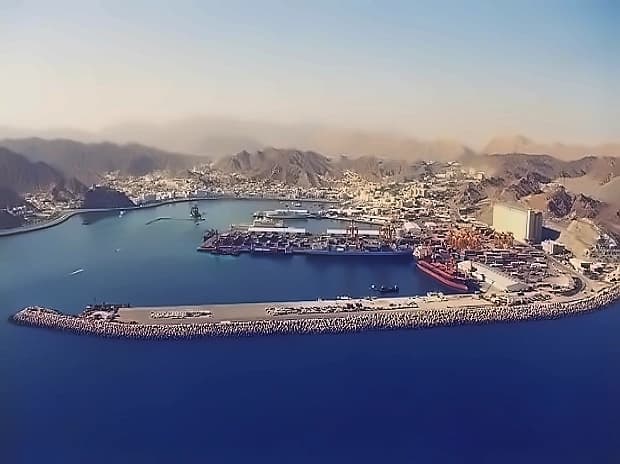
Oman's Sohar Port offers India enhanced access to Gulf energy resources, benefiting from its strategic location away from conflict zones in the northeast of Oman, close to vital energy pipelines of the United Arab Emirates and eastern Saudi Arabia. As reported by Reuters, Saudi Arabia is offering more loadings of crude oil to Asian refiners via ship-to-ship transfer off Sohar Port after drone attacks damaged its vital pipeline to the Red Sea. The port's importance is expected to increase further as the Oman-UAE rail begins connecting the port to the UAE's network, boosting cross-border freight transport. The Embassy of Oman described the Sohar Port and Freezone as a "mega project" developed by the ASYAD Group and the Port of Rotterdam, offering a "comprehensive range of services, including logistics, petrochemicals, metals and the Gulf region's first agribulk terminal."
The India-Oman Comprehensive Economic Partnership Agreement (CEPA) has created new opportunities for Indian companies to establish manufacturing and processing operations in Oman. FIEO Director General Ajay Sahai highlighted that the agreement allows Indian companies to view Oman not just as an export destination but also as a regional base for manufacturing, processing and distribution to other markets. According to Sahai, Sohar Port's location, logistics connectivity and adjoining free trade zone are particularly suited for such operations. Indian companies can export intermediate products to Oman for further processing and subsequently target markets with preferential trade arrangements, subject to applicable trade and origin requirements. The strategic location enables exporting processed products to the US or GCC countries while taking advantage of Oman's free trade arrangements.
Oman's Sohar Port is actively exploring expansion plans to accommodate increased cargo volumes, with Raid Al Rubaiey, deputy CEO of Sohar Port and CEO of Sohar Freezone, confirming discussions with multiple Indian terminal operators. According to reports from Business Standard, the port currently has enough land and waterfront available for expansion, with both captive berth options and multipurpose terminals being explored with Indian players. The port already hosts dedicated terminals, including the Jindal facility with two terminals as a captive operator. Speaking in New Delhi on Wednesday (September 16, 2026), Al Rubaiey welcomed Indian investments and said the port would serve as a platform to connect businesses in regional and global markets.
Since the West Asia crisis began in February 2026, shipping lines have shifted to ports east of the Strait of Hormuz, including Salalah, Khorfakkan, Sohar and Jeddah, leading to significantly increased cargo handling. As reported by Business Standard, feeder vessel services between India and Sohar have quadrupled to cater to Indian-origin GCC cargo, with cargo previously transported directly to GCC nations now routed through Oman via road connections. The port recorded 52% growth in cargo to 52 million tonnes in the first half of 2026. The latest developments show Saudi Arabia's oil exports have fallen to roughly 2.1 million bpd in the first half of September, representing a drop of more than 70% from pre-crisis levels of 7.5 million bpd in January and February. This crisis has accelerated the need for alternative shipping routes, with Hormuz-route exports increasing to more than two million bpd in the first two weeks of September, roughly one million bpd above August levels.
Experts emphasize that India needs to diversify its crude and gas suppliers while expanding strategic storage and strengthening port infrastructure as growing security tensions in West Asia expose vulnerabilities in the country's energy supply chains. India imported about 1.8 billion barrels of crude oil in 2025, with 48% coming from the Gulf region, according to Rajeev Agarwal, senior research consultant at the New Delhi-based Chintan Research Foundation. The UAE and Oman could provide alternative transhipment, storage and bunkering hubs outside the Strait of Hormuz, with Fujairah on the UAE's Gulf of Oman coast emerging as a major oil storage and bunkering centre. In May, India and the UAE signed a strategic collaboration agreement under which Abu Dhabi National Oil Company could increase its crude storage in India's strategic petroleum reserves to up to 30 million barrels. The experts warn that while alternative routes can provide resilience, they cannot completely eliminate India's exposure to Hormuz for oil and gas originating inside the Persian Gulf, as those supplies would still have to reach an outside port.