India's first mineral exchange is expected to be registered and operational by the next financial year, according to Mines Additional Secretary Veena Kumari Dermal during the 60th Annual General Meeting of Federation of Indian Mineral Industries (FIMI). As reported by CNBC TV18, Dermal confirmed that "We expect to register and operationalise the first Mineral Exchange by the next financial year. Work on the registration of the exchange is currently under way." The exchange will provide an electronic delivery-based trading platform for minerals, enabling market-based price discovery and reducing information gaps between producers and buyers. This development follows the mines ministry's notification of the Mineral Exchange Rules, 2026 in June, which aims to create a state-of-the-art platform with transparent price discovery and standardised quality assessment. The exchange will feature risk-management mechanisms to prevent market manipulation and protect participants, providing producers and buyers with a reliable and globally competitive marketplace for minerals.
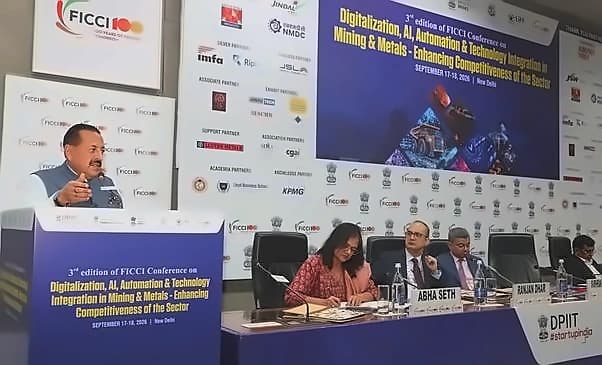
India is positioning itself to move from a resource advantage to technology-driven competitiveness in the mining and metals sector, according to Union Minister of State for Science & Technology and Earth Sciences Jitendra Singh. As reported by the Ministry of Science & Technology, Singh made these remarks while addressing the 3rd edition of FICCI Conference on Digitalization, AI, Automation & Technology Integration in Mining & Metals: Enhancing Competitiveness of the Sector at FICCI Federation House, New Delhi. The minister emphasized that technology must be integrated across the entire value chain, spanning from geological exploration and mining to processing, logistics, recycling and downstream manufacturing. Singh's latest remarks constitute policy direction set out in a ministerial address, rather than a new mining scheme, emphasizing the need for repeatable commercial technologies under Indian operating conditions.
Singh called on mining companies to define operational problems and give researchers and start-ups access to industry data and testing facilities. According to the Ministry of Science & Technology, the minister identified the ₹1 lakh crore RDI Scheme and 25 Technology Innovation Hubs as potential routes for taking technologies from validation to commercial use. The National Mission on Interdisciplinary Cyber-Physical Systems, which established the 25 Technology Innovation Hubs, provides an existing platform for organizing these collaborations. The proposed approach depends on Technology Readiness Level 4, when components have been validated in a laboratory environment, with the stated benchmark being whether technologies are qualified, adopted, replicated and commercialised rather than just patents or demonstrations produced. Mining companies would need to provide specific operational problems, performance requirements and cost targets to laboratories, universities, start-ups and Technology Innovation Hubs, while also providing the sites, data and technical expertise required for industrial testing.
The minister urged moving beyond isolated technology pilots towards connected, scalable and trusted technology systems that can transform the sector at industrial scale. According to the Ministry of Science & Technology, this approach addresses declining ore grades, deeper and more complex deposits, energy and logistics costs, geopolitical concentration of critical-mineral supply chains, decarbonisation requirements and changing customer expectations. Technology must therefore be treated not as an isolated capital investment or a collection of pilots, but as a strategic enabler spanning the mineral resource-to-metals-to-downstream value chain. The next phase of technology-led transformation requires bringing together national missions, research institutions, industry problem statements, start-ups, test facilities and risk capital, so that promising technologies can move from laboratory to pilot and from pilot to industrial scale. As reported by CNBC TV18, Dermal emphasized that "minerals form the backbone of the infrastructure, manufacturing, and national energy security" and that "to reduce this heavy burden on the national exchequer, the industry has to expand, increase the domestic capacity, increase the production, and optimise its local resources."
India's mining sector has demonstrated exceptional growth over the past decade, with mineral production value growing from ₹49,900-50,000 crore in 2013-14 to ₹1.86 lakh crore in 2025-26, showing a cumulative annual growth rate of 11.6 per cent. As reported by CNBC TV18, the production of iron ore increased from 152 million tonne in 2013-14 to 312 million tonne last year, while limestone production rose from 280 MT to 483 MT and bauxite production increased from 22 MT to 26 MT. Despite this growth, India imported minerals valued at ₹10,12,000 crore in financial year 2025-26 alone, highlighting the need for further expansion and domestic capacity building. The minister explained that while mineral production is increasing, it is not sufficient to meet the country's aspirations, underscoring the importance of the upcoming mineral exchange and technology integration initiatives. As reported by CNBC TV18, Dermal noted that "we are seeing the increase in mineral production, but that is not sufficient to meet the aspiration of the country".
The minister said India's mining and metals sector is entering a defining phase as the country moves towards Viksit Bharat @ 2047, with the sector playing a central role in infrastructure development, energy transition, manufacturing growth, self-reliance and economic competitiveness. According to the Ministry of Science & Technology, India's growth over the past decade, supported by infrastructure, domestic manufacturing, digital infrastructure, innovation and investment, has created the scale and capabilities required for technology-led expansion across major sectors. Digital technologies can bring together geological, operational, equipment, process, energy, logistics and market data, enabling faster and more precise decision-making through greater visibility, prediction, coordination and automation. The Minister called for collective efforts to build a mining and metals ecosystem that is technologically advanced, globally competitive and environmentally responsible, aligned with the vision of Atmanirbhar Bharat and Viksit Bharat @ 2047. As the country advances towards this vision, minerals form the backbone of infrastructure, manufacturing, and national energy security, making self-reliance in mineral resources a critical national objective. As reported by CNBC TV18, Dermal emphasized that "as the country advances towards the vision of Viksit Bharat 2047, India's primary objective is to build a self-reliant economy".