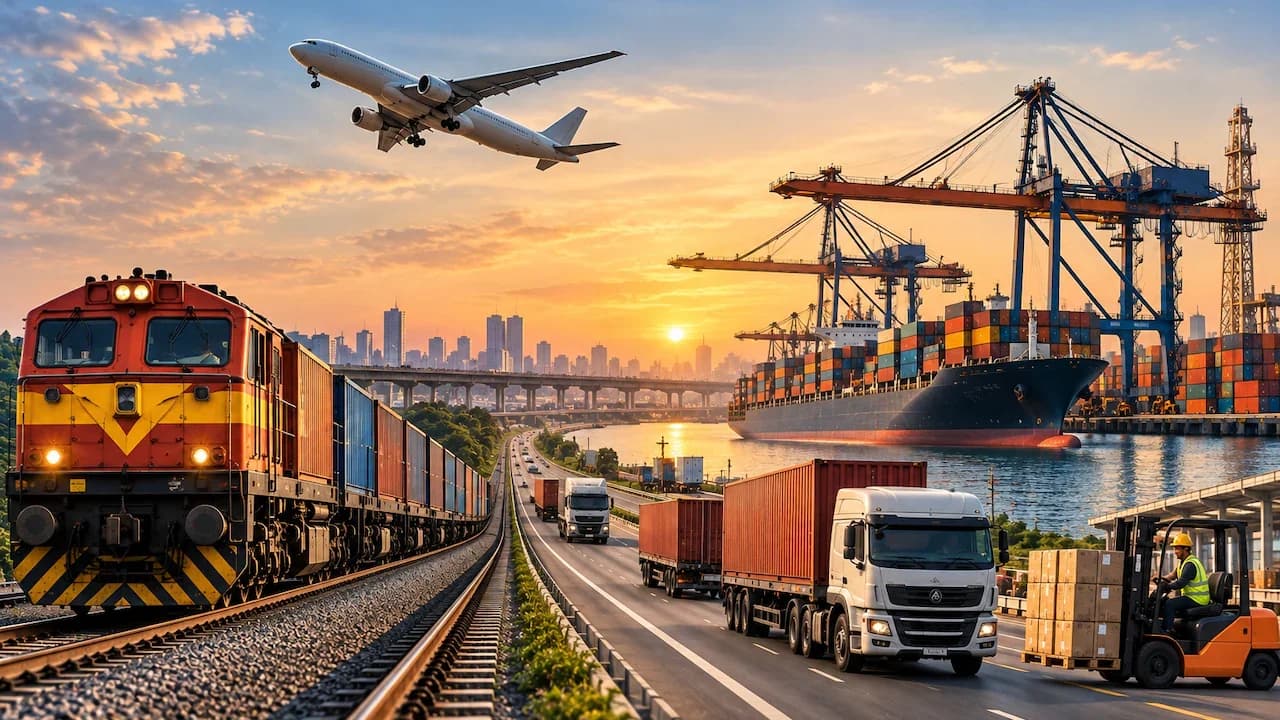
India has achieved a significant infrastructure milestone with the completion of its 2,843-km dedicated freight corridor network, marking the end of a 21-year-long project that began with the Union Budget of 2005. The network comprises the 1,506-km Western Dedicated Freight Corridor (WDFC) between Dadri and JNPT, and the 1,337-km Eastern Dedicated Freight Corridor (EDFC) between New Sahnewal in Punjab and New Sonnagar in Bihar. The final three Western DFC sections, inaugurated this week by PM Narendra Modi, cover 326 km and were developed at a cost of more than ₹20,700 crore. According to Business Standard, this completion addresses the critical problem of congestion on India's railway network, where freight routes were operating at 115-150% of their capacity, forcing freight trains to compete with passenger services.
The Dedicated Freight Corridors are delivering substantial operational improvements across India's logistics network. Around 400-plus freight trains run on the two corridors every day, with the average speed of freight trains on DFC networks reportedly above 50 kmph, about twice the average speed on non-DFC routes. As reported by Business Standard, the Western DFC takes two-and-a-half hours to cover 100 km compared to nearly six hours for regular freight trains, while the Eastern Corridor serves major thermal power plants and coal transportation needs. The ability to run double-stack container trains directly to important ports has increased cargo capacity per train, improving long-distance rail freight efficiency significantly. According to Business Standard, the DFCs currently shoulder around 14% of total freight volume despite forming only 4% of the railway network. The latest data shows the freight corridor has more than halved travel time, with journeys that can take around 30 hours by truck taking just 10-12 hours on the DFC.
The completion of India's dedicated freight corridor network is expected to deliver transformational economic benefits for the logistics sector. According to Business Standard, since DFC commissioning, trains per day on the full Indian Railways network have increased by 25-30% over the past three to four years. Jagannarayan Padmanabhan from Crisil Intelligence notes that the DFC improves rail productivity, asset utilization, and transport economics by enabling higher wagon count per rake and faster freight trains. The rail coefficient across the WDFC is currently at 20%, with the rest of cargo moved by roads, indicating significant potential for modal shift from roadways to railways. Indian rail freight costs ₹1.96 per tonne-km from terminal to terminal, making it cheaper than road transport at ₹4 per tonne-km. According to Business Standard, the optimum potential for cost-saving in container cargo is 25%, though current benefits to container train operators are roughly 6-7%.
The government is planning significant expansion of India's freight corridor network to enhance logistics efficiency. As reported by Business Standard, Finance Minister Nirmala Sitharaman in February announced a new freight corridor between Gujarat and West Bengal, though sector experts caution this may unintentionally move coastal shipping cargo entirely to railways once completed. The Union Budget proposed a new Dedicated Freight Corridor connecting Dankuni in West Bengal with Surat in Gujarat, passing through Odisha, Chhattisgarh, Madhya Pradesh and Maharashtra. This 2,052-km corridor will integrate with the existing Western Dedicated Freight Corridor, enabling seamless movement of goods to west coast ports. Additionally, the government has examined DPRs for an East Coast corridor between Kharagpur and Vijayawada, an East-West network linking Palghar with Dankuni, and a North-South sub-corridor connecting Vijayawada, Nagpur and Itarsi, though these have not yet been sanctioned.
The completion of India's dedicated freight corridor network represents a crucial step toward achieving the country's logistics transformation goals. According to Business Standard, the focus is shifting from completing the network to maximising economic gains, including how much capacity it can free up elsewhere and whether it can help India meet its larger logistics and freight targets. Jaffrey Thomas from PwC India emphasizes that the next phase should focus on expanding DFC capacity, accelerating multimodal logistics parks development, improving first- and last-mile connectivity, encouraging private sector participation, and strengthening port-rail integration. This comprehensive approach aims to further reduce logistics costs, improve freight efficiency, and enhance India's global competitiveness as the country positions itself as a major manufacturing hub, with the Railways targeting 3,000 million tonnes of freight loading by 2031 - a near-doubling from current volumes of 1,670 million tonnes. The timing is particularly significant as Indian Railways carried 1,670 million tonnes of freight in 2025-26, up from 1,617 million tonnes in the previous year, underscoring the importance of expanding rail capacity and improving cargo transportation speed.