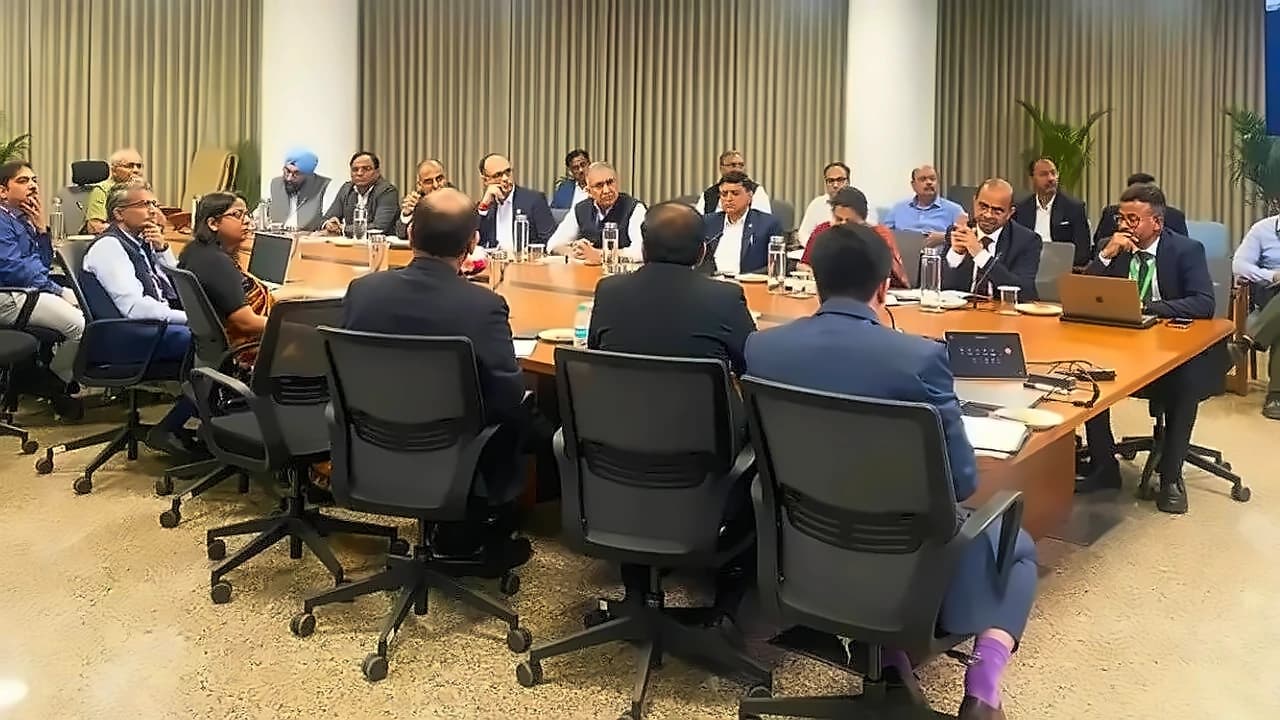
The Public Private Partnership Appraisal Committee (PPPAC) has granted in-principle approval for the privatisation of 11 Airports Authority of India (AAI) airports, which will be offered in five public-private partnership bundles with 50-year concessions. According to the PPPAC document accessed by NDTV Profit, the government plans to pair one larger airport with a smaller airport in each bundle, with Amritsar, Varanasi, Bhubaneswar, Raipur and Tiruchirappalli serving as anchor airports, while Kangra, Gaya, Kushinagar, Hubballi, Aurangabad and Tirupati will be bundled with them. The bidding process will have one-stage short-listing, with the per-passenger fee for domestic passenger throughput as the bidding parameter, and the airports will be awarded for a concession period of 50 years.

India's aviation sector demonstrates the highest concentration among Indian industries, with India's airline industry's HHI at 4,400, the highest among all sectors as of FY23, according to Business Standard analysis. InterGlobe Aviation and the Air India-Vistara combination together accounted for 92.6 per cent of the combined net sales of airlines in FY23. In July 2026, IndiGo and the Tata Group-owned Air India Group together accounted for about 91 per cent of domestic passenger traffic. The airport market is similarly concentrated, with State-run Airports Authority of India (AAI) managing 129 airports, while Adani Airport Holdings (AAHL), the country's largest private airport operator by network size, operates eight airports accounting for about 24-25 per cent of passenger traffic and 33 per cent of air cargo. According to the government record, GMR Airports, which operates Delhi and Hyderabad airports among others, has about 27.5 per cent of passenger traffic. Together, private operators Adani and GMR account for more than half of India's air passengers.
Under the new 'bundling' model, the government has paired major revenue-generating airports with smaller, loss-making ones into single bundles so that private concessionaires can cross-subsidise the operating and capital expenses of smaller airports using profits from high-traffic hubs. As reported by the government record, the bidding process will have one-stage short-listing, with the per-passenger fee for domestic passenger throughput as the bidding parameter. The PPPAC granted in-principle approval to privatisation of five airport bundles at the August 4 meeting, with bundles including Amritsar-Kangra (Amritsar with Kangra in one bundle), Varanasi-Gaya-Kushinagar, Bhubaneswar-Hubballi, Raipur-Aurangabad and Tiruchirappalli-Tirupati - with each bundle to be awarded to a single concessionaire. The record of discussion showed that after the February 2019 privatisation, the Airports Authority of India (AAI) developed the current bundling proposal to leverage the geographic and operational synergies between larger and smaller airports and improve the financial viability of the bundles.
The Ministry of Civil Aviation has proposed capping the number of airports that individual operators can win in the forthcoming auction of 11 airports, which will be auctioned as bundles of two or three, after the Ministry of Finance flagged the 'oligopolistic nature' of India's aviation sector. According to a record of discussion made public by the government, this cap is aimed at limiting market concentration and over-leveraging, or taking on excessive debt, which the government fears could create problems across multiple airport projects. The Civil Aviation Ministry told the Ministry of Finance at the 149th meeting of the Public Private Partnership Appraisal Committee (PPPAC) on August 4 that the modalities of such capping are being finalised and would be submitted as part of the proposal seeking final recommendation by the PPPAC. During the meeting, a top finance ministry official asked: "Given the oligopolistic nature of the aviation sector, what measures have been envisaged to ensure that the risks related to concentration and over-leveraging are minimised, considering these risks can have a cascading effect across all the projects?" The MoCA responded that the number of airport bundles that may be awarded to a single bidder would be capped to mitigate these risks.
The Union finance ministry's concerns over oligopoly in India's aviation sector stem from fundamental regulatory weaknesses that have allowed the sector to become dominated by a few private players. According to Business Standard analysis, the Airports Economic Regulatory Authority of India (AERAI) Act of 2008 was designed to regulate all airports with annual passenger traffic exceeding 1.5 million, but was amended in 2019 to reduce its scope to only airports handling over 3.5 million passengers. This legislative change reduced AERAI's regulatory jurisdiction from 33 airports to just 16 airports, effectively weakening the regulator's ability to oversee the entire sector. The Adani Group won all six major airports privatised in February 2019 - Lucknow, Ahmedabad, Jaipur, Mangaluru, Thiruvananthapuram and Guwahati - through competitive bidding, creating significant market concentration concerns. Experts argue that while caps on airport contracts may provide partial solutions, the real issue lies in regulatory weakness that has allowed the sector to become dominated by a few private entities.
In February 2019, the Centre privatised six major airports: Lucknow, Ahmedabad, Jaipur, Mangaluru, Thiruvananthapuram and Guwahati. According to the government record, after a competitive bidding process, the Adani Group won the rights to run all of them for 50 years. The Adani Group took over the six airports between October 2020 and November 2021. The government now plans to seek market feedback before finalising the transaction structure, with the MoCA telling the PPPAC that after receiving in-principle approval, it would conduct a fresh market-sounding exercise to approach infrastructure players and obtain feedback on the bundling arrangement. The timing of such expansion would be linked to traffic or capacity thresholds rather than fixed time-bound milestones to avoid premature infrastructure creation if traffic remains below projections.