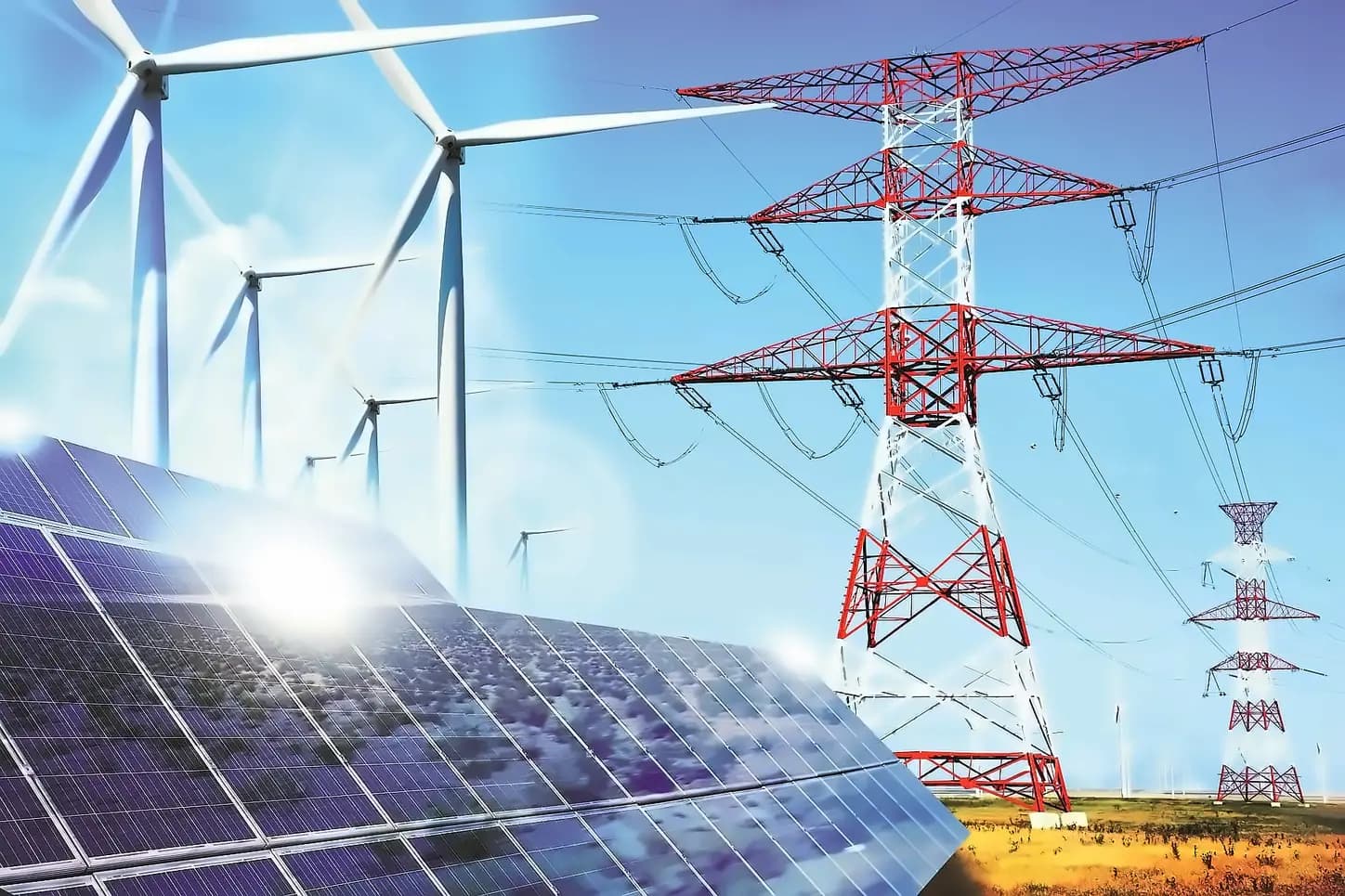
The Union Cabinet, chaired by Prime Minister Narendra Modi, has approved the ₹1.9 lakh crore Green Energy Corridor Phase-III (GEC-III) scheme aimed at strengthening the country's intra-state transmission system. According to reports from The Times of India, the scheme will enable evacuation of 135 gigawatt (GW) of renewable energy across states and Union territories, representing a significant expansion of India's green energy infrastructure capabilities. The scheme was officially approved on Wednesday and aims to develop harmonized and accelerated renewable energy access across India. Union Information Broadcasting Minister Ashwini Vaishnaw announced the initiative as PM DHARA (Developing Harmonized and Accelerated Renewable energy Access), emphasizing that managing high variations in renewable energy is a major challenge requiring grid design to handle load variations. The PM-DHARA scheme is particularly significant given India's ambitious target of 500 GW of renewable energy capacity by 2030.
The latest scheme will create 51,126 circuit kilometres of transmission lines and provide nearly 229 GVA of transformation capacity to strengthen intra-state transmission networks. As reported by The Times of India, this represents a significant expansion from previous phases, with the scheme including comprehensive battery energy storage systems with 50 gigawatt hour (GWh) of battery energy storage systems (BESS) deployment planned at renewable energy developer and generator locations. These systems will address intermittency, congestion, peak-hour curtailment and meet non-solar-hour demand, providing critical grid flexibility for renewable energy integration. The initiative will also include deployment of 50 GWh of Battery Energy Storage Systems at the Renewable Energy developer or generator end or any other significant location for grid flexibility. Under the program, renewable energy developers will receive support for setting up battery energy storage projects of 50 GWh capacity, with the scheme allocating ₹50,000 crore specifically for this component.
The total project outlay of ₹1,86,405 crore comprises ₹1,36,378 crore for the development of Intra-State Transmission Systems (InSTS) and ₹50,000 crore for 50 GWh of BESS over seven years. According to The Times of India, the scheme involves total central financial support of ₹54,082 crore, with central financial assistance helping offset intra-state transmission charges to keep power costs down. Santosh Kumar Sarangi, secretary, ministry of new and renewable energy, revealed that 70% of the scheme would comprise greenfield or new projects, which will be awarded through Tariff-Based Competitive Bidding (TBCB), with transmission service providers building, owning, operating and maintaining the assets under a Build-Own-Operate-Maintain (BOOM) model. The remaining 30% will comprise brownfield upgrades and network strengthening works, which will be executed on a Cost Plus Basis (CPB), with State Transmission Utilities serving as the overall implementing agency and Transmission Service Providers participating under TBCB.
The scheme addresses a critical challenge with more than 8,000 GWh of renewable energy being curtailed in Q1 of 2026-27 due to inadequate transmission networks. As reported by The Times of India, GEC-III is expected to address this problem to some extent by strengthening transmission infrastructure. To ensure project timelines are met, Sarangi announced that a project monitoring committee headed by a joint secretary will regularly review progress, while he will review projects every three months. Additionally, a steering committee at the level of cabinet secretary will monitor progress every six months, with the remaining projects under GEC-II also being monitored by the same committee. The ministry has also tied BESS deployment to domestic content requirements (DCR) to spur local manufacturing in the sector, with technical consultations planned to frame guidelines for DCR for locally made components.
The ₹1.9 lakh crore scheme represents a significant expansion from the ₹1.86 trillion allocated for previous phases, with the entire Capital Goods theme expected to benefit from this massive infrastructure buildout. According to The Economic Times, companies such as NTPC Green Energy, ACME Solar, Clean Max, Suzlon, Inox Wind, Larsen & Toubro, KEC International, Kalpataru Projects, GE Vernova T&D, Hitachi Energy India, Siemens Energy India, Apar Industries, Voltamp Transformers, Cummins India, ABB India and CG Power are positioned to benefit from implementation and buildout phases. Power Grid is also expected to be a significant beneficiary due to its near monopoly status in power transmission, while cable manufacturers like KEI Industries, Polycab and others with Medium Voltage Power Cables (MV) and Extra High Voltage (EHV) power cables capabilities will benefit from the transmission infrastructure development. Global brokerage Nomura has identified GE Vernova T&D India, Hitachi Energy India and CG Power and Industrial Solutions as top picks in the capital goods space, citing the sharply higher outlay and inclusion of BESS component under GEC-III as boosting demand visibility for transmission equipment manufacturers.