The West Bengal government has announced complete termination of all state welfare stipends and assistance projects allocated on religious grounds, with the policy shift immediately triggering widespread speculation about the continuity of long-standing state provisions. Municipal Affairs and Urban Development Minister Agnimitra Paul confirmed at Nabanna that financial aid run by the Department of Information and Cultural Affairs, alongside the Minority Affairs and Madrasah Education Department, will be permanently discontinued starting June 1. The decision represents a complete departure from the previous Trinamool Congress government's approach, which had introduced monthly stipends of ₹3,000 for imams and ₹2,000 for Hindu priests, with the financial assistance for imams launched in 2012 and aid for Hindu priests beginning in 2020 during the COVID-19 period. The policy shift has created intense speculation regarding the continuity of monthly financial allowances traditionally disbursed to local Muezzins and imams across the state.
One of the biggest announcements made by the West Bengal government was the approval of the 'Annapurna Bhandar' scheme under which eligible women beneficiaries will receive monthly financial assistance of ₹3,000 starting June 1. As reported by The Hindu BusinessLine, Zee News, and CNN News18, addressing a press conference after the cabinet meeting, state minister Agnimitra Paul confirmed that the cabinet has formally approved the scheme. The government further clarified that women who were enrolled in the previous Lakshmir Bhandar scheme will also receive benefits under the Annapurna scheme, and those whose names have been struck off the electoral rolls, but who have applied before tribunals or under the Citizenship Amendment Act (CAA) will be eligible to receive benefits. Women currently receiving benefits under Lakshmir Bhandar will be shifted to the new scheme through direct bank transfers, and those who have not yet enrolled would be able to apply once the portal opens on June 1. A dedicated portal will be launched for enrollment under the scheme, with the monthly assistance doubled from the previous ₹1,500 under Lakshmir Bhandar during the erstwhile Trinamool Congress government. Paul confirmed that women who have applied for citizenship under the Citizenship Amendment Act, or approached tribunals for inclusion in voter rolls amid the ongoing Special Intensive Revision exercise, would be eligible for Annapurna scheme benefits.
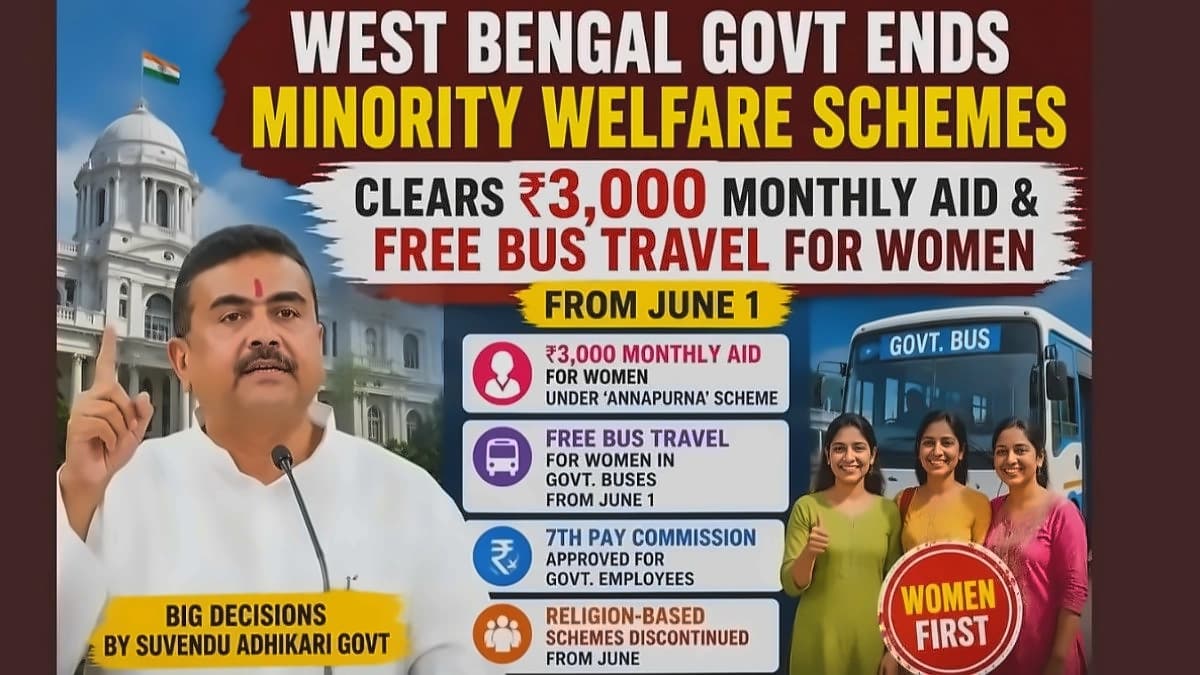
In another major welfare announcement, the West Bengal cabinet approved free bus travel for women in government-run buses across the state from June 1. According to reports from The Hindu BusinessLine, Zee News, and CNN News18, it is expected to benefit lakhs of daily commuters, especially working women, students and elderly passengers using state-run public transport services. The West Bengal government is following the lead of several states across India who are increasingly rolling out women-centric welfare measures, including free transport schemes and direct benefit transfers. As reported by Zee News, "The cabinet gave a nod to the Annapurna scheme of ₹3,000 monthly assistance to women from June 1. It also approved a proposal to allow free travel for women in government-run buses from next month," Paul told reporters. The announcement is expected to become one of the flagship welfare measures of the new administration, providing financial relief and improving mobility for women commuters.
Simultaneously with the welfare scheme announcements, the West Bengal cabinet resolved to completely reconsider and overhaul the existing list of Other Backward Classes (OBC) recognized for state government jobs and public posts. Minister Paul announced that the state cabinet has resolved to completely reconsider and overhaul the existing list of Other Backward Classes (OBC) recognized for state government jobs and public posts, citing the legal framework of the Calcutta High Court's landmark Division Bench verdict dated May 22, 2024. Under the previous framework, a significant majority of the communities listed under the OBC-A category—specifically 112 out of 118 communities—were from the Muslim underclass, while the OBC-B category included 65 Muslim communities out of 157 total listings, totaling roughly 177 Muslim groups receiving reservation benefits. The new administration has officially abolished all existing OBC sub-categories, with a new panel to be formed to determine quota eligibility afresh. The BJP government has also done away with the existing state OBC list in accordance with the Calcutta High Court judgement and would set up a panel to decide quota eligibility. A few days ago, the Suvendu government reportedly withdrew petition filed by Mamata government against the high court stay on state OBC list rollout.
In a significant development for state government employees, the West Bengal cabinet gave in-principle approval for the formation of the 7th Pay Commission for state government employees. According to the cabinet decision, the proposed 7th Pay Commission will cover West Bengal government employees, employees of government boards and corporations, staff working in state-aided bodies, employees of educational institutions and boards, school staff and allied statutory organisations. The announcement has brought fresh hopes for lakhs of state government employees and pensioners who have long been demanding salary revision and Dearness Allowance parity with central government staff. The cabinet decisions were announced today, as major political and administratively positive for the newly formed West Bengal government, with the announcements related to women's welfare, free transport and the 7th Pay Commission will directly impact lakhs of beneficiaries across the state.