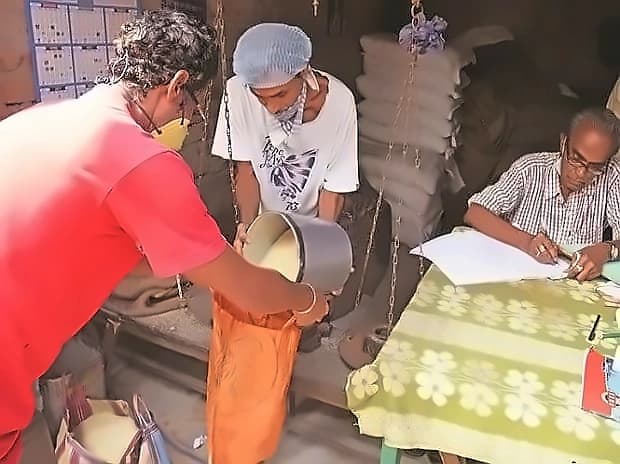
According to a study released in the latest edition of Sarvekshana, a journal of the National Statistics Office (NSO), free and subsidised goods from government welfare schemes have improved the standard of living of about 220 million Indians. The study finds that 15.8 per cent of the total population moved into a higher consumption class once the value of these in-kind transfers was counted. The goods include foodgrains from the Public Distribution System, pulses, sugar, salt and edible oil, as well as items such as school uniforms, school shoes, bicycles, mobile phones, tablets and laptops. As per the NSO study, a household that moved up was counted as having experienced an improvement in its level of living.
As reported by the NSO study, West Bengal led among the 18 major states in both rural and urban areas, with 40.5 per cent of the state's population moving into a higher consumption class. The state recorded 46.5 per cent of its rural population and 24.9 per cent of its urban population moving up a class. The smallest shares were in Gujarat (3.7 per cent) and Kerala (4.6 per cent). 18.8 per cent of India's rural population and 8.4 per cent of its urban population moved into a higher consumption class overall. According to the study, the largest upward movement was in the bottom three classes in both rural and urban areas, with the pattern holding across states where the poorest classes saw the largest improvement in 12 states in rural areas and 15 in urban areas.
According to the study, the authors used unit-level data from the NSO's Household Consumption Expenditure Survey 2022-23 to rank households by their monthly per capita consumption expenditure (MPCE) without these transfers and divided them into 12 classes, from the poorest 5 per cent to the richest 5 per cent. They then added the value of the free items, using the most common unit prices in the survey data, and tracked how many people moved into a higher class. Most of the movement was found at the bottom of the distribution, with rural India showing the share of people moving to the next higher class ranging from 4 per cent to 33 per cent, and urban India ranging from 1 per cent to 22 per cent. The authors observed that such lateral movement of the population resonates with the progressive nature of the social transfers, i.e., these are intended for the poor, not the rich.
As noted in the study, the transfers also narrowed consumption inequality slightly in 2022-23. The Gini coefficient fell from 0.266 to 0.261 in rural India and from 0.314 to 0.309 in urban India once the value of in-kind transfers was included. The authors concluded that the analysis emphatically shows the positive impact of in-kind social transfers in the level of living of the population belonging to the lower fractile classes, i.e., the population who deserves the in-kind transfers the most. They noted that such an improvement will definitely have its influence in reduction of incidence of poverty in the country and would be visible whenever official poverty estimates are made. According to the study, some schemes hand out bicycles, laptops, mobile phones and school uniforms regardless of a household's economic status, which may explain some upward movement among better-off households.