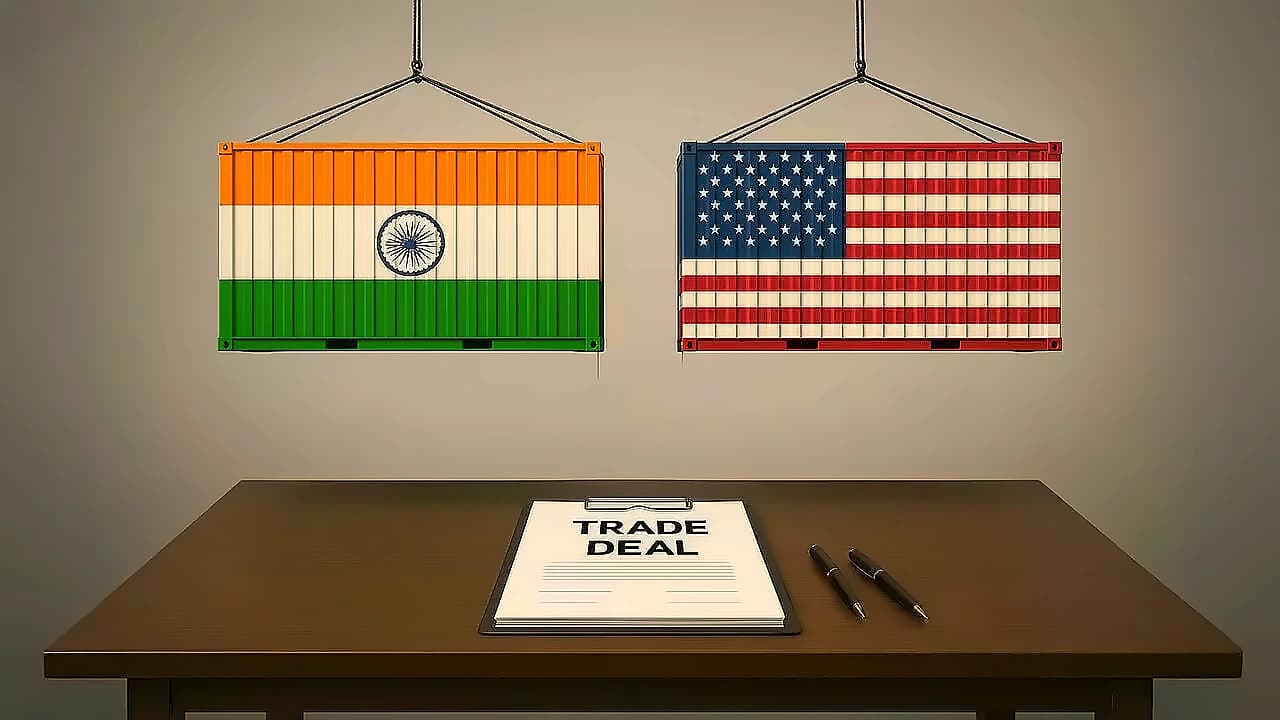
Brokerage firms JM Financial and Emkay Global have argued that the proposed 25% US tariff on Indian goods is a negotiating tactic rather than a punitive measure. According to their analysis, the 25% tariff rate is higher than the 15% rate applied to major surplus economies like the European Union, Japan, and Taiwan, leaving room for India to negotiate more favorable terms. Emkay Global stated that the rate could decline to 17% under an India-US trade deal, as reported by ET Now. The decision to levy tariffs is likely to be made in late January 2027 or even later, according to Jefferies research. This timeline provides India with significant negotiating space to address US concerns while maintaining market access.
The Indian government has strongly refuted Washington's accusation that it has structural excess manufacturing capacity, with the Ministry of Commerce and Industry declaring its commitment to an early finalisation of the bilateral trade arrangement. According to the official release, 'India engaged constructively throughout this investigation' and in response to the Notice of Initiation, the Department of Commerce stated that 'India does not have structural excess capacity in any sector'. The Ministry emphasized that 'Government of India remains committed to working closely with the United States towards the early conclusion of the India-U.S. Bilateral Trade Agreement' as announced on February 7, 2026 and in accordance with the Joint Statement issued on February 7, 2026. New Delhi has maintained that any trade issues should be discussed within the parameters of these ongoing negotiations, with India stating on multiple occasions that the deal has been finalised and will be signed once the US tariff framework is in place.
The Federation of Indian Export Organisations (FIEO) has sought clarity on how the proposed tariffs would interact with existing US levies and product exemptions. According to Business Standard, one question is whether ordinary US customs duty would count towards the conditional 17% rate. For example, an Indian garment valued at $100 attracting 12% ordinary US customs duty could face total duties of $17 or $29, depending on how the deal defines the 17% rate. If ordinary duty counts towards the 17%, the importer pays $5 in additional duty, taking the total to $17. If the 17% is charged separately, the importer pays $29 in all. Under the proposals for India and Bangladesh, ordinary Customs duty is payable separately. At the proposed maximum rates, a covered garment with 12% ordinary US Customs duty would face total duties of 37% from India and 30% from Bangladesh, assuming no other levies apply. If India secures the 17% rate and ordinary duty counts towards it, the Indian garment would have a 13-percentage-point duty advantage. If ordinary duty is charged separately, the advantage would shrink to one point.
The USTR report specifically targets India's manufacturing policies for creating structural excess capacity and impacting US-India trade relations. According to the latest USTR statement, India's 'unreasonable acts, policies, and practices include industrial plans to expand manufacturing, inadequate labour protections, financial repression policies, sustained market access barriers, and failure to address global excess capacity'. However, JM Financial argues that India, as a lower-middle-income country, must expand manufacturing and invest in foundational infrastructure (roads, ports, and power), whereas the post-industrial US is driven by services and private consumption. The report alleges that India's policies promote exports, creating unfair competition and a growing trade surplus with the US. The USTR highlights India's reliance on non-market economy inputs, which distorts competitive conditions and raises concerns about labor practices that lead to artificially lower labor costs and impact worker welfare. The document specifically mentions major programmes such as Make in India, Production Linked Incentives (PLI), Atmanirbhar Bharat (Self-Reliant India), and the India Brand Equity Foundation (IBEF).

The US has been India's largest trading partner since 2021-22, with exports growing 0.92% to USD 87.3 billion during 2025-26, while imports increased 15.95% to USD 52.9 billion. India's trade surplus with the US declined to USD 34.4 billion in 2025-26 from USD 40.89 billion in 2024-25. The US is India's largest export destination for sectors such as textiles, pharmaceuticals, engineering goods, gems and jewellery, chemicals and electronics. About 19.8% of India's merchandise exports go to the US but they constitute only about 3.02% of total US imports. The Global Trade Research Initiative sees the gap between the proposed maximum of 25% and the conditional 17% as pressure on India to accept a one-sided deal. The USTR has scheduled public hearings on its proposals on January 25 and has sought written comments from interested persons by January 5 as part of the final regulatory requirements before the tariffs come into effect. The latest developments suggest that India intends to purchase USD 500 billion of US energy products, aircraft and aircraft parts, precious metals, technology products, and coking coal over the next 5 years.