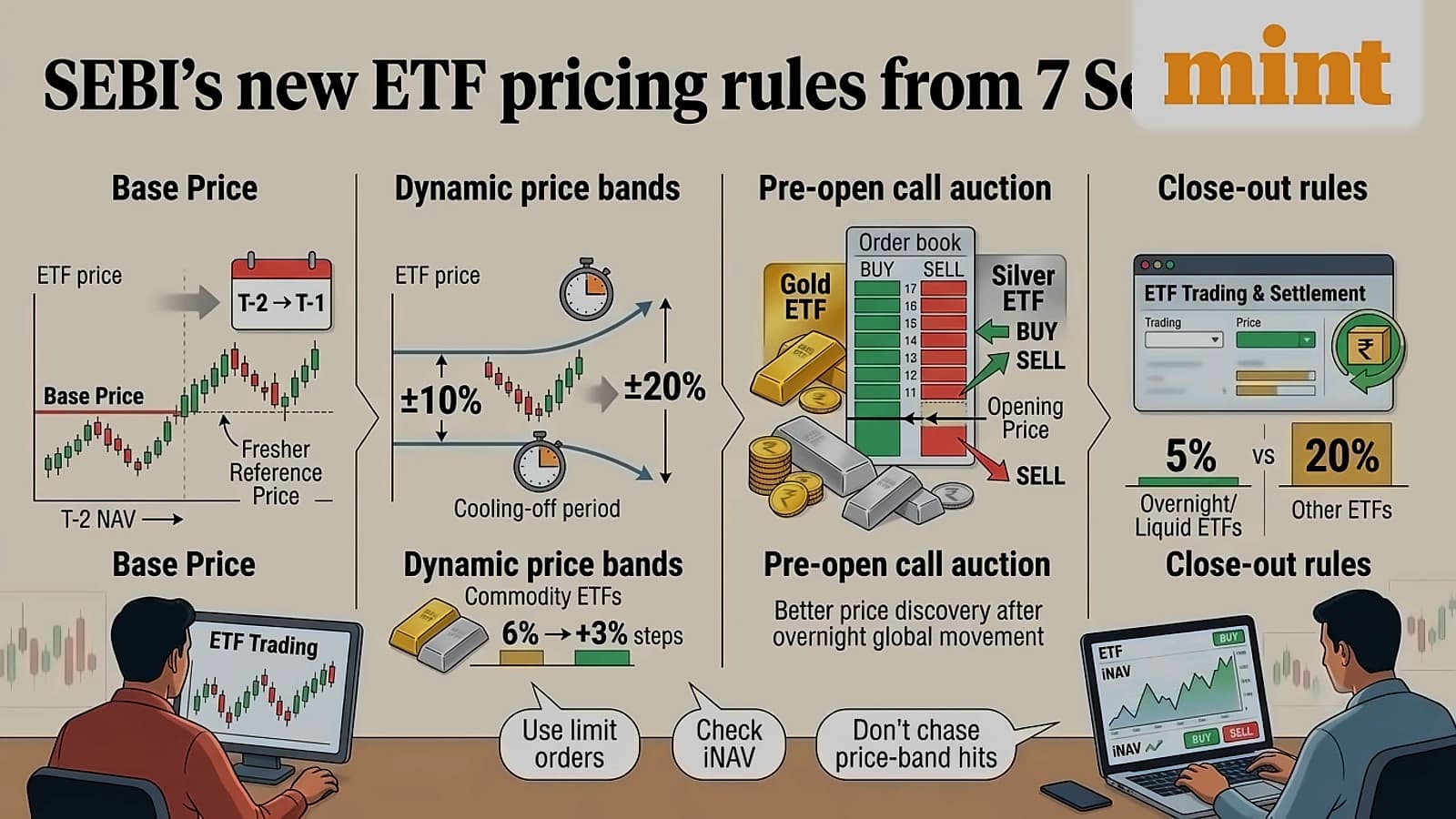
Markets regulator SEBI has introduced a new framework for exchange traded funds (ETFs), replacing the existing fixed price band mechanism with dynamic price bands for most ETF categories and changing the method used to determine their base price. The changes will come into effect from September 1, 2026, according to a circular issued by the regulator. Under the revised framework, equity ETFs and debt ETFs, excluding overnight and liquid ETFs, will have an initial dynamic price band of 10%, which can be expanded up to 20% after a cooling-off period. The price band will be widened by 5% increments if prices hit the upper threshold during trading. Commodity ETFs tracking gold and silver will have an initial price band of 6%, which can be expanded in stages of 3% depending on market conditions and international commodity price movements. As per The Economic Times, the regulator said the existing framework creates challenges because of the one-day lag in price discovery and because the fixed bands do not adequately reflect movements in the underlying assets.
SEBI has also changed the methodology for determining ETF base prices, with exchanges now using the previous day's closing price, calculated as the volume-weighted average price (VWAP) during the last 30 minutes of trading. If there is no trade during that period, the last traded price will be used. In the absence of any trading, the latest available NAV will serve as the base price. The regulator said stock exchanges and asset management companies should work towards using the T-1 day closing NAV as the base price from April 1, 2027, subject to operational readiness. This represents a significant departure from the current system where ETFs are subject to a fixed 20% price band based on the net asset value (NAV) from two trading days earlier. Currently, equity, debt and commodity ETFs are subject to a fixed 20% price limit, while overnight ETFs operate with a 5% band. As per The Economic Times, considering the operational challenges in usage of T-1 day closing NAV as base price, to start with, the base price for determination of price bands of ETFs would be T-1 day closing price, i.e. last 30 minutes of volume weighted average price (VWAP) of the ETF.

Under the new dynamic framework, equity and debt ETFs will initially trade within a 10% band on either side of the base price, with a 15-minute cooling-off period triggered when trades occur at or above 9.90% of the band limit. After the cooling-off period, the band can be expanded by 5% of the base price, allowing the effective band to widen to 20%. The process can occur twice in one direction, with where the trigger occurs during the last 30 minutes of trading, the cooling-off period will be reduced to five minutes. The expanded band will apply across all stock exchanges and will widen only in the direction of the price movement. Overnight ETFs and liquid ETFs will continue to operate under a fixed 5% price band. Unlike equity and debt ETFs, there will be no cap on the number of times price bands for commodity ETFs can be expanded during a trading session, with stock exchanges allowed to relax limits further in exceptional circumstances if international commodity prices move beyond the aggregate domestic price limit after Indian markets have closed.
In another key change, SEBI has mandated a pre-open call auction session for gold and silver ETFs to improve price discovery, given that the underlying commodities trade continuously across international markets while domestic ETFs trade only during Indian market hours. The regulator said the changes were based on recommendations from a working group of stock exchanges, deliberations by SEBI's Secondary Market Advisory Committee and feedback received through a public consultation process that started in February. The new framework aims to improve price discovery, better reflect underlying asset movements and enhance trading efficiency across equity, debt and commodity ETFs, addressing the current anomaly where exchanges independently calculate circuit limits using their own previous closing prices. The changes follow recommendations from a working group of stock exchanges, deliberations by SEBI's Secondary Market Advisory Committee and feedback received through a public consultation process that started in February.
To operationalise the framework, stock exchanges must enter into necessary agreements or make suitable arrangements for sharing closing-price data to facilitate the smooth implementation of the mechanism, as reported by The Hindu BusinessLine, Mint, CNBC TV18, Zee News, and latest developments. The inter-exchange data sharing arrangement is presented as a practical foundation without which the harmonised price band mechanism could not function reliably. The proposal follows recommendations made by the Secondary Market Advisory Committee after its deliberations in April. Public comments on the consultation paper have been invited until July 2, 2026, giving market participants, exchanges and other stakeholders roughly three weeks to respond. SEBI has also sought feedback on whether similar treatment should be extended to stocks with extremely low trading activity rather than only those that record no trades during a session. The changes are expected to primarily affect illiquid and small-cap stocks that do not trade regularly across all exchanges, while actively traded securities are likely to see little impact.