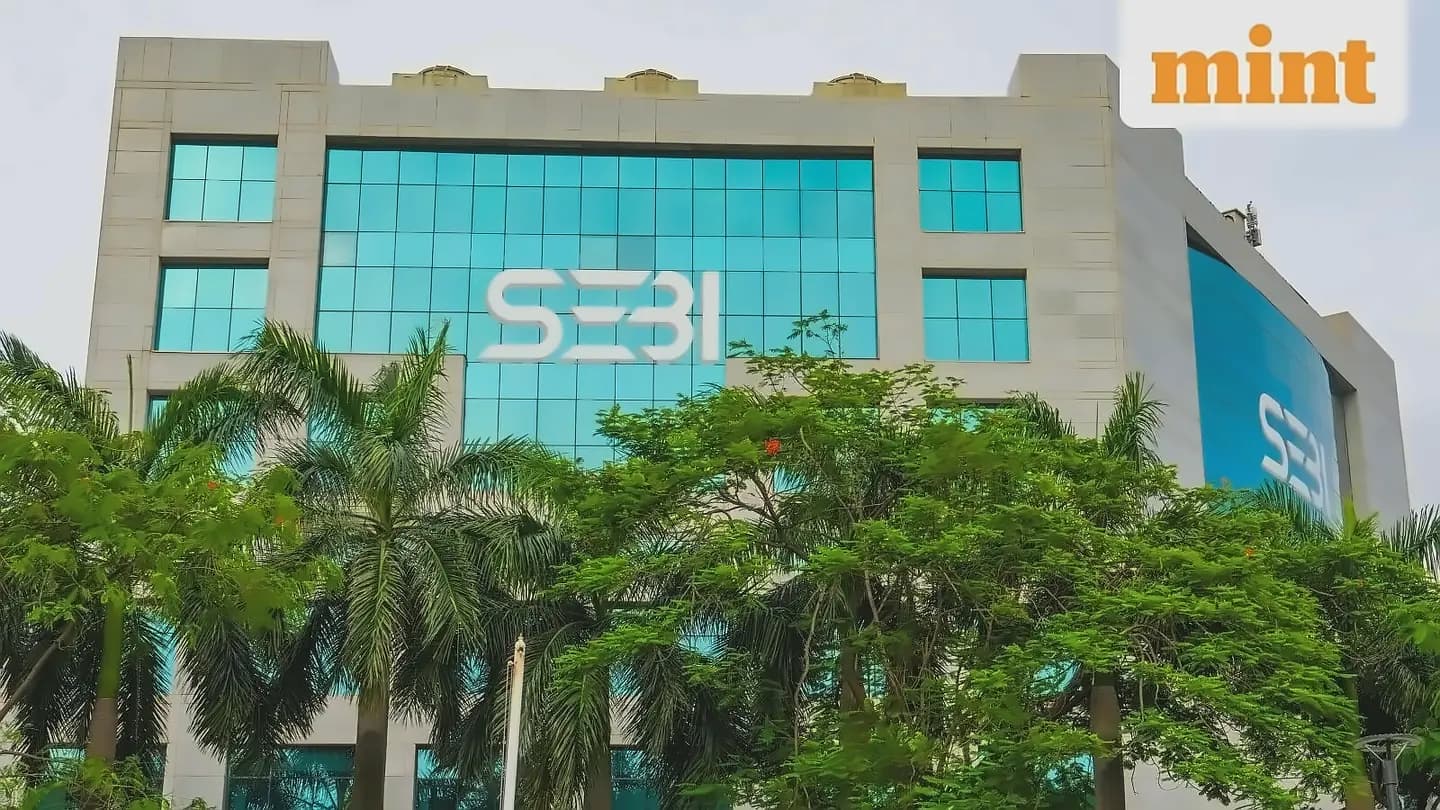
The Securities and Exchange Board of India (Sebi) board is scheduled to discuss several key regulatory proposals at its 24 September meeting, according to reports from Mint, The Hindu BusinessLine, and Business Standard. The board will primarily focus on Portfolio Management Services (PMS) framework expansion and Foreign Portfolio Investor (FPI) participation in commodity derivatives. Additionally, the meeting will address settlement framework reforms and depository receipts for Real Estate Investment Trusts (ReITs) and Infrastructure Investment Trusts (InvITs). The latest reports indicate the board may also consider expansion of the regulatory framework for vault managers and changes to debt market rules, among other significant regulatory changes. As per Business Standard, reforms for debt segment and accredited investors are also on cards, with gift cards for MFs may not be approved. According to Zee News, SEBI is preparing a range of measures to make Indian capital markets more accessible, efficient and resilient, with a particular focus on foreign investors, corporate bond markets and new investment products.

In a July consultation paper, Sebi proposed introducing mutual-fund-only PMS schemes, which would allow portfolio managers to offer professionally managed portfolios of mutual fund investments. According to Mint reports, under the proposal, portfolio managers could exclusively manage client money in direct plans of mutual fund schemes, including exchange-traded funds and specialized investment funds, through a separate MF-PMS registration. The current PMS minimum investment threshold of ₹50 lakh would remain unchanged, while the framework would expand investment universe to include unlisted securities and overseas markets through listed foreign equities and real estate investment trusts. Latest reports from The Hindu BusinessLine reveal that Sebi has also suggested widening the investment universe available to PMS firms, including permitting investments in yet-to-be-listed securities and allowing discretionary portfolio managers to invest up to 10 per cent of a client's assets under management in investment-grade unlisted debt securities. As per Business Standard, the overhaul of regulations governing portfolio management services (PMS) may allow a new mutual fund-only PMS with lower entry barriers.
Sebi Chairman Tuhin Kanta Pandey announced at the 11th JP Morgan India Conference that the regulator is working to simplify digital onboarding for persons resident outside India and widen participation by foreign portfolio investors (FPIs) in non-agricultural commodity derivatives. According to Business Standard, the regulator's approach has been to reduce friction across the entire investment journey, with SWAGAT-FI reflecting this approach for trusted, low-risk investors, with around 205 FPIs already using the framework since it became operational from June 1, 2026. Pandey emphasized that the regulator's approach going forward would centre on easier access, deeper markets and greater resilience, with designated depository participants already using digital workflows and application programming interface-based integration to cut FPI onboarding timelines. The onboarding procedures are becoming faster, more digital and proportionate to risk, as highlighted by Zee News. The regulator wants such technology-led solutions adopted more widely so that 'ease of access' becomes a systemic feature rather than an exception.
According to Zee News, SEBI is also consulting on the introduction of Fixed Income Channel Partners to expand distribution through regulated online bond platforms and considering a Credit Risk-o-Meter framework to help investors better understand credit risks associated with debt instruments. On the corporate bond market, work is underway on a market-making framework aimed at improving liquidity, infrastructure and access to the repo market. As per Zee News, SEBI will continue efforts to broaden participation in the cash market while strengthening securities lending and borrowing mechanisms and promoting hedging and arbitrage activities to improve price discovery. The regulator is also consulting on net settlement of funds for mutual fund schemes in the cash market, demonstrating comprehensive approach to enhancing market structure across multiple segments.
SEBI Chairman Tuhin Kanta Pandey announced at the 11th JP Morgan India Conference that the regulator intends to address concerns over settlement price for derivatives on expiry days and other related issues. To address market participants' concerns, Sebi floated a consultation paper on September 12 seeking public comments on proposed changes to the methodology for determining expiry-day settlement prices of index and single-stock derivatives. The proposals include delinking derivatives' settlement prices from the cash-market closing price, discontinuing live indicative index values during the CAS, and making orders placed beyond the one per cent band more binding. According to The Economic Times, Pandey stated that 'Having successfully established the Closing Auction Session as an important market structure reform, we intend to address concerns in respect of settlement price for derivatives on expiry days and other related issues'. The regulator proposed two options for determining settlement prices: the first called Blended VWAP, based on transactions executed during the last 30 minutes of the Continuous Trading Session (CTS) and the 10-minute CAS, with no fixed weight assigned to either period, and the second continuing with the existing CTS Volume weighted average price (VWAP) methodology. The CTS VWAP could be retained as an interim methodology to provide continuity, with transition to blended VWAP after at least one year subject to adequate liquidity and participation in CAS. Market participants are more in favour of the second option of reverting to the VWAP system for now, as reported by The Economic Times.