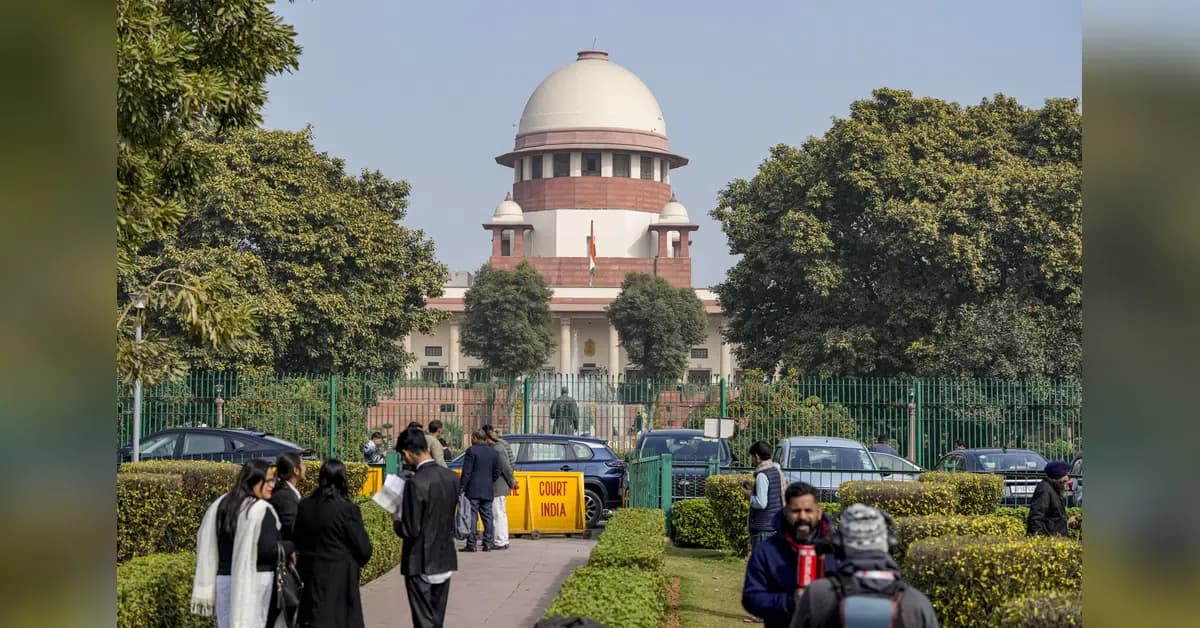
The Supreme Court has delivered a significant ruling on contractual freedom, holding that courts cannot rewrite commercial agreements voluntarily accepted by parties. According to reports from Business Standard, a Bench of Chief Justice Surya Kant and Justice V Mohana set aside a Punjab and Haryana High Court ruling that had declared a contract clause invalid. The dispute centered on a mining contract awarded by the state to Jai Durgaa Finvest for sand extraction, where Clause 19 stated that the contractor's security deposit would not carry interest and would be refunded within three months of contract expiry.
The High Court had previously held Clause 19 to be contrary to public policy and ordered the Haryana government to pay interest on the security deposit from the date it was made. As reported by Business Standard, after the contractor defaulted on payments, the state terminated the agreement in March 2000 and forfeited the security deposit. The High Court later ruled that the clause was oppressive and awarded 9 per cent annual interest from the date of deposit. However, the Supreme Court reversed this decision, stating that public policy cannot be used to set aside commercial contracts that expressly deny interest on security deposits.
The Supreme Court emphasized that contractual terms must be enforced as agreed, with the court stating it will not rewrite contract terms once parties have voluntarily accepted them. According to Business Standard, the court reiterated that parties cannot assail commercial contracts merely because stipulations prove onerous. The Bench held that Clause 19 was valid and binding, while clarifying that the clause also required the state to refund the security deposit within three months of contract ending. The court ruled that the contractor would be entitled to simple interest at 9 per cent per annum from June 9, 2000, until the security deposit was adjusted against outstanding dues or refunded.
The ruling establishes important precedent for commercial contract enforcement in India. As reported by Business Standard, the Supreme Court set aside the High Court's direction awarding interest from the date of deposit while retaining the 9 per cent rate for the delayed period. The decision reinforces that courts cannot use public policy to override voluntarily accepted contractual terms, provided they are not contrary to law or morality. This ruling is expected to impact how courts approach commercial contract disputes involving security deposits and interest clauses in the future.