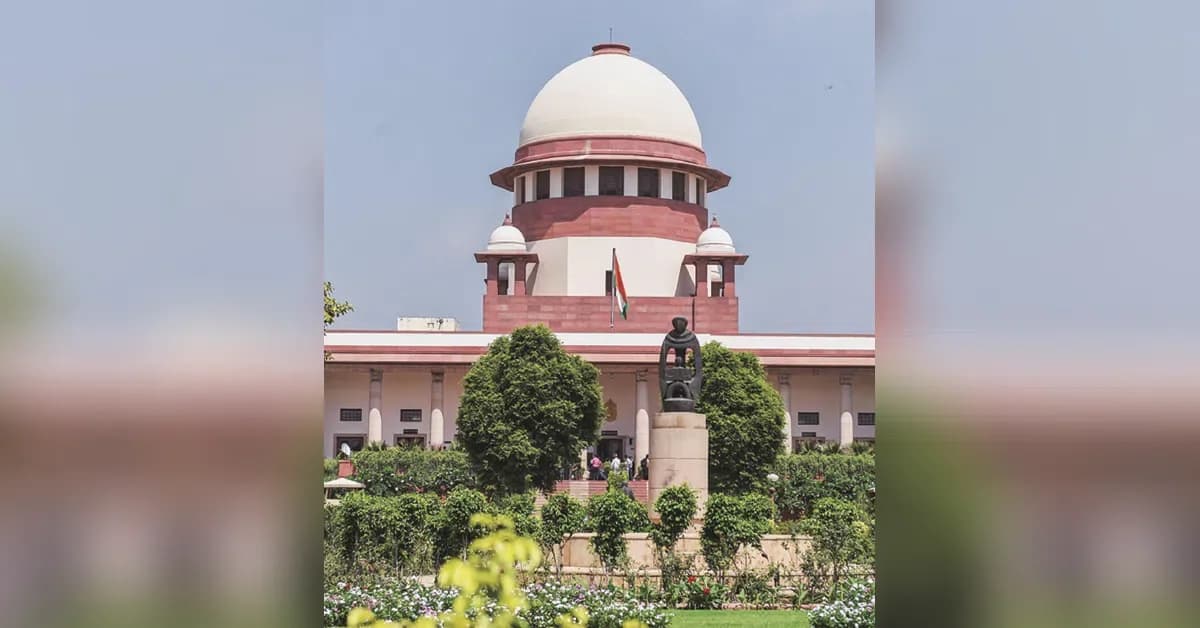
The Supreme Court on Wednesday sought responses from the Centre and the Central Board of Secondary Education (CBSE) on a petition filed by 30 Class XII students from CBSE-affiliated schools in Gulf countries. According to reports from Business Standard, a Bench of Justice KV Viswanathan and Justice Alok Aradhe issued notice on the plea and directed that a copy of the petition be served on the Solicitor General to assist the court. The matter came up before the apex court with the students represented by advocate Raj Kishore Choudhary. As per latest reports, the Supreme Court on Wednesday (July 8, 2026) issued notice on the petition and directed that a copy be served on the office of Solicitor General Tushar Mehta. The matter has been posted for further hearing on July 14.
The petition has sought comprehensive compensatory measures for affected students, including one-time moderation and grace marks to recognize the adverse impact of the regional conflict. According to ETEducation, the plea has prayed for directions to conduct Special Fresh Examinations and Special Improvement Examinations in all subjects without restricting the number of subjects that may be opted for, while allowing students to retain whichever result is more beneficial to them through a 'better-of-two' protection. The petition also seeks directions for the formulation of a transparent, time-bound review, verification and grievance redressal mechanism for students assessed under the March 27 assessment scheme. Additionally, it has sought one-time relaxation in the eligibility criteria under the Direct Admission of Students Abroad (DASA) Scheme by reducing the minimum aggregate marks requirement from 75 per cent to 60 per cent for the academic session 2026-27, along with similar relaxation for admissions under the Children of Indian Workers in Gulf Countries (CIWG) category.
On June 22, the Centre informed the Supreme Court that the CBSE had introduced a new evaluation policy for private students affected by the cancellation of Class XII board examinations in Gulf countries due to the war. According to reports from Business Standard, the Solicitor General, appearing for the Centre and the CBSE, said that a fresh all-India policy was framed to address the concerns of similarly situated students affected by the cancellation of examinations in the Gulf countries due to the regional conflict. Under the new policy notified on June 21, a distinct formula was developed specifically for private students. For subjects for which an examination could not be held, the performance would be assessed based on the marks obtained by the private candidate in Class X and the last-attempted Class XII board examination. The new policy addresses the unique challenge posed by private candidates who had no school to supply internal assessment records such as quarterly, half-yearly and pre-board examination marks, which were the basis of the original March 27 evaluation scheme.
The petition contends that the formula has drastically lowered students' marks and jeopardised their higher education prospects. According to Business Standard, it argues that many candidates have fallen short of the 75 per cent aggregate required under the Direct Admission of Students Abroad (DASA) and Children of Indian Workers in Gulf Countries (CIWG) admission schemes despite otherwise being academically strong. The plea settled by advocate Vineet Jindal described the scheme as arbitrary, unreasonable and violative of Articles 14 and 21 of the Constitution. The petitioners contend that the CBSE's "Assessment Scheme for Declaration of Results of Class XII in West Asian Countries," issued on March 27, 2026, has caused serious prejudice by relying solely on school-level quarterly, half-yearly, and pre-board examinations for cancelled papers. As per the latest reports, the petition assails the assessment scheme as "arbitrary, unreasonable and violative of Articles 14 and 21 of the Constitution" and argues that the scheme is arbitrary and contrary to the doctrine of legitimate expectation.
The students also claim that several students have either been declared failed or placed in the compartment category despite maintaining consistently good academic records. According to Business Standard, this represents a significant concern for students who had been performing well in their studies before the examination cancellations due to security concerns arising from geopolitical tensions in the Gulf region. According to the latest reports, the petition states that "historically, students demonstrate significant improvement between pre-board assessments and the actual board examinations after focused preparation during the final months of Class XII." The plea contends that the impugned assessment methodology resulted in a distorted evaluation of merit and failed to accurately reflect the actual academic capability and board-level preparedness of affected students. The Supreme Court is also hearing a separate plea filed by a private candidate from Al Jubail, Saudi Arabia, who had challenged CBSE's failure to declare his Class XII improvement examination results as per the original evaluation scheme. The Class XII board examinations were cancelled by the CBSE in seven West Asian countries (Bahrain, Iran, Kuwait, Oman, Qatar, Saudi Arabia and the UAE) due to the conflict in West Asia.