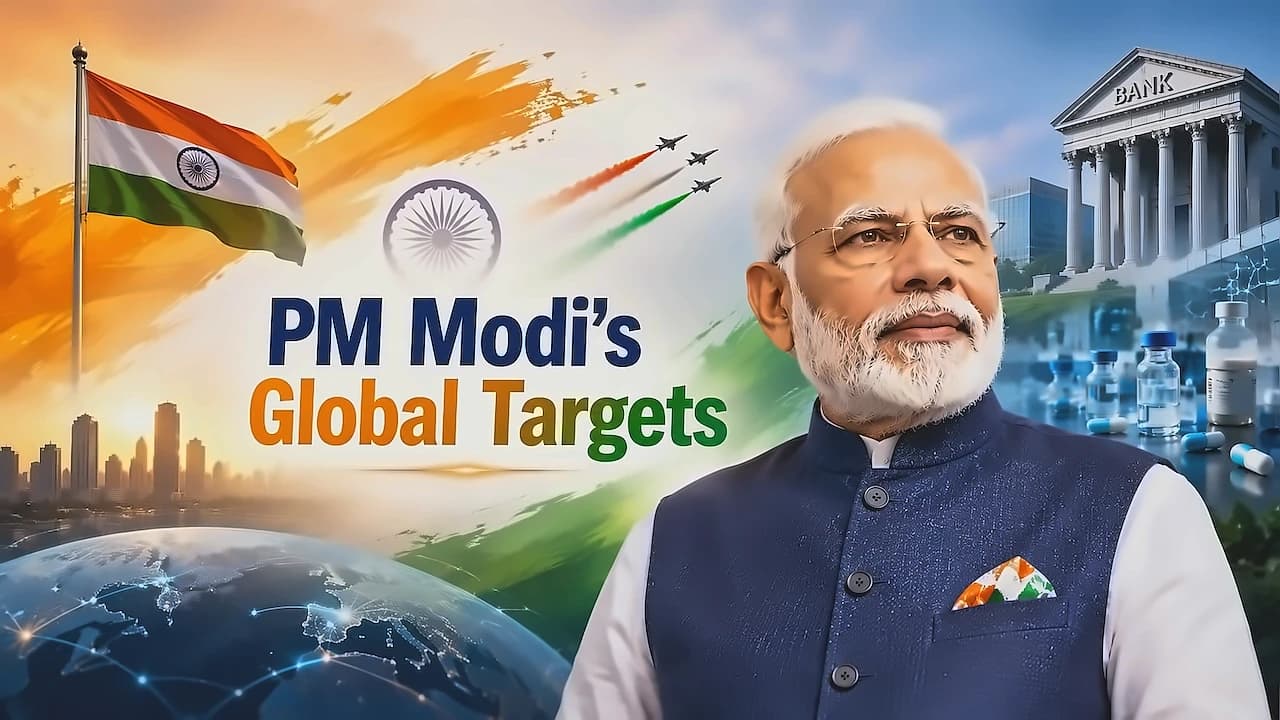
Prime Minister Narendra Modi has set three ambitious targets for Indian companies as he outlined his vision for India Inc to build a stronger global presence on this Independence Day. Addressing the nation from the Red Fort, Modi said India's economic growth must be matched by the emergence of globally competitive companies with a larger international footprint. The targets include having at least one Indian bank and one Indian pharmaceutical company among the world's top five, along with 50 Indian companies featuring in the Fortune 500. The targets reflect the government's broader push to help Indian businesses expand in scale, competitiveness and global reach, with Modi emphasizing that Indian companies should aim higher and build businesses capable of competing with the world's largest corporations.
Currently, there are 10 Indian companies that rank in the Fortune 500 global list for the year 2025. Of these, Reliance Industries (RIL) and the Life Insurance Corporation of India rank among the top 100, while Indian Oil Corporation (IOC), State Bank of India (SBI), Oil and Natural Gas Corporation (ONGC), HDFC Bank, Bharat Petroleum Corporation, Tata Motors Passenger Vehicles, and ICICI Bank rank between 130 and 471 on the list. The Fortune 500 list, published by Fortune, is an annual ranking of the world's 500 largest companies by revenue, with the combined Fortune 500 universe generating ₹341 lakh crore in revenue in 2025, representing over one-third of the world's GDP.
One of the targets is for at least one Indian bank to feature among the world's top five. As reported by Essential Business Intelligence, Indian banks have grown significantly in scale over the past decade, supported by rising credit demand, digital banking and rural penetration. The banking sector's growth trajectory has been substantial, with the sector now positioned to compete on a global scale. Modi emphasized that the banking sector in India is flourishing and called for one Indian bank to be among the top five globally, highlighting the sector's potential to establish itself among the world's leading financial institutions.
Prime Minister Modi has now specifically urged for one or two Indian pharmaceutical companies to be among the top five global corporations. Speaking on the 80th Independence Day, Modi emphasized that "We have done significant work in the pharmaceutical sector, but the need of the hour is for one or two Indian companies to feature prominently among the global top five. India must secure its place there." With pharmaceutical exports to 191 countries in 2024-2025, India currently ranks 11th in the world by value and third globally by volume. The sector's yearly turnover reached ₹4.72 lakh crore in FY25, with exports increasing at a compound annual growth rate of 7% over the previous 10 years (FY15 to FY25). India is the world's biggest provider of generic medications, making up about 20% of the worldwide supply with 60,000 generic products produced in 60 therapeutic categories.
Modi also urged Indian micro, small, medium enterprises (MSMEs) to make the most of the country's trade agreements and take domestic products to global markets. The Prime Minister highlighted that India has trade agreements with around 40 countries, creating significant opportunities for MSMEs to expand their reach internationally. As reported by Essential Business Intelligence, Modi emphasized that "these trade agreements that have been made are a huge opportunity" and urged MSMEs not to miss these opportunities. He pointed to Indian agricultural products, including shrimp, reaching international markets, and said Indian products should increasingly move from farms and factories to consumers around the world.
The Prime Minister's larger economic target is to build Indian companies and products that can compete in the global markets as the country works towards becoming a developed economy by 2047. Modi pointed to the changes of the past 12 years to make the case for this faster pace, highlighting that defence production has increased nearly fourfold, khadi and village industries production nearly fivefold, and electronics manufacturing nearly sevenfold. He also noted that production of modern railway coaches has increased 21 times, mobile phone production has risen 33 times, and digital transactions have grown 100 times. The targets form part of the Prime Minister's wider economic vision, which places manufacturing, technology, innovation and international trade at the centre of India's next phase of growth, with the next phase being driven by "Shakti ki Sapt Dhara", or seven streams of strength: manufacturing, agriculture and food processing, technology and innovation, connectivity and infrastructure, defence, the green and blue economy, and India's soft power.