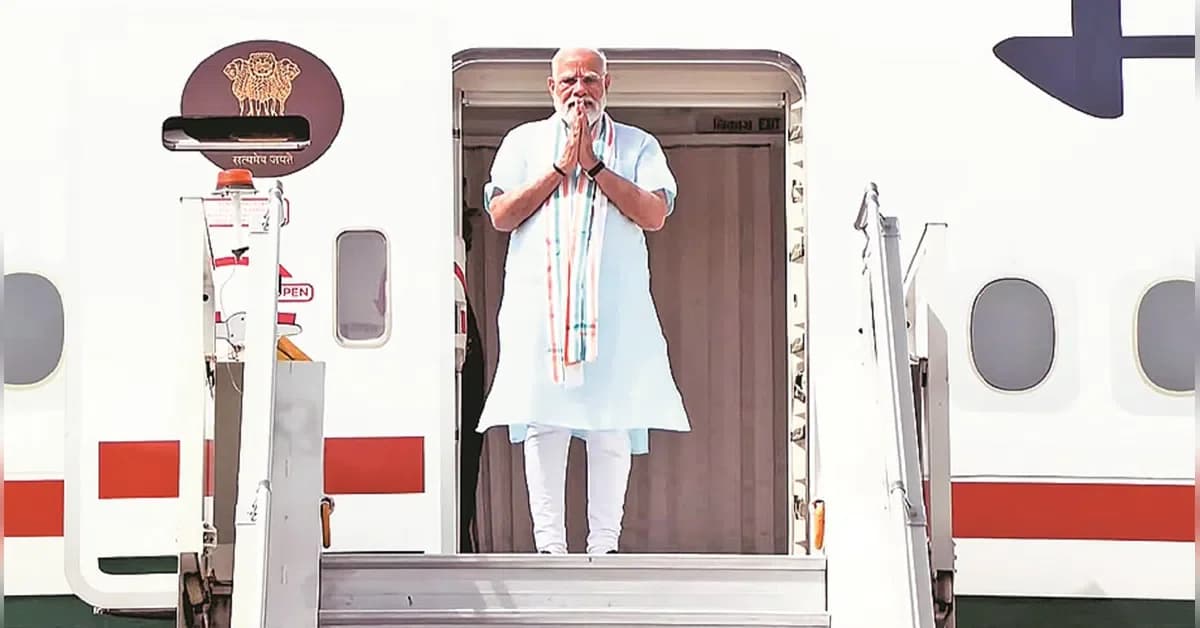
Prime Minister Narendra Modi's recent five-nation tour has emerged as a defining moment for India's green diplomacy, securing nearly $40 billion in investments across the UAE, Netherlands, Sweden, Norway and Italy. According to latest reports, the tour's agenda was dominated by clean energy, green technology, shipping, the blue economy and climate resilience, highlighting how environmental and economic stakes have converged at a moment of global uncertainty. The tour's success demonstrates how India's engagement abroad is no longer confined to conventional diplomacy, but strategically investing in partnerships that secure long-term strategic interests, including energy security. Modi's multi-nation visit has elevated India's position as both a beneficiary and driver of the global energy and climate agenda, with the emphasis on convergence around clean energy, green technology and climate resilience advancing self-reliance while shaping global environmental discourse.
The tour secured significant strategic partnerships across multiple countries, with the Green Strategic Partnership with Norway elevating cooperation in clean energy, Arctic collaboration, defence technology, and other areas. With Sweden, the partnership focuses on green transition and resilient supply chains, while with the Netherlands, engagement encompasses solar innovation, green hydrogen, storage and renewable investments, alongside maritime and sustainable agriculture. In Italy, Prime Minister Modi and his counterpart agreed to strengthen the 2025-2027 Executive Programme for Scientific Cooperation, promoting joint research in renewable energy, quantum technologies, green hydrogen and the blue economy. The tour's timing and scope are particularly pivotal amid global supply-chain disruptions and mounting pressure on fossil-fuel systems, with India's diversification of its energy basket through diplomatic channels being both a pragmatic and economic necessity.
India has significantly ramped up its climate commitments, pledging a 60 per cent rise in installed non-fossil-fuel capacity, a 47 per cent reduction in emission intensity, and the creation of a 3.5-4.0 billion-tonne CO2 sink by 2035, aligned with Net Zero 2070 and Viksit Bharat 2047. As reported by multiple sources, this commitment underscores India's sincerity towards meaningful climate goals and is further complemented by strengthening grassroots institutions, developing a carbon-market framework, infrastructure for clean and green transition, and increased climate resilience. India is also driving crucial international initiatives such as the International Solar Alliance, CDRI, LEADIT and circular-economy forums, showcasing its capacity to lead the global energy and climate agenda. The country's decision to ratchet up its Nationally Determined Contributions (NDCs) demonstrates its active, assertive and confident approach to environmental governance.
Addressing the gathering after inaugurating and laying foundation stones for development projects worth ₹18,000 crore, Modi detailed how the current global crises had underlined the importance of atmanirbharta, or self-reliance, in the energy sector. As reported by Business Standard, he highlighted the crucial role played by the country's efforts over the last 12 years to diversify its sources of oil supplies and build renewable energy capacity. The PM detailed how India's solar energy generation grew to 250 GW from low level, ethanol blending capacity expanded, Railway electrification accelerated, nuclear energy initiatives advanced, power transmission networks were modernised, gas pipeline coverage expanded, and port capacities to facilitate transport and storage of petroleum products were modernized and enlarged. Modi emphasized that the government secured oil and gas supplies from various parts of the world while ramping up historic investments in renewable energy, with Gujarat alone contributing 50 GW to India's total renewable energy capacity of 250 GW.
Addressing the gathering, Modi stated that the country clocked 7.7 per cent gross domestic product (GDP) growth in FY26, with the expansion being 7.8 per cent in the January-March quarter, emphasizing that India is the fastest growing major economy in the world. The PM also highlighted how India's diplomatic strength on the environmental agenda emerges largely from a wide array of domestic climate and environmental initiatives, with the country positioning itself as both a beneficiary and driver of the global energy and climate agenda. By aligning with European countries on green partnerships, India maintains its long-standing Global South position on equity while unlocking finance and technical expertise. The tour's success reflects how India's approach is active, assertive and confident, with the country securing convergence with European countries on clean energy and climate action that reflects a shift in mindset from traditional climate negotiations to practical partnerships for sustainable development.