The Supreme Court has upheld that Aadhaar cannot be regarded as proof of citizenship or domicile, according to a 124-page verdict delivered by Chief Justice Surya Kant and Justice Joymalya Bagchi. The court clarified that the law governing the 12-digit unique identification number does not recognise Aadhaar as proof of citizenship or domicile, noting that Aadhaar was designed as an identity document and not as evidence of citizenship status. The Election Commission was justified in not treating Aadhaar as a primary document for establishing eligibility to vote, as the court emphasized that Aadhaar is not conclusive proof and authorities retain the power to seek further material if necessary. The judgment reaffirmed that preparation of electoral rolls is not a mechanical exercise but a constitutional responsibility that requires careful verification of statutory conditions. On 27 May 2026, the Supreme Court upheld the Election Commission's revision of Bihar's electoral rolls but clarified that the Commission may examine citizenship only to decide voter-roll eligibility — a check that is not a final declaration of citizenship. In a separate development, the Supreme Court recently issued notices to the Centre, states and Union Territories on a petition alleging misuse of Aadhaar cards as proof of citizenship, domicile and residence.
The central government issued a clarification on Thursday asserting that an Indian passport has "never been treated as conclusive proof of citizenship", stressing that the position is neither new nor recently adopted. This comes a day after the Ministry of External Affairs (MEA), during a media briefing on 24 June 2026, stated that a passport is primarily a "travel document" and should not be viewed as definitive proof of citizenship. The remarks drew criticism from sections of the Opposition, with Rajya Sabha MP Kapil Sibal questioning the implications of the MEA's remarks, writing on X: "MEA June 24, 2026: "A passport is a travel document, and not a document of citizenship." Which document then is proof of citizenship? BLO can doubt my citizenship Deprive me of my vote Result BJP wins the election Over to Supreme Court!" Lyricist Javed Akhtar also called MEA's statement "absurd" and questioned whether the ministry is issuing passports to non-Indian citizens as well. The BJP, however, accused critics of misrepresenting a long-settled legal position, with BJP IT department head Amit Malviya stating that the MEA has not announced a new policy but merely reiterated a settled legal position. The renewed debate follows after an official from the Ministry of External Affairs clarified that the Indian passport is a travel document and not proof of citizenship, stating the passport is primarily meant for international travel and is meant to identify a person's nationality while abroad.
The government's clarification cited Section 20 of the Passports Act, 1967, which empowers the Centre to issue passports or travel documents to non-citizens in certain circumstances. The provision states, "Notwithstanding anything contained in the foregoing provisions relating to issue of a passport or travel document, the Central Government may issue, or cause to be issued, a passport or travel document to a person who is not a citizen of India if that Government is of the opinion that it is necessary so to do in the public interest." The legal position has also been upheld by courts, including the Bombay High Court, which ruled in 2013 that possession of a passport alone does not establish Indian citizenship. As reported by ANI, Malviya further cited court rulings and provisions under the Citizenship Act, arguing that citizenship is determined through eligibility and documentary evidence rather than any single document. Citizenship in India is established through a range of records, including birth certificates, electoral rolls, school records, government service records, residence documents and passports, among others. Under the Passports Act, 1967, the Central Government has the power in specified circumstances to issue a passport or travel document even to a non-citizen, indicating that the Act is not concerned exclusively with citizens and contemplates issuance in public-interest circumstances involving non-citizens as well.
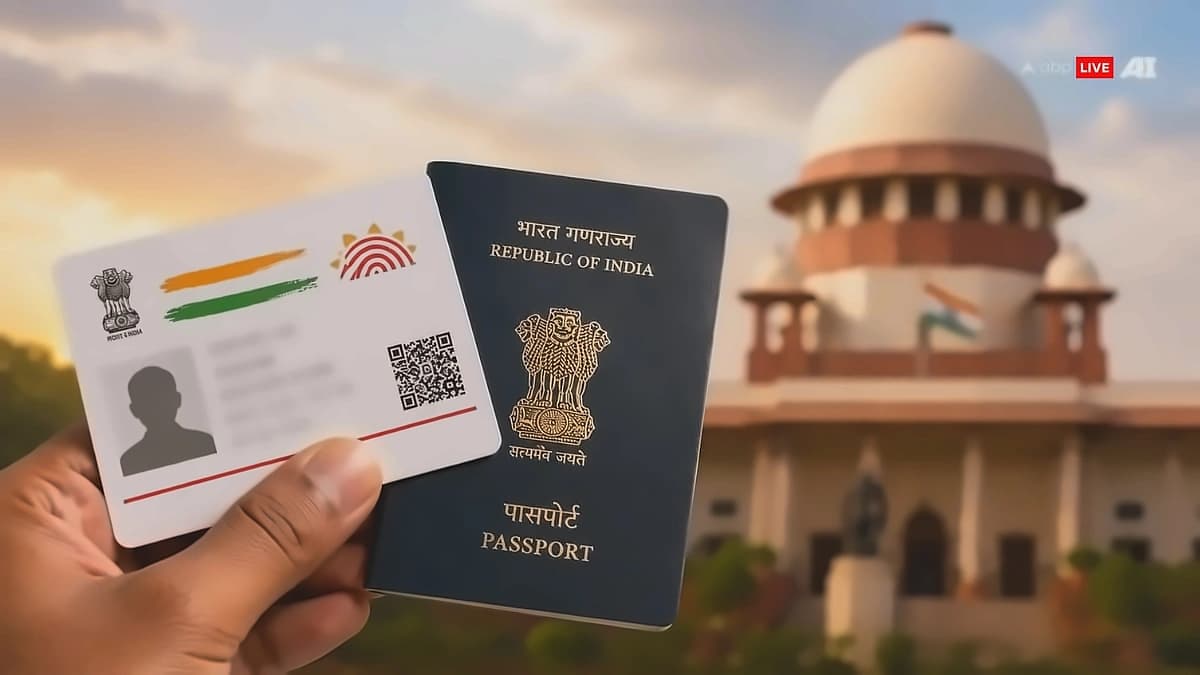
Indian citizenship is not established through the most commonly used identity documents such as Aadhaar, PAN card, Voter ID, passport or driving licence. Contrary to common misconception, these government documents are largely used for establishing identity or address proof by the authorities. Under Indian law, citizenship is determined primarily by legal criteria such as birth, descent, registration, naturalisation or incorporation of territory. To establish proof of citizenship, one must meet specific legal conditions depending on the time and circumstances of acquisition. Among commonly available documents, a birth certificate directly records a person's date and place of birth, and can be used to support citizenship-related claims. However, citizenship by birth in India is subject to conditions based on the date of birth and the citizenship status of the parents. Different rules apply to people born before 1987, between 1987 and 2004, and after December 2004. Other documents such as Aadhaar and PAN card serve different purposes, primarily for identity verification and taxation, helping to facilitate access to different government services.
The ambiguity becomes even more striking when viewed through the lens of judicial precedent. In 2013, the Bombay High Court held that an Indian passport is fundamentally a travel document and cannot be regarded as conclusive proof of citizenship. The reasoning relied partly on the Passports Act, 1967, which allows the Central Government, under specific circumstances, to issue passports even to non-citizens in the public interest. According to the court, questions of citizenship must ultimately be determined under the Citizenship Act rather than through possession of a passport alone. However, five years later, the Delhi High Court appeared to assign considerably greater evidentiary value to the same document in Prabhleen Kaur v. Union of India (2018). The court described an Indian passport as a significant document evidencing a citizen's nationality and ruled that passport authorities could not arbitrarily question an applicant's nationality based on vague suspicions, particularly where previous passports and other official records already existed. Taken together, these decisions reveal a noticeable divergence in judicial interpretation, with one court treating the passport as insufficient to conclusively establish citizenship while another emphasises its substantial evidentiary value.