NITI Aayog has released a comprehensive report titled Key Sectors to Position India as a Global Manufacturing Hub, which provides a structured and data-driven framework for identifying major sectors that can fuel India's ambition to become a global manufacturing powerhouse. According to the report, the analysis focuses on four key sectors: Chemicals, Textiles, Telecom & Networking Equipments, and Solar Photo Voltaic manufacturing. The assessment examines India's manufacturing landscape in relation to global trends, sectoral growth opportunities and global benchmarks, with the report providing a data-driven assessment of market potential, infrastructure, policy support, availability of raw materials, technology readiness, employment potential and the country's position in global value chains.
India's telecom and network equipment sector could soon emerge as a major contributor to the country's GDP, with significant export potential despite current challenges. According to the latest NITI Aayog report, the telecom and network equipment sector could play a bigger role in India's economy, helping double its GDP contribution and achieve $1 trillion in exports by 2030 under the National Telecom Policy 2025 (NTP-25). The domestic telecom hardware industry has reached a decisive turning point, with the domestic telecom and network equipment (TANE) market worth around $25 billion in FY25 and could nearly double to $50 billion by FY32, growing at about 10 per cent annually. However, the sector continues to face substantial hurdles, with telecom and network equipment exports accounted for just 0.2-0.3% of India's total exports between 2020 and 2024, at $0.6-1 billion annually, while imports stood at $4-5 billion a year, accounting for 0.7-1.1% of total imports. More critically, more than 80% of critical components, including 4G/5G antennas and signal processors, are sourced from China, highlighting severe supply chain vulnerabilities.
The report represents NITI Aayog's first volume of its manufacturing roadmap, which evaluated an initial universe of 62 manufacturing sectors and identified 4 in which India can realistically aspire to global leadership. As reported by NITI Aayog, these 4 sectors include electronics, telecom equipment, solar PV, pharmaceuticals, chemicals, automobiles, defence and drones, steel, capital goods, textiles, food processing, and leather and footwear. The analysis focuses on strengthening domestic capabilities, moving up the value chain, improving export competitiveness, reducing import dependence and integrating Indian manufacturers more deeply into global production networks. The sectors were assessed based on market size and growth projections, strategic alignment, operational and financial viability, raw-material dependencies, geopolitical considerations and India's position in global value chains. The study was undertaken through a four-phase framework - first phase focused on shortlisting sectors based on market attractiveness, second phase involved comprehensive assessment of shortlisted sectors, third phase examined international best practices, and final phase developed actionable recommendations and roadmap. The current edition covers four high-potential manufacturing sectors - chemicals, textiles, telecom and networking equipment, and solar PV manufacturing, with eight additional sectors expected to be covered in subsequent reports.
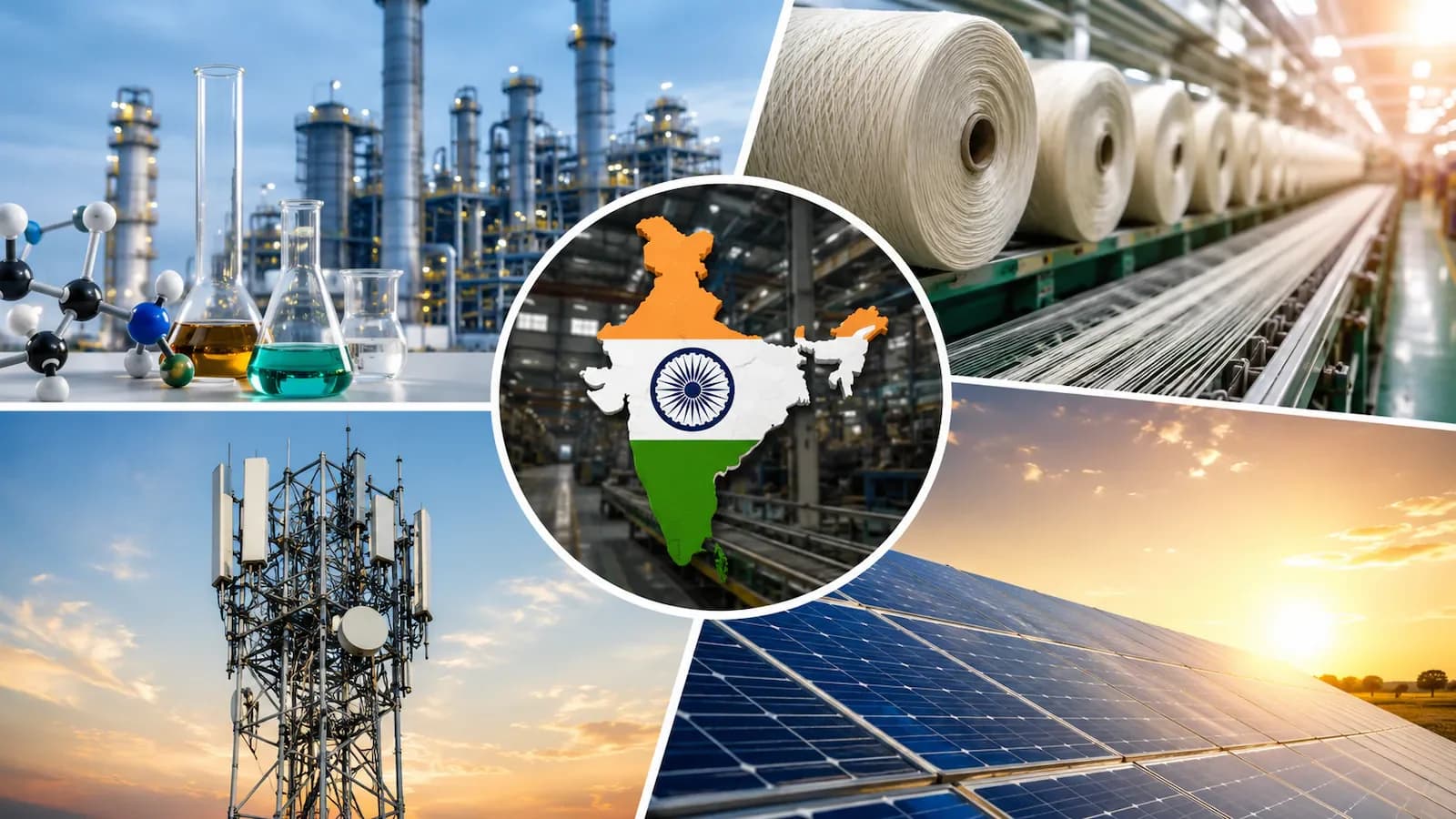
Textiles and apparel contribute around 2% of India's GDP, 11% of manufacturing GVA and 9% of merchandise exports, while providing livelihoods to more than 45 million people and being the country's second-largest employment-generating sector after agriculture. India exported $37.7 billion in textile products in FY2025 and accounted for 4.1% of global textile and apparel exports, making it the sixth-largest exporter globally. The report recommends improving raw-material availability, infrastructure, technology adoption and skills, while highlighting technical textiles, man-made fibres, sustainable products and premium Indian weaves as areas where India can achieve greater value addition. India had 106 GW of solar capacity as of March 2025 and would need another 174 GW to reach its 280 GW 2030 target, with the domestic PV market estimated at ₹32,400 crore ($3.7 billion) and projected to grow at 17-20% CAGR between FY23 and FY30. The chemicals sector shows particular promise, with India's chemicals industry valued at $200-220 billion in FY25, making it the world's sixth-largest chemicals industry and accounting for 3-3.5% of the global market. The report expects the domestic market to grow by 6-8% annually over the next five years and reach $290-310 billion by FY30, with speciality chemical exports potentially reaching $45 billion by FY30.
NITI Aayog has emphasized the critical importance of cluster-based manufacturing and developing integrated industrial parks with shared utilities, infrastructure and efficient approvals to build scale and lower costs. According to the report, across the sectors examined, the recommendations include reducing import dependency through targeted incentives and viability gap funding, deepening domestic value addition, promoting joint ventures and technology transfer, raising labour productivity, and diversifying export markets while negotiating balanced free trade agreements. By reducing its reliance on imports, India can conserve foreign exchange, mitigate the impact of global price volatility and ensure a stable supply of essential chemicals, as argued in the chemicals sector analysis, naming phenol, methanol and acetic acid as priority products. On solar, where the US accounted for 97 per cent of India's solar module exports between fiscal 2020 and 2026 — a "heavy dependence on one geography" — the report recommends moving upstream into polysilicon and wafers and broadening the export base. The report also highlights that sustained policy consistency, industrial clusters, infrastructure, targeted incentives, technology and skills investment and stronger links with global markets will be necessary to build complete manufacturing ecosystems rather than isolated production capacities. The government has introduced measures such as the Production Linked Incentive scheme to support the sector, with NITI Aayog stating that continued supportive measures could raise telecom and network equipment's contribution to GDP to 1-1.5%, create 500,000 skilled jobs and help India emerge as a $50 billion export hub by 2035.